Climate considerations in Tamalpais-Homestead Valley
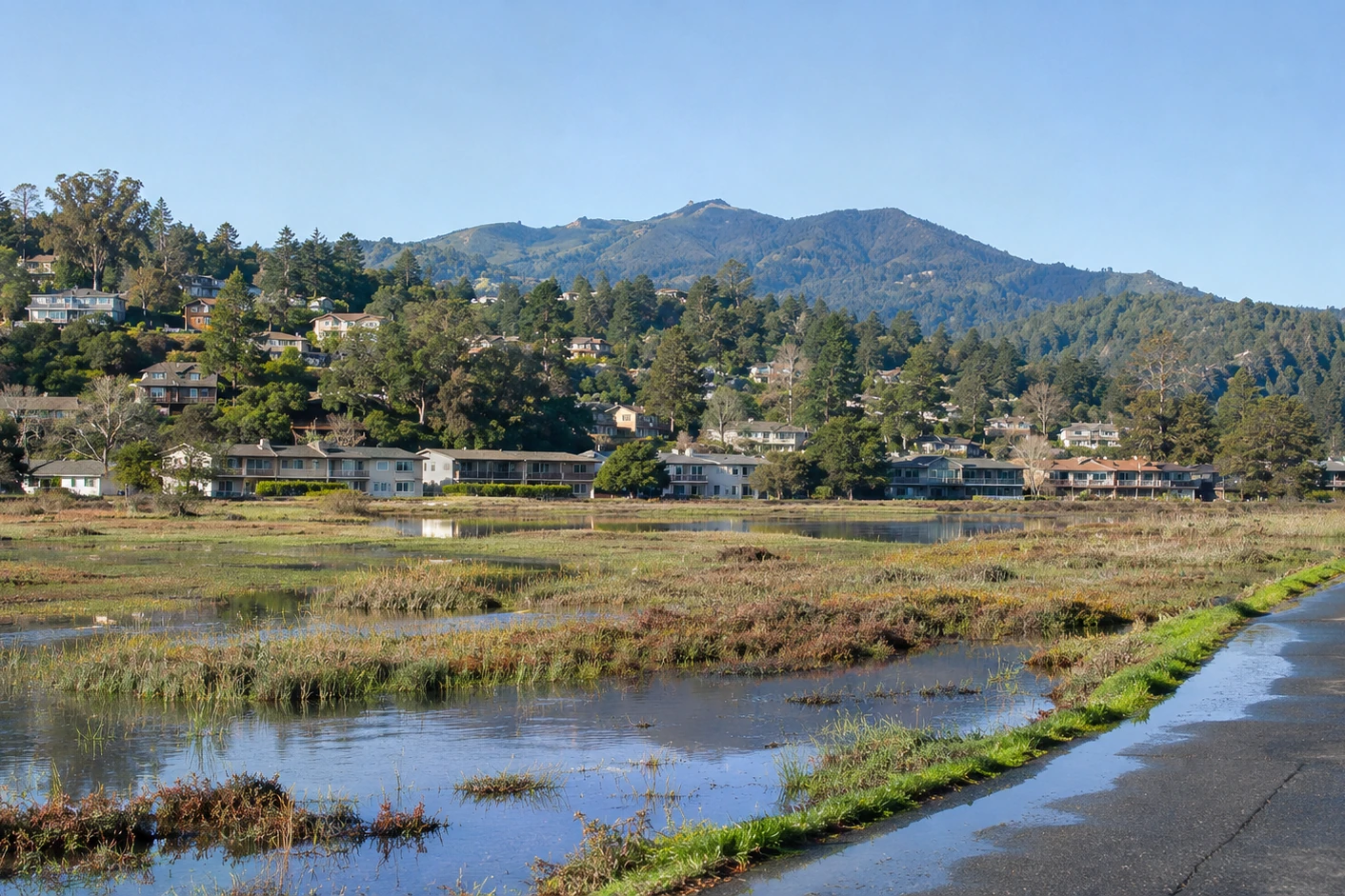
The valley has a mild marine climate, with wet winters, dry summers, and frequent fog moving in from the coast. Conditions change sharply with elevation. The low ground near the bay is flat, close to sea level, and exposed to tides and wind off the water. Higher up, the hillsides are wooded and shaded, and decks there stay damp longer after rain. A deck at Tam Junction and a deck high in Homestead Valley a mile away face quite different problems, so we assess each for its own site.
King tides at the marsh edge
The County has identified Tam Junction as one of the places where high tides bring localized flooding, and king tides flood the shoreline around the marsh dozens of times a year. In December 2024 a rising tide breached the levee at Tam Junction and put brackish water into a business. For homes and apartment buildings along that edge, the lowest parts of decks and stairs are the ones at risk: posts, stair stringers, bottom treads, and the connectors that hold them. Salt water soaks into wood that was never meant to sit in water, and it attacks fasteners and hardware far faster than rain does, often from the inside of a connection where it cannot be seen. After a season of high tides, we check for tide lines, salt residue, soft wood at post bases, and rusted connectors. Repairs use pressure-treated lumber rated for ground contact, corrosion-resistant fasteners and connectors, and, where possible, posts set on raised bases so they drain and dry between tides.
Eucalyptus and what collects on decks
Eucalyptus was planted here as a windbreak in the first years of settlement, more than a century ago, and tall trees still stand over many lots. Fire Safe Marin notes that all eucalyptus species are prone to fire, advises removing them or giving them significant maintenance within 100 feet of structures, and calls for regularly removing dead wood and peeling bark. From our side, the problem shows up on the deck itself. Shed bark strips and leaves pack into board gaps, at ledgers, and in corners, where they hold water against the wood and rot it from the top down, and in fire season the same dry litter is fuel lying against the house. We clear it, replace boards that have decayed beneath it, widen gaps where needed so debris falls through, and suggest a regular clearing schedule. Decisions about the trees themselves belong with an arborist.
Early twentieth-century neighborhoods
Much of the valley was laid out early. Homestead Valley was divided into lots on a 1903 map, and many San Franciscans displaced by the 1906 earthquake settled there and built homes. Parts of Almonte were developed as a subdivision in 1911. Houses from those decades have been altered and added to many times, and their decks, porches, and stairs often date from different eras than the houses themselves. We check how each deck is connected to the house and what it is resting on before deciding what can be kept.
Common building stock we work on
About three-quarters of homes in the valley are owner-occupied. Older houses fill Homestead Valley and Almonte, and Tamalpais Valley has many hillside homes with decks on posts over sloping ground. Near the marsh and along the Shoreline Highway corridor, apartment and condominium buildings form much of the SB 721 and SB 326 inventory, with ground-floor decks and stairs closest to the tides. Our certified construction crew scopes every project to the elevation, the trees overhead, and the code in effect at installation.
Areas served
Our certified crew covers Tamalpais Valley, Homestead Valley, Almonte, Tam Junction, the Shoreline Highway corridor, the Rosemont Avenue area, the Montford Avenue area, the Ethel Avenue area, the Evergreen Avenue area, the Tennessee Valley Road area, and the wider Tamalpais-Homestead Valley community. ZIP code 94941 covers the community.
What we typically see
Across our inspections here, our company most often documents: (1) posts, stringers, and connectors at the marsh edge damaged by repeated tidal flooding — a pattern specific to the valley’s low ground near Tam Junction; (2) bark and leaf litter packed into board gaps and ledgers under eucalyptus and other large trees; (3) dry litter collected against the house on decks in fire season; (4) early twentieth-century houses with decks and stairs from several later eras; (5) shaded hillside decks that stay damp after rain; (6) railings on pre-2000 stock that fall short of the current CRC 42-inch height and 4-inch sphere rule. Every finding is captured in a written assessment with prioritized repair, replacement, or restoration scope.
Emergency response & remodeling
For properties here with acute safety issues — sagging framing, loose railings, a stair weakened by tidal flooding, a limb fallen on a deck, visible rot at load-bearing connections, red-tagged structures, or storm damage — our emergency repair crew responds within 24–48 hours with temporary shoring and code-compliant stabilization. Tree work is for an arborist; we handle the deck and stair structure. We also handle full deck remodeling with materials matched to the site.