Climate considerations in Marysville
Marysville sits on the valley floor where two rivers meet. July and August are the hottest months, with temperatures in the upper 90s, and January is usually the wettest. Long dry heat opens checks in exposed boards and dries out paint, and winter rain then soaks into them. On older houses with deep porches, the porch protects the floor but not the column bases and steps at its front edge, which take the rain off the roof and dry slowly in winter. That is where most of the decay we find on Marysville porches begins.
Living inside the levee
Hydraulic mining in the Gold Rush raised the riverbeds around Marysville, and the city has long been protected by levees. Today a ring levee about 7.6 miles long encircles it completely. For homes and lots along the edge of town, that has a practical side. The state flood protection board’s permit coverage extends to the area 10 feet landward of the levee’s inner toe, and its list of covered work includes fences and landscaping. Decks and stairs are not named, but work of any kind in that strip may need the board’s encroachment permit in addition to a city building permit, and the board can waive the permit for minor work. Before a deck, stair, or fence goes in near the levee, we measure the distance, note it in the report, and suggest confirming with the board. Where it makes sense, keeping new work back from that strip is the simplest solution. We never dig footings into the levee itself.
Bungalow porches and what holds them up
Central Marysville is full of early twentieth-century bungalows and Tudor Revival houses, most built before 1950, and many of the bungalows have deep front porches with a roof carried on columns. The weak point is usually not the porch floor. It is the base of each column, where it sits on a step, pier, or wall and where rain off the porch roof collects, and the beam that spans between the columns. When a column base rots, the porch roof starts to sag at that corner, and the beam above often cracks or deflects. These problems can look serious from the street but are often repairable: we shore the roof, rebuild or replace the column base, repair or sister the beam, and set the column back on a base that sheds water. Steps and railings usually need attention at the same time, since many were built well before current standards.
An older city than its neighbors
Marysville was named in 1850, and ringed by its rivers and levee, the city has stayed compact rather than spreading out the way newer valley towns have. Its housing is older than the state’s as a result: the median home here was built in the late 1960s, about a decade earlier than the California median, and the central streets are much older than that. About half of homes are rented. For deck and porch work, that means a large share of the stock has been repaired more than once, often by different people, with mixed framing and fasteners from several eras. We document what is there before deciding what can be kept.
Common building stock we work on
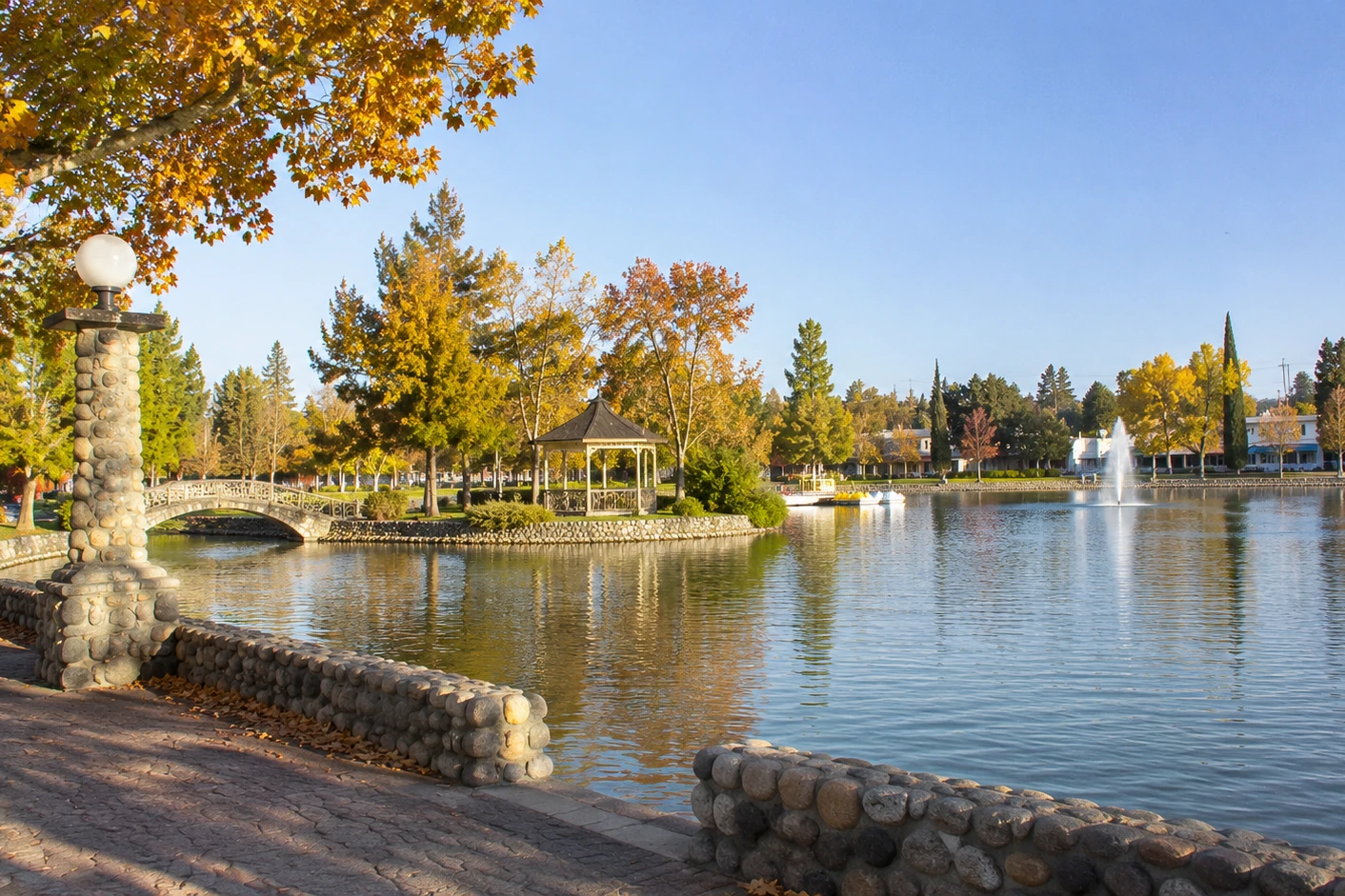
Much of Marysville’s housing is single-family, with bungalows and other pre-war houses in the center and later houses toward the edges of town, many with backyard decks and patios. Downtown along D Street, the historic commercial district holds older buildings, some with apartments or offices upstairs and balconies or rear stairs. Homes around Ellis Lake and along the levee each bring their own considerations. Small apartment buildings across town form the SB 721 inventory. Our certified construction crew scopes every project to the age of the building, its location in the city, and the code in effect at installation.
Neighborhoods served
Our certified Marysville crew covers Downtown Marysville and the D Street corridor, Central Marysville, the Ellis Lake area, the B Street area, the E Street area, the G Street area, the Washington Park area, the Sixth Street area, the Fourteenth Street area, the levee-edge streets, and the wider Marysville community. ZIP code 95901 covers the city.
What we typically see
Across our Marysville inspections, our company most often documents: (1) bungalow porch columns rotted at the base, with the porch roof sagging at that corner — a Marysville pattern given how many pre-1950 porches line the central streets; (2) cracked or deflected porch beams between columns; (3) decks, stairs, or fences planned close to the levee without checking whether a state permit applies; (4) porches and decks repaired piecemeal over decades with mixed materials; (5) heat-checked boards and failed paint letting winter rain into the wood; (6) railings on pre-2000 stock that fall short of the current CRC 42-inch height and 4-inch sphere rule. Every finding is captured in a written assessment with prioritized repair, replacement, or restoration scope.
Emergency response & remodeling
For Marysville properties with acute safety issues — sagging framing, loose railings, a porch roof dropping at a failed column, visible rot at load-bearing connections, red-tagged structures, or storm damage — we offer expedited scheduling within 5–7 business days, ahead of our normal block scheduling for this part of the service area, with temporary shoring where needed. We also handle full porch and deck remodeling that keeps the character of older houses.