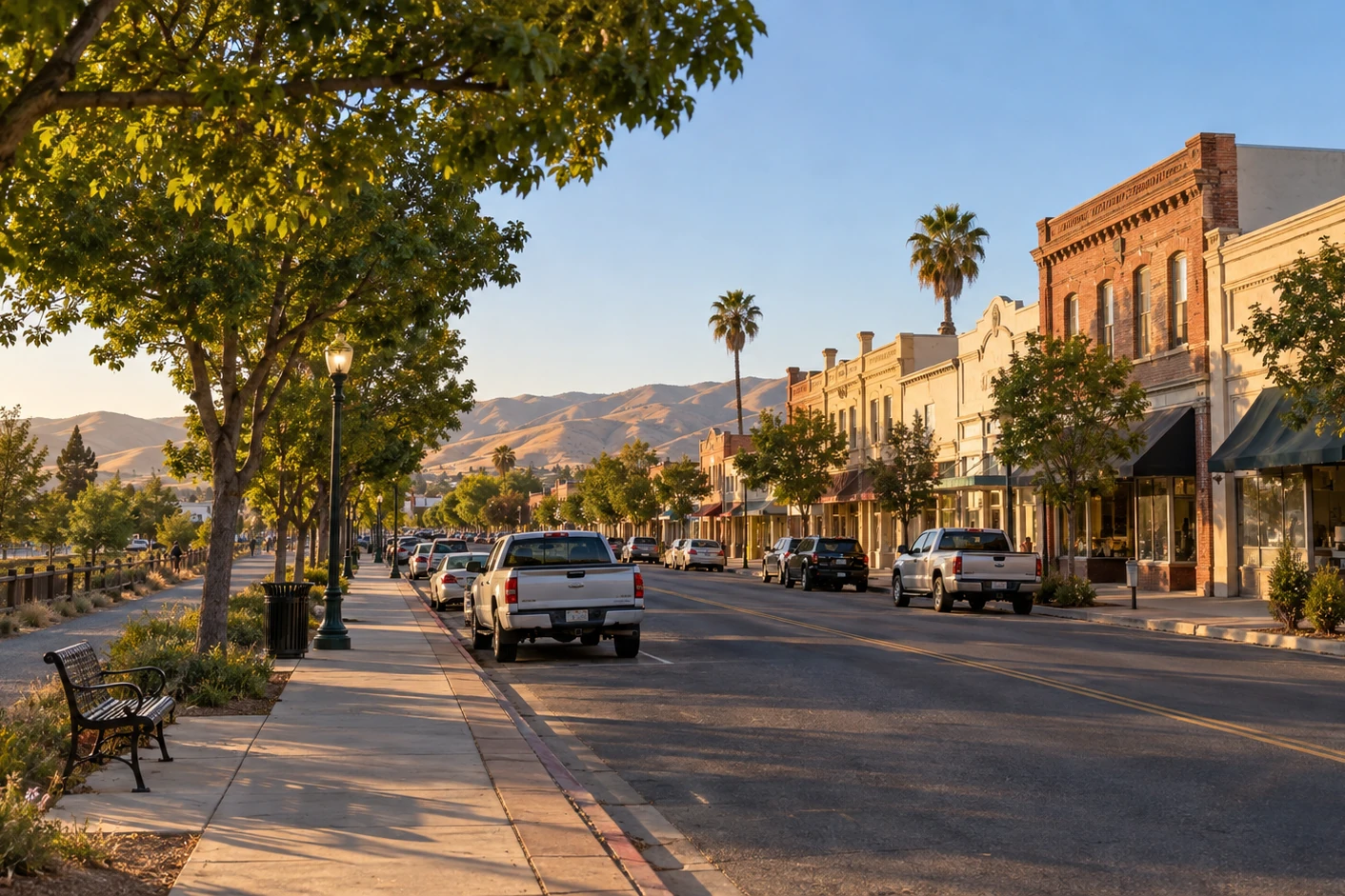
Climate considerations in Los Banos
Los Banos sits on the western side of the valley at the foot of the coastal range, and the conditions are severe at both ends of the year. Summers are long and genuinely hot, with afternoons past 100°F for extended runs through July and August and very little relief. Annual rainfall is around nine to ten inches — low even by Central Valley standards — falling almost entirely between November and March, with dense tule fog in between holding moisture against surfaces for days at a stretch. Wind comes through from the west across the low ground, carrying agricultural dust through the dry months. Each of those on its own is manageable. Together they produce a wear rate on exposed finishes that most maintenance guidance simply does not anticipate.
Maintenance intervals written for somewhere else
This is the most useful thing we can tell a Los Banos property owner, and it costs nothing to act on. Sealant and finish products carry re-application intervals written for average conditions, and owners here follow them in good faith and still watch their decks deteriorate. The intervals are not wrong in general; they are wrong for nine inches of rain and six weeks above 100°F. Finishes here reach end of life materially sooner than the label suggests, and the consequence is not cosmetic — once the finish is gone, UV and heat work directly on the wood, checking and splitting open up, and the next wet season puts water into the splits. A deck that has been maintained diligently to the wrong schedule can be in worse condition than one maintained occasionally to the right one. We set an interval against local conditions in the written report, and we would rather tell an owner to re-seal more often than sell them a board replacement that a shorter interval would have prevented.
The commuter day and when anyone can actually be there
A substantial share of Los Banos households commute over the pass to job markets on the other side, leaving before dawn and returning after dark on weekdays. That is a straightforward operational fact and we build around it rather than around it inconveniencing us. Practically it means three things. Site visits and walkthroughs are scheduled early, in the evening, or at weekends, because an appointment at eleven on a Tuesday is useless to someone who is ninety minutes away at that hour. Documentation matters more than usual — we photograph thoroughly enough that an owner can see what we saw without having been present, rather than relying on a verbal account. And deterioration here tends to be noticed later, because a deck that is only seen in daylight at weekends gets looked at properly a handful of times a year. None of that changes the work; it changes how the work is arranged and how much is usually found when someone finally looks.
Dust, debris and the wet season
Los Banos sits in working agricultural country with wetland habitat to the east, and both leave traces on exterior structures. Airborne dust through the long dry season settles into deck surfaces, sealant joints, and the gaps between boards, where it packs down and holds moisture once the rain arrives. Organic debris does the same. Because the dry season here is so long, the accumulation is heavier than in wetter parts of our service area before anything washes it out, and then the entire year’s rain arrives across four or five months onto surfaces that are already loaded. A thorough clean ahead of the wet season does more good here than it does in most places, and it is worth doing at the same time as the re-seal rather than as a separate task nobody gets around to.
Common building stock we work on
Los Banos spans a wide range for a city of its size. Pre-war and early twentieth-century buildings around the historic downtown carry original wood porches and stairs with connection details predating current standards entirely. Mid-century and 1960s–1980s housing across the older central neighborhoods needs ledger restoration, railing replacement to current height and geometry requirements, and refinishing. The large subdivisions built from the 1990s onward across Westside, Northgate, Stonecreek, Regency Park, and the Village area make up the bulk of the inventory and are now at the age where builder-grade flashing and first-generation waterproofing reach end of service life — accelerated here by the exposure conditions. Apartment and HOA-managed townhome stock along the Pacheco Boulevard and Mercey Springs Road corridors forms the SB 721 and SB 326 inventory. Our certified construction crew scopes every project to the era, exposure, and code in effect at installation.
Neighborhoods served
Our certified Los Banos crew covers Downtown Los Banos, Westside, Northgate, Stonecreek, Regency Park, the Village area, Pacheco Park, East Los Banos, the Pacheco Boulevard corridor, the Mercey Springs Road corridor, the Center Avenue area, and the wider Los Banos community. ZIP code 93635 covers the city.
What we typically see
Across our Los Banos inspections, our company most often documents: (1) finish and sealant failure well ahead of the schedule the owner was following, with exposure damage already into the boards beneath — a Los Banos-specific pattern from how far local conditions diverge from general maintenance guidance; (2) deterioration that progressed further than it needed to because the property is rarely seen in daylight on a weekday; (3) packed dust and organic debris in board gaps and against ledgers, holding moisture once the wet season starts; (4) heat-driven checking and splitting on south and west elevations, with water entering the splits in winter; (5) railings on pre-2000 stock that fall short of the current CRC 42-inch height and 4-inch sphere rule; (6) builder-grade ledger flashing failing on the 1990s and 2000s subdivisions. Every finding is captured in a written assessment with prioritized repair, replacement, or restoration recommendations.
Emergency response & remodeling
For Los Banos properties with acute safety issues — sagging framing, loose railings, visible rot at load-bearing connections, red-tagged decks, or storm damage — we offer expedited scheduling within 5–7 business days, ahead of our normal block scheduling for this part of the service area. We also handle full deck remodeling for owners replacing structures that exposure has taken past the point of worthwhile repair, specified with heat-rated materials and UV-stabilised finishes so the next one lasts longer than the last.