Climate considerations in Pittsburg
Pittsburg runs hot and dry through the summer, with afternoon temperatures regularly reaching 95–100°F and occasionally higher. That heat drives UV degradation of sealants and finishes, surface checking and warping in exposed decking, and thermal expansion stress at every connection. Annual rainfall is modest at roughly 14–16 inches, falling almost entirely November through March, and winter brings tule fog that holds moisture against surfaces on still mornings. But the number that matters most here is not temperature or rainfall — it is wind. The Delta breeze runs through Pittsburg most afternoons for most of the year, and it changes how every other stress factor behaves. Heat-driven drying happens faster. Rain arrives horizontally. Fasteners work loose through cycling rather than corroding in place. Maintenance intervals that hold up elsewhere come up short here.
The Delta wind corridor
Pittsburg sits at the western mouth of the Delta, where the daily pressure differential between the cool coast and the hot interior valley pulls air through in a sustained, predictable flow. Afternoon winds are a near-constant feature for most of the year, and they are strong enough that the surrounding area supports commercial wind generation. For elevated structures, that means continuous cyclic lateral loading: railings are pushed and released thousands of times a season, fasteners back out through vibration and working rather than failing all at once, guardrail posts loosen at their base connections, and lag screws and nails lose holding power in the framing around them. We see railing movement on Pittsburg properties that owners have tightened repeatedly without ever fixing, because the real answer is upgrading to properly rated connectors and through-bolted connections rather than retightening what is already fatigued. Our certified construction firm specifies wind-rated fasteners and connectors on all Pittsburg work.
Suisun Bay waterfront & the Marina District
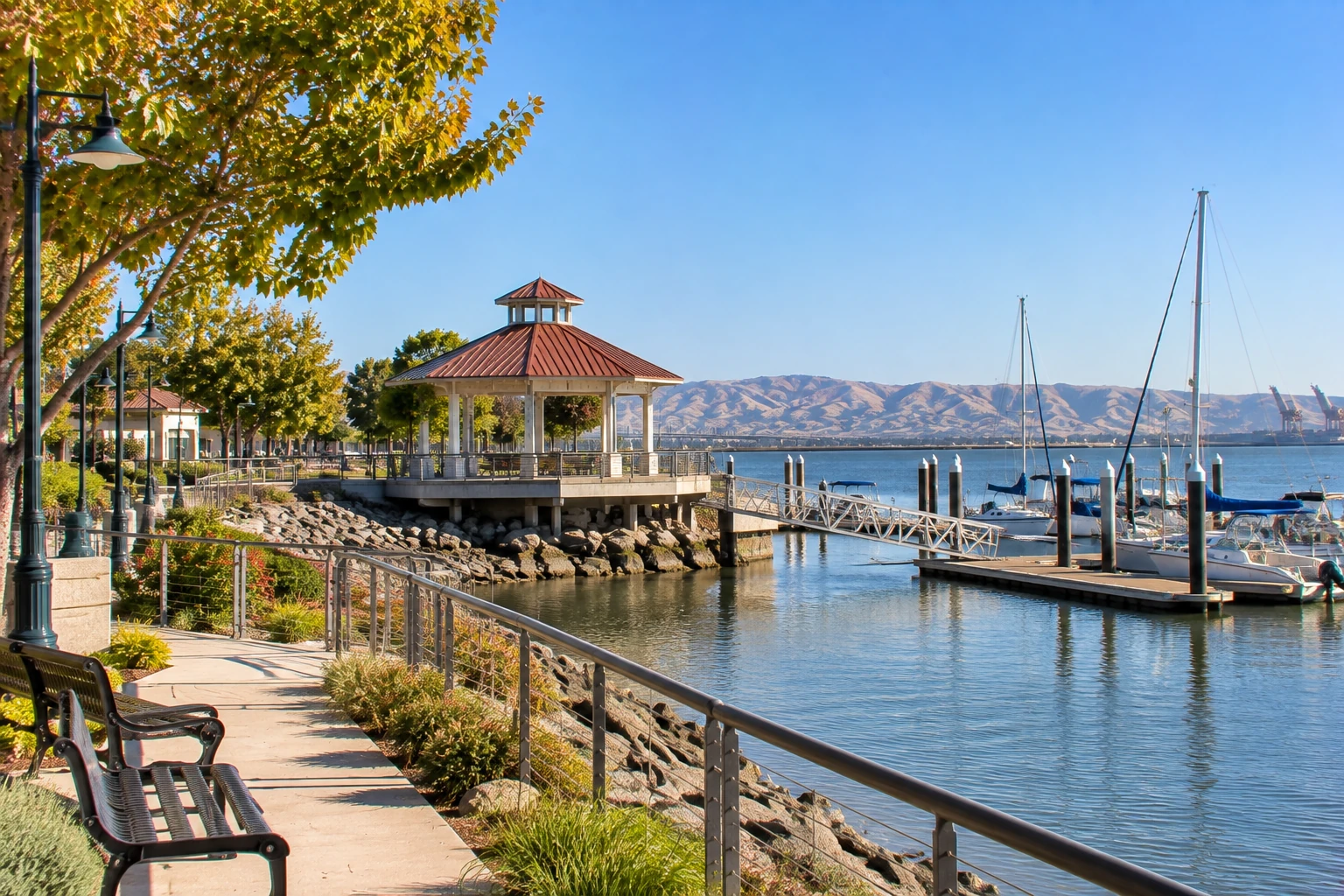
Pittsburg’s northern edge fronts Suisun Bay and New York Slough, and properties near the Marina District and the waterfront corridor sit in brackish-water air. The exposure is milder than open-ocean conditions but real: humidity stays elevated, salinity in the air accelerates corrosion of metal connectors and fasteners, and the wind that defines the city carries that moisture inland rather than leaving it at the shoreline. Joist hangers, ledger bolts, post anchors, and railing hardware on waterfront-facing structures corrode faster than their counterparts a mile inland, and the damage is usually concealed inside the assembly while the visible surface still looks sound. We specify corrosion-resistant hardware on waterfront-exposed Pittsburg repairs and open assemblies during inspection to check what the surface is hiding.
The post-2000 hillside cohort
Pittsburg grew substantially in the southern hills through the 2000s, adding large subdivisions in San Marco, Vista Del Mar, Highlands Ranch, and the surrounding areas. That housing is now roughly twenty to twenty-five years old, which is exactly the age where builder-grade construction starts showing its limits. Original flashing at deck-to-house connections, caulked joints that were never intended as long-term seals, and first-generation waterproofing membranes all reach end of service life in this window. Owners often assume a house this new cannot have a structural problem, so the failure progresses unseen — water tracks behind failed ledger flashing and rot establishes in the rim joist before anything is visible from the deck surface. The wind exposure and summer heat here accelerate that timeline compared with milder markets. Any Pittsburg deck built in the early 2000s is worth a proper inspection now rather than after the damage shows.
Common building stock we work on
Pittsburg’s residential stock spans more than a century. Early-1900s and pre-war homes and small apartment buildings in Old Town and along the Railroad Avenue corridor date to the city’s industrial era and typically need full railing replacement, ledger restoration, and refinishing of original wood porches and balconies — most predate modern fastener standards entirely. Post-war and 1960s–1980s apartment communities along Railroad Avenue, Leland Road, and the central corridors form the bulk of the SB 721-eligible inventory, with aging connectors, undersized connections, and waterproofing decades past service life. 1990s–2000s HOA-managed townhome and condominium developments fall under SB 326 scrutiny. Post-2000 single-family subdivisions in the southern hills are in the builder-grade failure window described above. Our certified construction crew scopes every project to the era, original materials, site exposure, and code in effect at installation.
Neighborhoods served
Our certified Pittsburg crew covers Old Town Pittsburg, the Railroad Avenue corridor, the Marina District and waterfront, Los Medanos, San Marco, Vista Del Mar, Highlands Ranch, Woodside, Oak Hills, Delta View, the Stoneman Park area, Buchanan Park, the Leland Road corridor, and the southern hillside neighborhoods. ZIP code 94565 covers the city.
What we typically see
Across our Pittsburg inspections, our company most often documents: (1) fastener fatigue and railing movement from sustained wind cycling, frequently on properties where hardware has been retightened repeatedly without addressing the cause — a Pittsburg-specific concern from the Delta corridor; (2) wind-driven rain intrusion at flashing seams, transitions, and fastener penetrations on storm-facing elevations; (3) failed builder-grade ledger flashing with established rot behind it on post-2000 hillside housing; (4) corroded connectors on waterfront-facing structures near the Marina District, usually concealed inside the assembly; (5) heat-driven surface checking, splitting, and sealant breakdown from 95–100°F summer stretches; (6) railings on pre-2000 buildings that fall short of the current CRC 42-inch height and 4-inch sphere rule. Every finding is captured in a written assessment with prioritized repair, replacement, or restoration recommendations.
Emergency response & remodeling
For Pittsburg buildings with acute safety issues — sagging framing, loose or moving railings, visible rot at load-bearing connections, red-tagged decks, or wind- and storm-driven damage — our emergency repair crew responds within 24–48 hours with temporary shoring and code-compliant stabilization. We also handle full balcony and deck remodeling for property owners modernizing the look and function of older outdoor spaces while bringing the structure up to current safety code with wind-rated hardware throughout.