Deck Builders · CSLB #1060736
Commercial Deck Builders in California
We’re CSLB-licensed deck builders working across the Bay Area, Central Valley, and Sacramento — building, rebuilding, repairing, and maintaining decks for apartment communities, condominiums, HOAs, and hotels, and for property owners who want the structure done properly. As deck building contractors we handle the frame, the flashing and the surface with one crew. Every deck we’ve ever taken apart taught the same lesson: what decides how long a deck lasts is almost entirely invisible in the finished deck.
- CSLB #1060736 Licensed California contractor
- 9+ yrs Building commercial decks & balconies
- SB 721 / 326 Built and documented to pass
- One crew Frame, flashing and surface
Where to start
Deck Building by Type
Amenity decks, pool surrounds and hillside builds for apartment, HOA and hotel property — the deck type sets the structure and the budget.
-
 Above-Ground Pool Deck Building
Raised pool surrounds for HOA and amenity areas View service
Above-Ground Pool Deck Building
Raised pool surrounds for HOA and amenity areas View service
-
 Accessible Deck Building
ADA-ready ramps, landings and rails for multifamily property View service
Accessible Deck Building
ADA-ready ramps, landings and rails for multifamily property View service
-
 Entertainment Deck Building
Amenity and event decks for communities and hotels View service
Entertainment Deck Building
Amenity and event decks for communities and hotels View service
-
 Hillside Deck Building
Engineered footings and framing on sloped sites View service
Hillside Deck Building
Engineered footings and framing on sloped sites View service
-
 In-Ground Pool Deck Building
Pool-edge decking built for drainage and foot traffic View service
In-Ground Pool Deck Building
Pool-edge decking built for drainage and foot traffic View service
-
 Pool Deck Building
Slip-resistant pool surrounds for shared amenity areas View service
Pool Deck Building
Slip-resistant pool surrounds for shared amenity areas View service
-
 Waterfront Deck Building
Corrosion-rated hardware for coastal and marina sites View service
Waterfront Deck Building
Corrosion-rated hardware for coastal and marina sites View service
-
 Terrace Building
Podium and rooftop terraces for multifamily buildings View service
Terrace Building
Podium and rooftop terraces for multifamily buildings View service
-
 Patio Building
Ground-level patios for courtyards and common areas View service
Patio Building
Ground-level patios for courtyards and common areas View service
CSLB #1060736SB 721 / SB 326 documentedCommercial, multifamily & HOA
01 Why it matters
You’re buying the frame. The boards are what you look at.
Deck quotes get compared on the surface — the species, the composite line, the railing style — because that’s the part anyone can see. It’s also the cheapest layer in the assembly and the easiest to replace. The frame beneath it is what carries people at height, what rots, what fails inspections, and what costs the most to put right once it’s wrong.
After enough tear-outs the pattern stops being surprising. Four details separate a deck that reaches thirty years from one that needs work at fifteen, and none of them shows in a photograph. The ledger connection into the building has to be flashed and fastened properly, because it’s the most common failure point on any attached deck and its failure takes the building’s framing with it. Joist tops need tape or flashing, because water off the boards otherwise sits on the frame for the deck’s whole life. Posts need metal bases holding timber clear of soil. And the hardware has to be rated for treated lumber and the local environment, because a deck is held together entirely by metal nobody will ever look at again.
All four cost very little at build time and a great deal afterwards. That’s the whole argument for who builds your deck: not the material catalogue, but whether the person selecting the fasteners knows why it matters.
We’ve replaced redwood decks at fifteen years and repaired treated decks at thirty. The difference was never the boards.

Explore further
More ways we work on decks
Material options and the full range of deck work for apartment, HOA and commercial property.
Decking material options for shared property, costed for the long run.
-
 Cedar Deck Building
Natural cedar decks with a sealed maintenance plan View service
Cedar Deck Building
Natural cedar decks with a sealed maintenance plan View service
-
 Composite Deck Building
Low-maintenance boards for high-traffic common decks View service
Composite Deck Building
Low-maintenance boards for high-traffic common decks View service
-
 Pressure-Treated Deck Building
Budget-conscious framing and decking for large runs View service
Pressure-Treated Deck Building
Budget-conscious framing and decking for large runs View service
-
 Trex Deck Building
Trex composite systems for HOA and rental property View service
Trex Deck Building
Trex composite systems for HOA and rental property View service
-
 Wood Deck Building
Redwood and hardwood decks framed to outlast the boards View service
Wood Deck Building
Redwood and hardwood decks framed to outlast the boards View service
-
 Thermally Modified Wood Decking
Stable, rot-resistant timber for exposed decks View service
Thermally Modified Wood Decking
Stable, rot-resistant timber for exposed decks View service
From a new amenity deck to a single documented repair.
-
 Deck Installation
New decks installed from footings to railings View service
Deck Installation
New decks installed from footings to railings View service
-
 Wood Deck Installation
New wood decking installed over sound framing View service
Wood Deck Installation
New wood decking installed over sound framing View service
-
 Deck Design
Drawings and engineering ahead of permit and build View service
Deck Design
Drawings and engineering ahead of permit and build View service
-
 Deck Extension
Extend existing decks with matched, engineered framing View service
Deck Extension
Extend existing decks with matched, engineered framing View service
-
 Deck Remodeling
Rework layout, levels and finishes on existing decks View service
Deck Remodeling
Rework layout, levels and finishes on existing decks View service
-
 Deck Renovation
Update surface, rails and stairs on a sound frame View service
Deck Renovation
Update surface, rails and stairs on a sound frame View service
-
 Pool Deck Renovation
Resurface and repair concrete and wood pool decks View service
Pool Deck Renovation
Resurface and repair concrete and wood pool decks View service
-
 Deck Rebuilding
Full rebuild on a failed frame, documented for the file View service
Deck Rebuilding
Full rebuild on a failed frame, documented for the file View service
-
 Deck Replacement
Tear-out and replacement of decks past repair View service
Deck Replacement
Tear-out and replacement of decks past repair View service
-
 Deck Restoration
Bring weathered decks back without a full rebuild View service
Deck Restoration
Bring weathered decks back without a full rebuild View service
-
 Deck Repair
Targeted structural and surface repairs, inspection-ready View service
Deck Repair
Targeted structural and surface repairs, inspection-ready View service
-
 Deck Wood Rot Repair
Cut out rot, replace framing, seal the cause View service
Deck Wood Rot Repair
Cut out rot, replace framing, seal the cause View service
-
 Deck Waterproofing
Membranes and flashing for walkways and podium decks View service
Deck Waterproofing
Membranes and flashing for walkways and podium decks View service
-
 Deck Stairs
Code-compliant stair runs, risers and handrails View service
Deck Stairs
Code-compliant stair runs, risers and handrails View service
-
 Deck Railing Installation
Guardrails to current height and spacing codes View service
Deck Railing Installation
Guardrails to current height and spacing codes View service
-
 Deck Railing Replacement
Swap failed or non-compliant guardrails for rated ones View service
Deck Railing Replacement
Swap failed or non-compliant guardrails for rated ones View service
-
 Deck Railing Repair
Loose posts, rusted fasteners and rail fixes View service
Deck Railing Repair
Loose posts, rusted fasteners and rail fixes View service
-
 Inspections
SB 721 / SB 326 inspections with a written report View service
Inspections
SB 721 / SB 326 inspections with a written report View service
-
 Deck Drainage Services
Under-deck drainage retrofits without re-decking View service
Deck Drainage Services
Under-deck drainage retrofits without re-decking View service
-
 Deck Board Installation
New boards on an existing frame, sorted and staggered View service
Deck Board Installation
New boards on an existing frame, sorted and staggered View service
CSLB #1060736SB 721 / SB 326 documentedCommercial, multifamily & HOA
02 The D&B difference
What we do differently
Three commitments that decide how the deck performs long after handover — and why property managers call back.
One crew owns the frame, the flashing and the surface
No interface between trades for a leak to become an argument about scope. The people flashing the ledger are the people laying the boards and the people warranting both.
Built for the inspection cycle, not just for handover
On multifamily and HOA property a deck more than six feet above grade is a regulated structure with a repeating obligation attached. We build to that standard and hand over documentation for the file rather than leaving you to reconstruct it later.
We tell you when the cheaper answer is right
Restoration instead of replacement. Posts instead of a cantilever. Composite when the property won’t re-seal timber. Repair when a rebuild isn’t warranted. It costs us margin often enough, and it’s the reason property managers call back.
03 · Service Areas
Local Deck Builders Across California
Searching for deck builders near me usually turns up a list rather than an answer. Every city below links to a dedicated local page — crews, recent projects and compliance details for that area — so you can see which local deck contractors actually cover your property before you call.
Sacramento Metro
14 cities
East Bay
21 cities
Don’t see your city? We likely still cover it — call (916) 848-2728.
04 How a project runs
How a deck project runs with us
-
01
Assessment
Site or existing deck surveyed, with probe testing at the framing, ledger, and post bases where a deck already exists. This is where the real scope is established.
-
02
Options priced
Where more than one approach genuinely works — repair against rebuild, timber against composite, stepped against elevated — we price both rather than presenting one.
-
03
Design & engineering
Drawn against the actual structure, with stamped engineering where spans, loads, or connections require it.
-
04
Permitting
Handled by us, started early, because plan review runs on the jurisdiction’s schedule rather than ours.
-
05
Structure
Footings, framing, ledger connections flashed to current code, rated hardware throughout, joist tops protected.
-
06
Surface, railings & stairs
Decking, guardrails to current height and spacing, stairs with code risers and graspable handrails.
-
07
Handover
Documentation, photographs of the connections before they were closed up, and the compliance file material on commercial property.
05 Scope
What we build and repair
Everything from the footings to the handrail, in-house — the full range of deck building services from one licensed contractor rather than three.
- New deck construction — ground-level, elevated, multi-level, and hillside
- Deck materials — pressure-treated, redwood, cedar, hardwood, composite, Trex, thermally modified timber
- Pool decks — in-ground, above-ground, and framed surrounds
- Amenity and entertainment decks with outdoor kitchens, fire features, and built-ins
- Accessible decks and ramps built to usable slope, landings, and handrail standards
- Waterfront, lakefront, and coastal decks specified for the exposure
- Deck design and design-build
- Repair — framing, rot, ledgers, posts, stairs
- Restoration, renovation, remodeling, extension, replacement, and full rebuilds
- Railing installation and replacement in timber, aluminum, steel, cable, and glass
- Deck stairs, landings, and handrails
- Deck waterproofing and under-deck drainage
- SB 721 and SB 326 inspection support and post-inspection repair programmes
- Annual maintenance programmes for multifamily and HOA portfolios
Built to current code: CBC 1604.8.1 ledger connections · ASCE 7 load criteria · Title 24 · 42″ / 4″ guardrail standard on commercial and multifamily property
06 Investment
What deck work costs
The cost to build decking is quoted after an assessment, because on decks the visible half rarely determines the price.
What drives the number
- Footings and structure, which on elevated and hillside decks dominate the number
- Demolition and disposal on replacements and rebuilds
- What the framing turns out to need once the surface is off
- Access — whether concrete and material can reach the site
- Surface material, which is the layer everyone compares and the cheapest one
- Railings and stairs, priced by length and count rather than by deck area
- Permits and engineering where the scope requires them
A price given before anyone has looked under the boards is a guess, and the gap between the guess and the job is where change orders come from. An hour with a probe is the difference between a number you can plan around and one that moves.
When you compare estimates, compare what each one includes rather than the total. Demolition and disposal, framing repair found after the surface comes off, permits, and making good around the work are the four lines most often left out — and the four most likely to reappear later. A written scope that names all four is worth more than a lower number that names none of them. Final pricing follows a free on-site assessment — no obligation.
In the field
The part you stop seeing
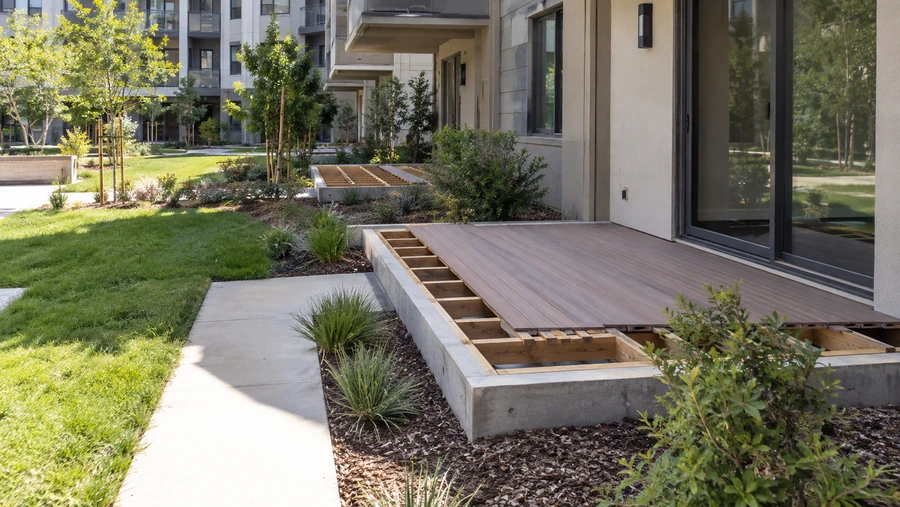
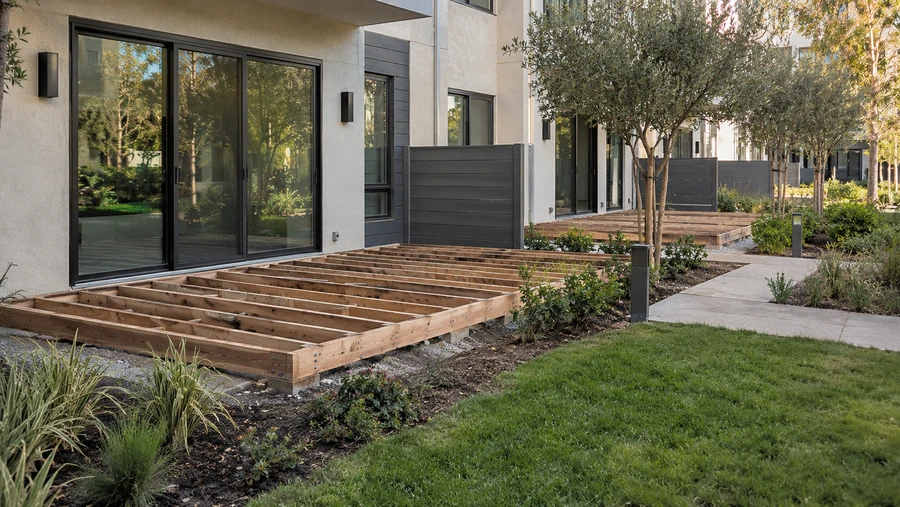
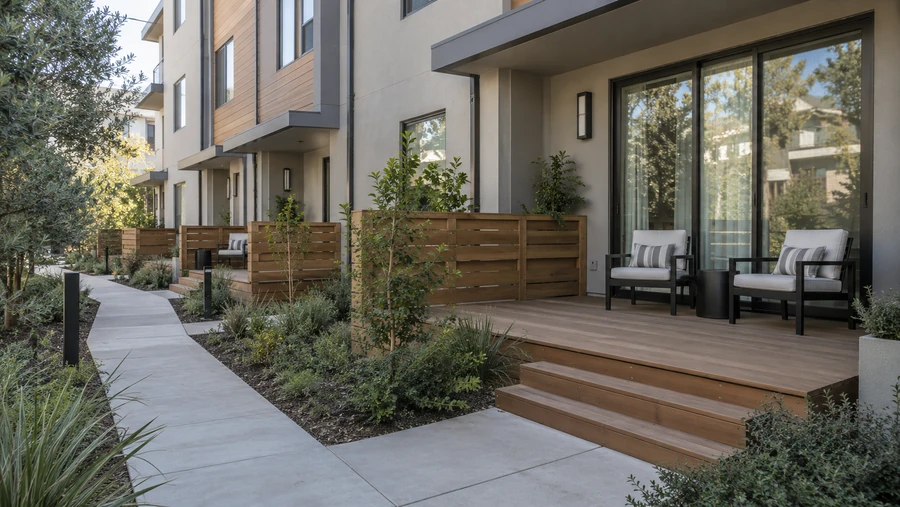
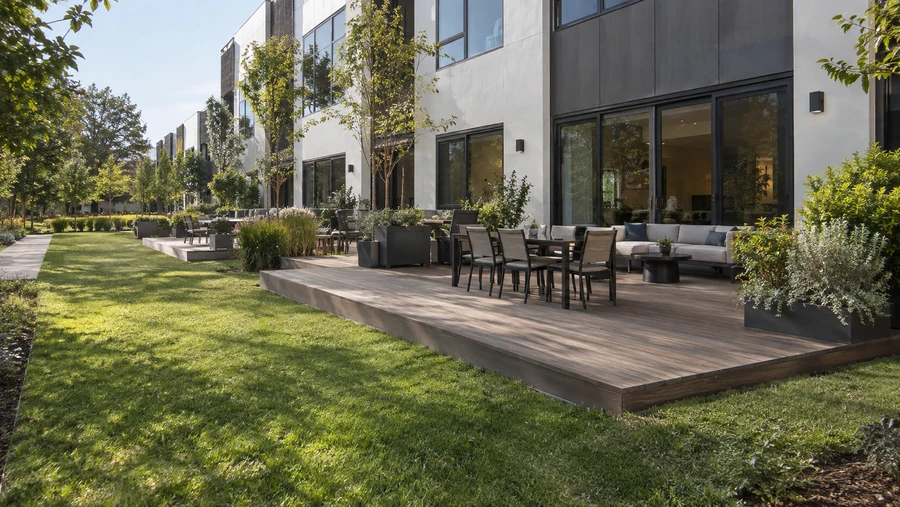
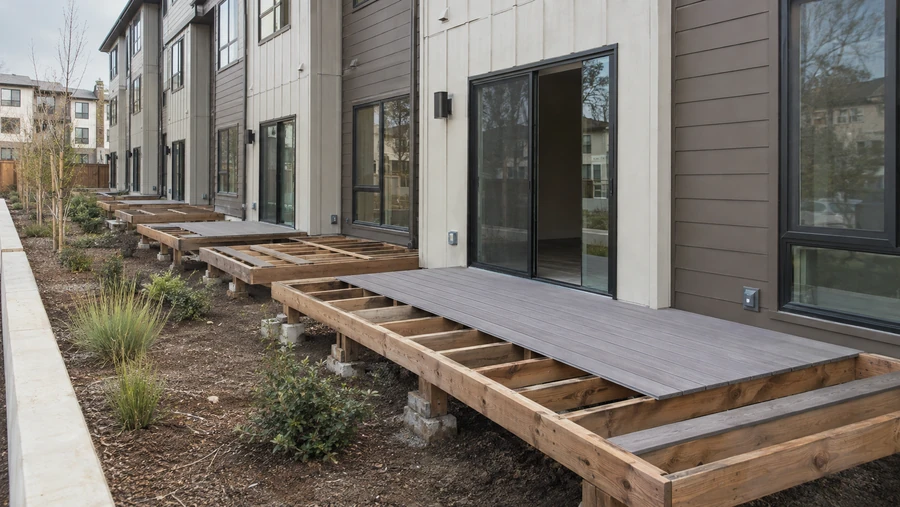
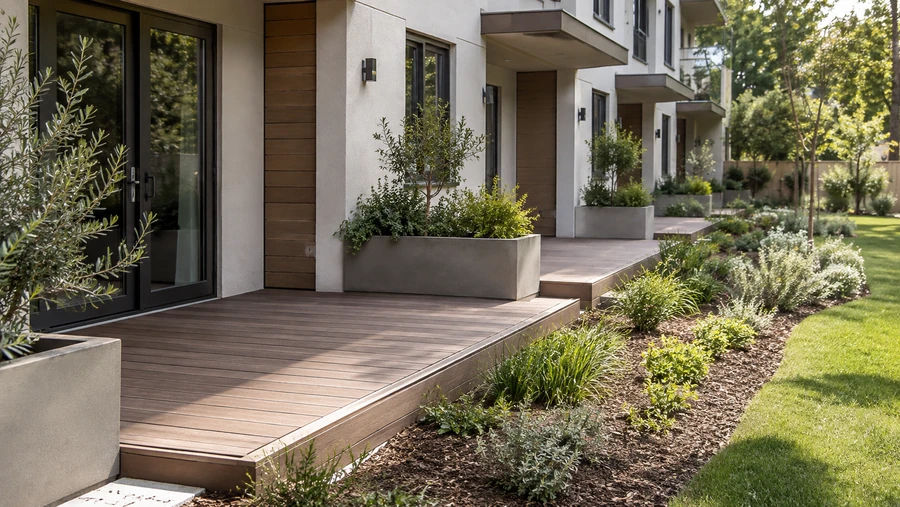
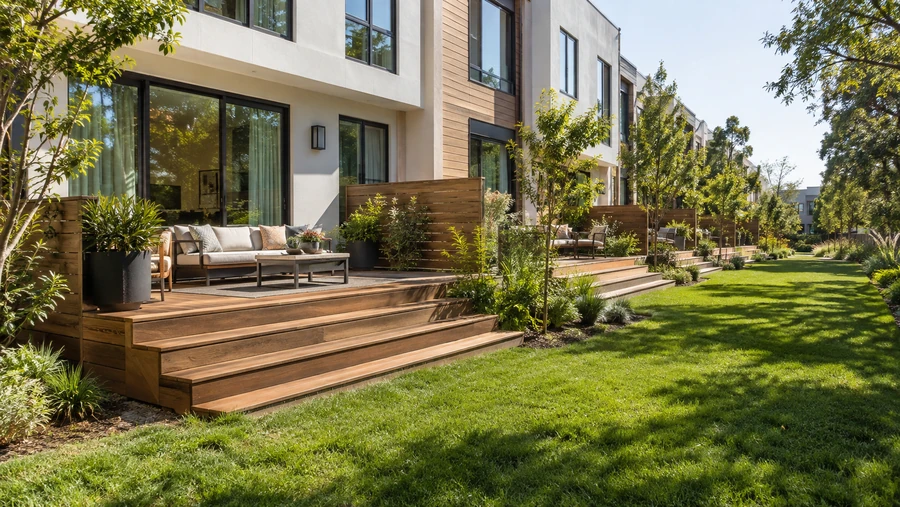
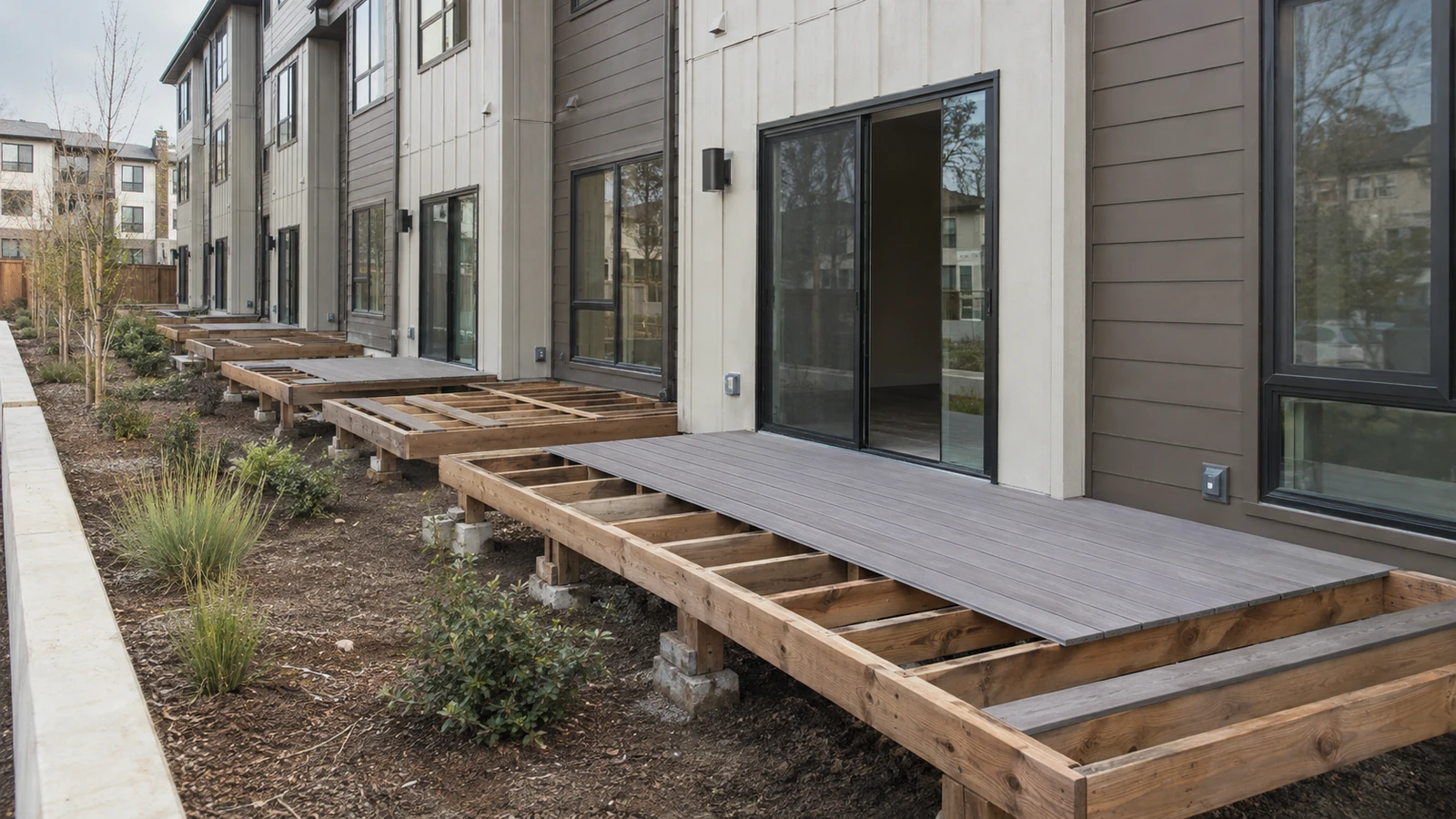
Joist frames at ground floor units, boards going on, and finished decks along the same rows.
07 Project example
A recent deck project
A sloping rear elevation needed an elevated deck, and the site did what sloping sites do: the first few feet of bank turned out to be fill, so the footings went deeper than the drawing assumed. Beyond that the job was the ordinary version of what we do — piers sized for the actual spans, posts on metal bases clear of the ground, bracing designed for posts of different heights, a ledger flashed and bolted to current code, and joist tops taped before a single board went down. Every connection was photographed before it was closed up, which is the only time anyone will see them.
They sent us photographs of the frame before the boards went on. Nobody had ever done that, and it’s the only record of the part that matters. Client · California
08 Case studies
Recent Projects, Documented
Real commercial properties — what the building needed, what we did, and what it delivered.
 Deck ConstructionCommunity-Wide Elevated Deck Replacement — San RamonEvery elevated deck across a hillside townhome community rebuilt to a single spec in one managed program —…View case study
  Deck ConstructionPatio Deck & Post Base Replacement Across a Bungalow Community — San RafaelDeck-by-deck replacement across a courtyard community, driven by the one detail that failed first — posts set straight…View case study
  Deck RepairElevated Restaurant Dining Deck Restoration — SaratogaA multi-level hillside dining deck taken from failing boards and moisture-damaged connections back to a sound, sealed structure…View case study
 09 Client feedback
What property managers and clients say
They talked us out of a replacement. Sixteen years old and the frame was fine — nobody else had bothered to look underneath.
One contractor for the framing, the flashing and the boards. On the last project those were three companies and the leak belonged to none of them.
Photographs of every connection before it was closed up. Our engineer asked for them at the next inspection and we actually had them.
10 FAQ
Where to start
I need a new deck built. Where do I begin?
With the material and the site, because those set the budget. Our deck installation page covers the process, and the material pages — pressure-treated, wood, cedar, composite, Trex, and thermally modified — cover what each one costs to build and to own. If the site slopes, or the deck goes over water or around a pool, those have pages of their own too.
My deck looks terrible but I don’t know if it’s serious.
Usually it isn’t as bad as it looks — wood weathers on the surface long before it weakens. Our restoration page explains how to tell the difference, and the deck repair page covers what happens when the framing is genuinely affected. The assessment is free either way, and the honest answer is often that you need less than you feared.
Should I repair, restore, renovate, remodel, replace, or rebuild?
Those are six different budgets and the words get used interchangeably. Repair fixes damage. Restoration renews the surface. Renovation brings the whole deck to current standard. Remodeling changes what the deck is. Replacement swaps boards or the whole deck. Rebuilding starts from new footings. Each has its own page with what it costs and when it’s the right answer.
How do I choose a deck builder?
Two questions settle most of it. First, is the contractor licensed for structural work — a deck carries people at height and is a structure, not joinery. Second, who owns the flashing and the ledger connection? Plenty of contractors that build decks subcontract the waterproofing, and every interface between trades is a place where a failure becomes an argument about scope. A professional deck builder who frames, flashes and boards with one crew removes that. It’s also worth asking what happens if rot turns up once the surface is off: a scope that doesn’t say is a scope that will change. Ask for photographs of connections on a recent job, too — anyone who documents the frame before closing it up will have them, and anyone who doesn’t will explain why they don’t.
Are you deck builders near me?
We cover the Bay Area, Central Valley and Sacramento, so for most California property managers the answer is yes. Searches for deck building near me return national directories as often as real crews, which is part of why the shortlist takes so long to build. Rather than comparing deck companies in your area one by one, call once and we’ll tell you whether your city is on the list — and if it isn’t, we’ll say so instead of quoting a job we can’t service properly.
What does it cost to build decking?
It depends on what’s under the boards, not on the boards themselves. Footings, framing condition, access and railing length drive the number far more than the decking material everyone compares. That’s why we assess before quoting rather than publishing a rate per square foot that no real project matches.
Do you offer custom deck building?
Yes — most commercial work is custom by necessity, because amenity decks, pool surrounds and hillside builds don’t fit a standard plan. Custom deck construction here means drawn to your site and your structure, with the framing implications of each design choice priced as it’s made rather than discovered later.
My railings failed an inspection.
That’s the most commonly cited item on both SB 721 and SB 326, usually because older railings are 36 inches with wide baluster gaps rather than the 42-inch and 4-inch standard. Our railing installation and railing replacement pages cover what’s involved — and the honest part, which is that nobody can price it accurately until a section comes off.
Do you work on commercial property or on houses?
Both, with a commercial focus. Apartment communities, condominiums, HOAs, and hotels are the bulk of what we do, and those carry compliance obligations a private deck doesn’t. We also build for private clients, and the standard is the same either way.
What’s the difference between a deck builder and a general contractor?
Scope and repetition. A general contractor builds decks occasionally between other work; deck contractors build them weekly and have made every mistake available on a ledger connection already. On commercial property that difference shows up in the documentation as much as the carpentry — a deck over six feet at a multifamily building carries a compliance obligation that has to be evidenced, not just satisfied.
Are you licensed and insured?
CSLB #1060736, insured and bonded, in business since 2017. Deck framing is structural work carrying people at height, and it’s worth confirming that with any contractor you talk to — not just us.
What areas do you cover?
The Bay Area, Central Valley, and Sacramento, including Oakland, San Jose, Elk Grove, Stockton, Modesto, Vallejo, Concord, Walnut Creek, Fremont, and the South Bay. The service areas section lists the full coverage.
How quickly can you look at it?
Assessments are free and we book them within days. A licensed contractor calls back the same business day. If you have an inspection deadline, say so when you call and we’ll work to it.
11 Start here
Tell us about the deck — free assessment
Whether it’s a new build, a deck that’s failed an inspection, or one you’re not sure about, the first step is the same: someone licensed looks at what’s under the boards and tells you honestly what it needs.
CSLB #1060736 · 9+ years · Insured & Bonded · Commercial, multifamily & HOA properties across the Bay Area, Central Valley & Sacramento