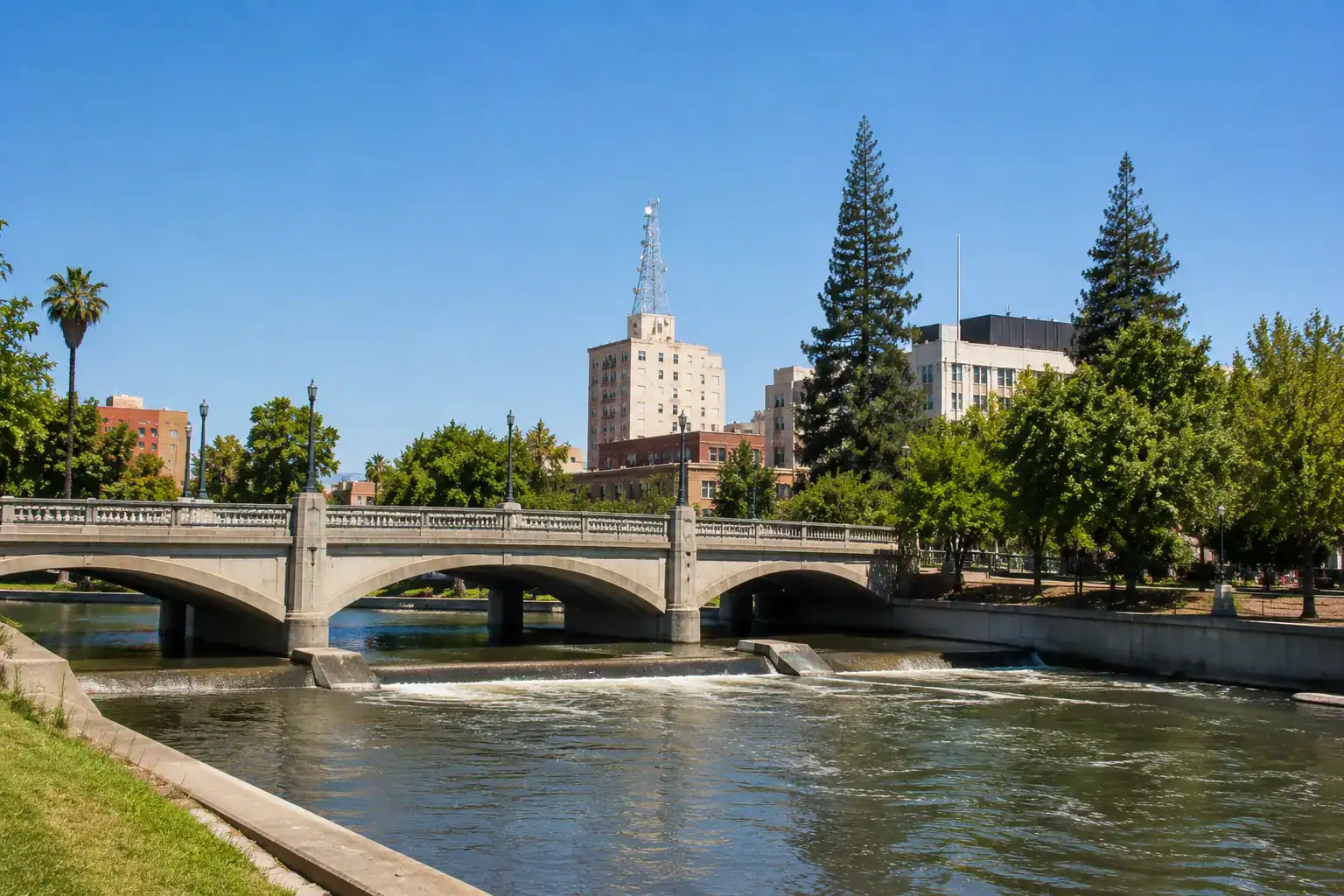
Climate considerations in Modesto
Modesto’s Central Valley climate is one of the most punishing in the state for exterior wood and metal structures. Summer afternoons regularly clear 105°F, with surface temperatures on exposed decks and balcony surfaces reaching 150°F or higher under direct sun. This extreme heat drives rapid moisture loss in wood (causing checking, splitting, and warping), aggressive UV breakdown of sealants, and continuous expansion-contraction cycling that loosens metal fasteners over time. Winter brings concentrated rainfall and persistent tule fog (November through February) that keeps surfaces wet for days at a time. The combined heat-then-moisture cycle accelerates wood decay, sealant fatigue, and waterproofing membrane wear faster than steady climates of either type. For Modesto property owners, heat-rated materials and disciplined waterproofing maintenance are essential.
County-enforced compliance pressure
The local enforcement environment for SB 721 has tightened materially since the compliance deadline passed, with potential fines and restrictions on occupancy permits for non-compliant buildings. Modesto’s apartment stock — concentrated along McHenry Avenue, Oakdale Road, and the downtown core — includes many older buildings where exterior elevated elements have seen deferred maintenance. Our certified firm works with Modesto property owners to complete both the required inspections and any resulting repairs efficiently, restoring full compliance and protecting against enforcement actions that can interrupt building operations.
Agricultural-to-urban growth
Modesto has expanded steadily outward from its agricultural core into master-planned communities and modern multi-family developments. Village One is the most visible example — a master-planned community with substantial HOA condominium and townhouse inventory now approaching first-cycle waterproofing maintenance. The Kiernan Business Park corridor and the Briggsmore Avenue corridor host newer multi-family construction, while McHenry Avenue and the downtown core anchor the older apartment stock. Each era brings different repair priorities: 1960s–1980s stock needs full railing replacement and ledger restoration; 1990s–2010s stock falls into SB 326 territory; post-2000 construction is approaching first-cycle membrane renewal.
Common building stock we work on
Modesto’s residential stock spans more than a century. Older homes and small apartment buildings near downtown and Graceada Park typically need railing replacement, ledger restoration, and refinishing of original wood balconies and porches. 1960s–1980s garden apartment complexes along McHenry Avenue, Oakdale Road, and Briggsmore Avenue fall under heavy SB 721 scrutiny — aging fasteners, undersized connections, and waterproofing systems decades past service life. 1990s–2010s condominium and townhouse developments in Village One and the surrounding master-planned communities fall under SB 326. Newer subdivisions along the Kiernan Business Park corridor are post-2000 construction approaching first-cycle maintenance. Our certified construction crew scopes every project to the era, original materials, and code in effect at installation.
Neighborhoods served
Our certified Modesto crew covers Downtown Modesto, the McHenry Avenue corridor, Briggsmore Avenue, Village One, Graceada Park, the Kiernan Business Park corridor, Oakdale Road, College Area, La Loma, and the wider Modesto community. ZIP codes include 95350, 95351, 95354, 95355, 95356, and 95357.
What we typically see
Across our Modesto inspections, our company most often documents: (1) heat-driven surface checking, splitting, and warping on south- and west-facing balconies — a Modesto-specific concern from 105°F+ summer stretches and 150°F+ surface temperatures; (2) loose fasteners and railing wobble caused by years of thermal expansion-contraction cycling; (3) dry rot at ledger connections on 1960s–1980s apartment stock from winter tule fog moisture exposure; (4) UV-driven sealant breakdown and waterproofing membrane fatigue on exposed balconies; (5) railings on pre-2000 buildings that fall short of the current CRC 42-inch height and 4-inch sphere rule; (6) first-cycle waterproofing wear on newer Village One and Kiernan corridor developments. Every finding is captured in a written assessment with prioritized repair, replacement, or restoration scope.
Emergency response & remodeling
For Modesto buildings with acute safety issues — sagging framing, loose railings, visible rot at load-bearing connections, or storm-driven damage — our emergency repair crew responds within 24–48 hours with temporary shoring and code-compliant stabilization. We also handle full balcony and deck remodeling for property owners modernizing the look and function of older outdoor spaces while bringing the structure up to current safety code and heat-rated material standards.