Structural Assessment · CSLB #1060736
Commercial Deck & Balcony Structural Assessment
Engineering-grade load analysis, retrofit recommendations, and stamped reporting for multifamily, mixed-use, and HOA properties across the Bay Area — when a deck shows deflection, hardware corrosion, or post-tension distress, or an inspection flagged “further investigation required.”
- CSLB #1060736 Licensed California contractor
- 9+ yrs Building commercial balconies & decks
- PE-backed Via licensed CA structural engineers
- Commercial Multifamily, HOA & mixed-use only
01 Why it matters
When liability is on the line, an opinion isn’t enough — you need a stamp
There’s a point where a deck or balcony question stops being a maintenance decision and becomes a liability question. Visible deflection in a balcony. Corrosion at the hardware and connections. Distress in a post-tension slab. Or the line every property manager dreads in an SB 721 or SB 326 report: “further investigation required.” At that point, a contractor’s opinion doesn’t protect anyone — the situation calls for an engineering-grade assessment backed by a licensed engineer’s seal.
The reason is that everyone downstream needs the same document. Your attorney needs it to manage exposure. Your insurance carrier needs it to keep coverage in force. Your lender needs it for the asset. And the building department needs it to accept whatever repair follows. A stamped structural report with load calculations and a defined retrofit scope is the single artifact that satisfies all of them — and a visual walkthrough without a PE seal satisfies none of them.
This is the assessment you commission when getting it wrong is no longer an option — when the balcony is over occupied space, when an inspection has escalated, or when the question has reached your legal, insurance, or lending file.
“Further investigation required” is not a maintenance note. It’s the point where you need a stamped engineering report, not another opinion.

02 The D&B difference
A licensed engineer’s stamp, translated into a buildable repair
D&B partners with licensed California structural engineers (PE) to deliver stamped reports, load calculations, and retrofit recommendations — and then translates those engineering findings into a constructible repair scope and budget.
Engineer-backed, PE-sealed
Every assessment pairs an experienced contractor with a licensed California structural engineer. You receive a stamped report with the PE seal, supporting load calculations, and photo plates — the document your carrier, attorney, lender, and building department will actually accept.
We translate engineering into a repair
A stamped report tells you what’s wrong; it doesn’t build anything. We turn the engineer’s findings into a constructible retrofit scope and a real budget — so you move from diagnosis to a priced, buildable plan without a second round of consultants.
Built for the liability file
We assess and document for the people who need it: attorney, insurance carrier, and lender. The deliverable is structured to manage exposure and support coverage and lending decisions — not just to describe the structure.
03 · Service Areas
Where We Work in California
Every city links to a dedicated local page — crews, recent projects and compliance details for that area.
Sacramento Metro
11 cities
East Bay
18 cities
Don’t see your city? We likely still cover it — call (916) 848-2728.
04 How a project runs
From escalated finding to a stamped report and retrofit scope
-
01
Visual + probe assessment
An experienced contractor and a licensed PE assess the assembly on-site — visual evaluation plus targeted probing to confirm the condition of concealed connections, framing, and load-bearing components.
-
02
Load analysis
The engineer runs the load analysis — dead load, live load, snow / wind, and occupancy — to determine whether the assembly carries the load it’s required to.
-
03
Hardware & post-tension audit
We audit anchorage, fasteners, brackets, and connections, and assess post-tension cables where applicable — the hardware that most often drives a structural failure.
-
04
Stamped report
You receive a stamped engineering report — PE seal, calculations, and photo plates — suitable for your building department, attorney, carrier, and lender.
-
05
Retrofit scope & budget
We translate the engineering findings into a constructible retrofit scope and budget, and coordinate with your attorney, insurance, and lender as required.
05 Scope
What’s included in a D&B structural assessment
An engineering-grade assessment delivered by an experienced contractor and a licensed California structural engineer — built to stand up where liability, coverage, and lending are on the line.
- Visual + probe assessment by experienced contractor + licensed PE
- Load analysis — dead load, live load, snow / wind, occupancy
- Hardware + connection audit — anchorage, fasteners, brackets
- Post-tension cable assessment (where applicable)
- Stamped engineering report — PE seal, calcs, photo plates
- Retrofit scope + constructible budget
- Coordination with attorney, insurance, and lender as required
Assessed and stamped to current standards: ASCE 7 load criteria · CBC structural requirements · PE-sealed engineering report · constructible retrofit scope
06 Investment
What a structural assessment typically costs
An engineering-grade structural assessment is priced to the complexity of the assembly and the depth of analysis required — including the licensed engineer’s stamped report. On-site work is usually 1–2 days.
What drives the number
- Complexity of the assembly — standard balcony versus cantilever or post-tension
- Depth of load analysis and the calculations required
- Extent of probing needed to confirm concealed conditions
- Whether post-tension cable assessment is involved
- Number of assemblies and buildings included
- Level of coordination required with attorney, carrier, and lender
Ranges reflect typical recent commercial work and include the licensed engineer’s stamped report. Final pricing follows a scope review — no obligation.
In the field
What structural assessment finds
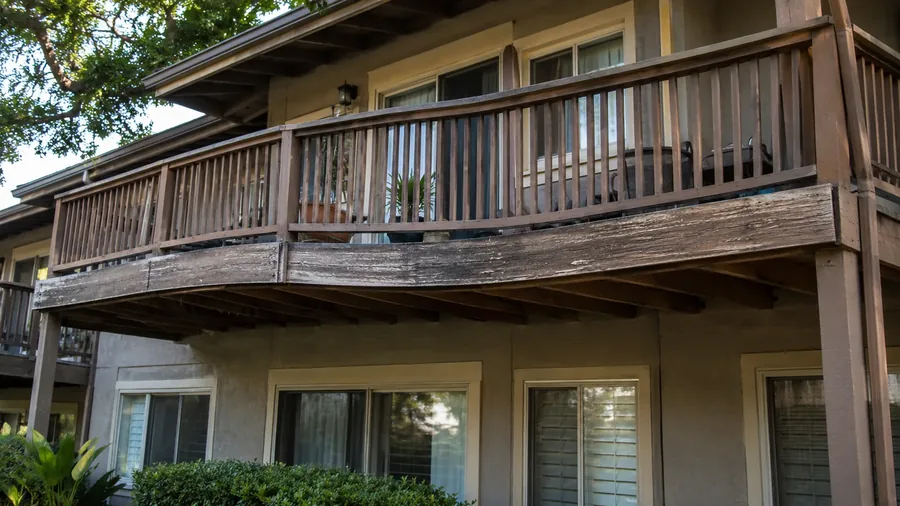
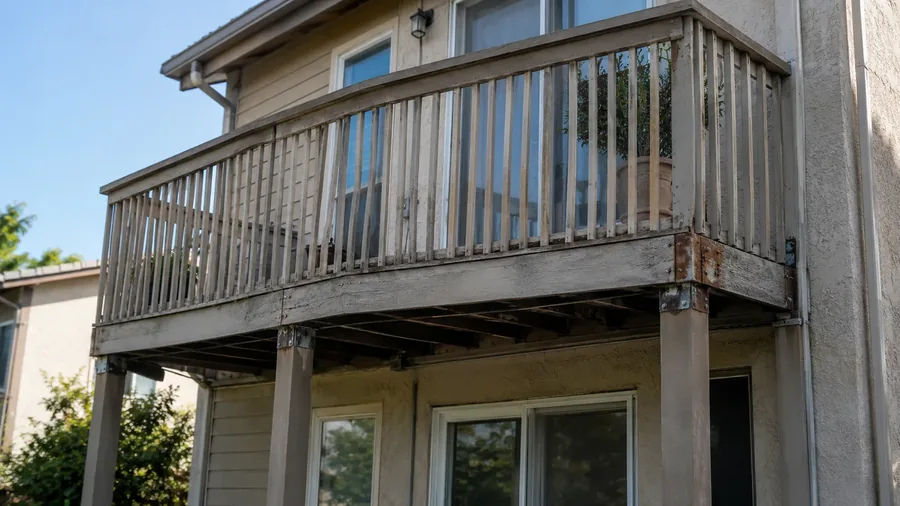
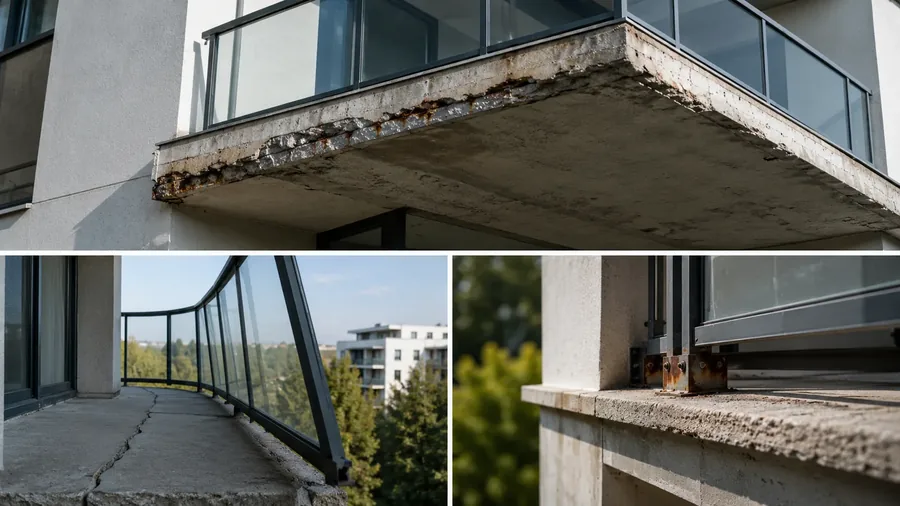
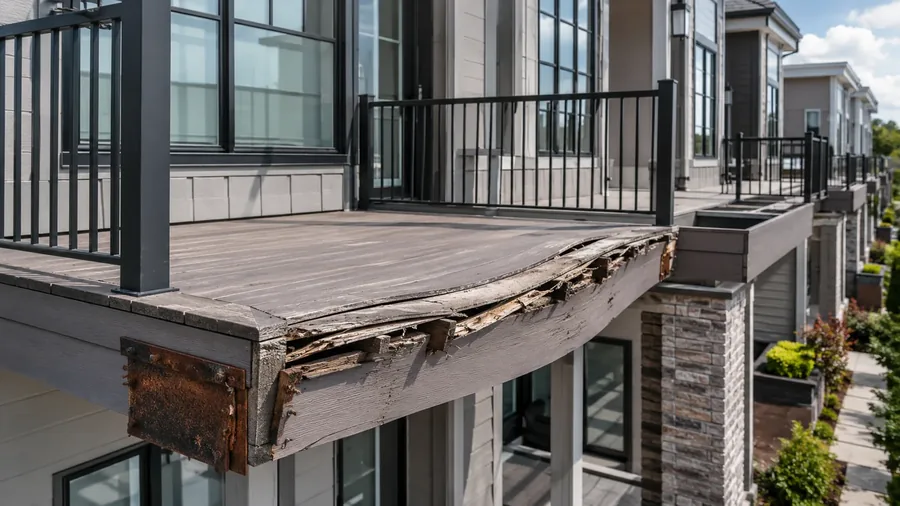
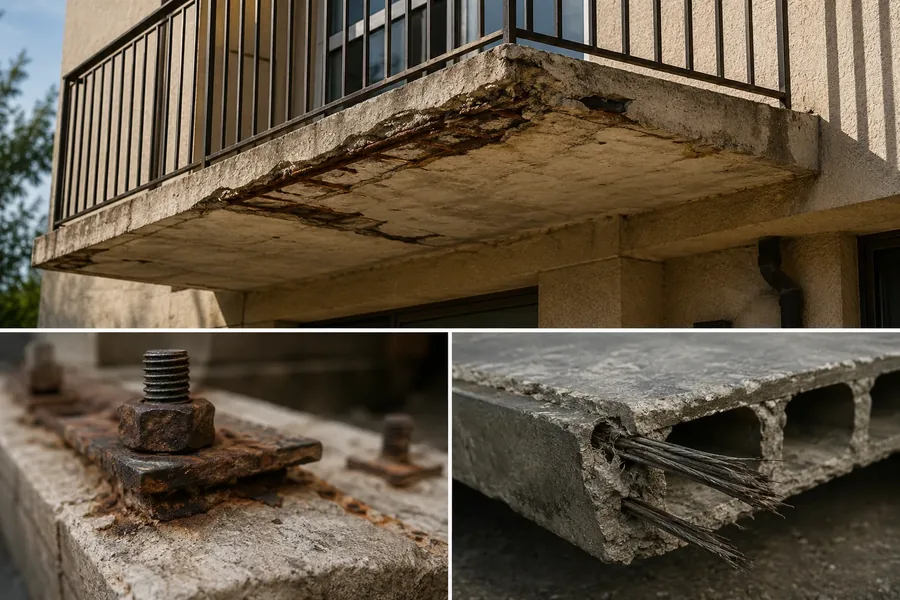
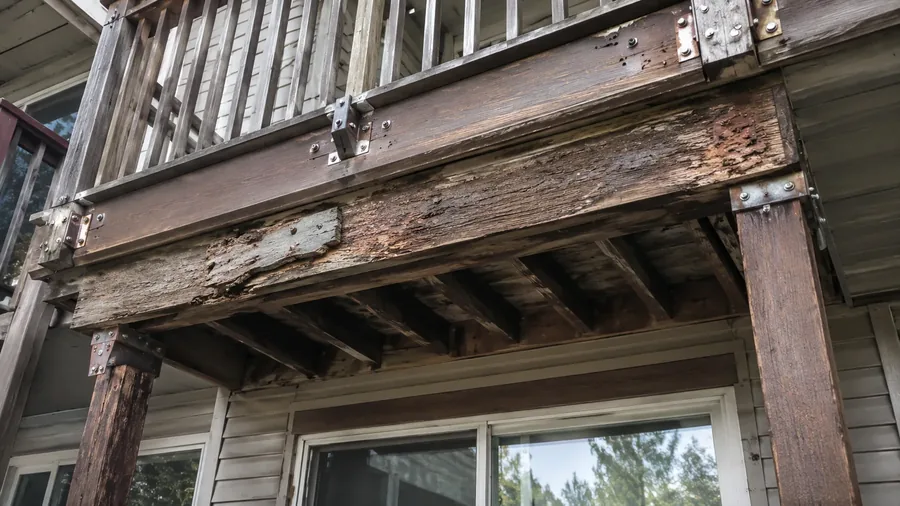
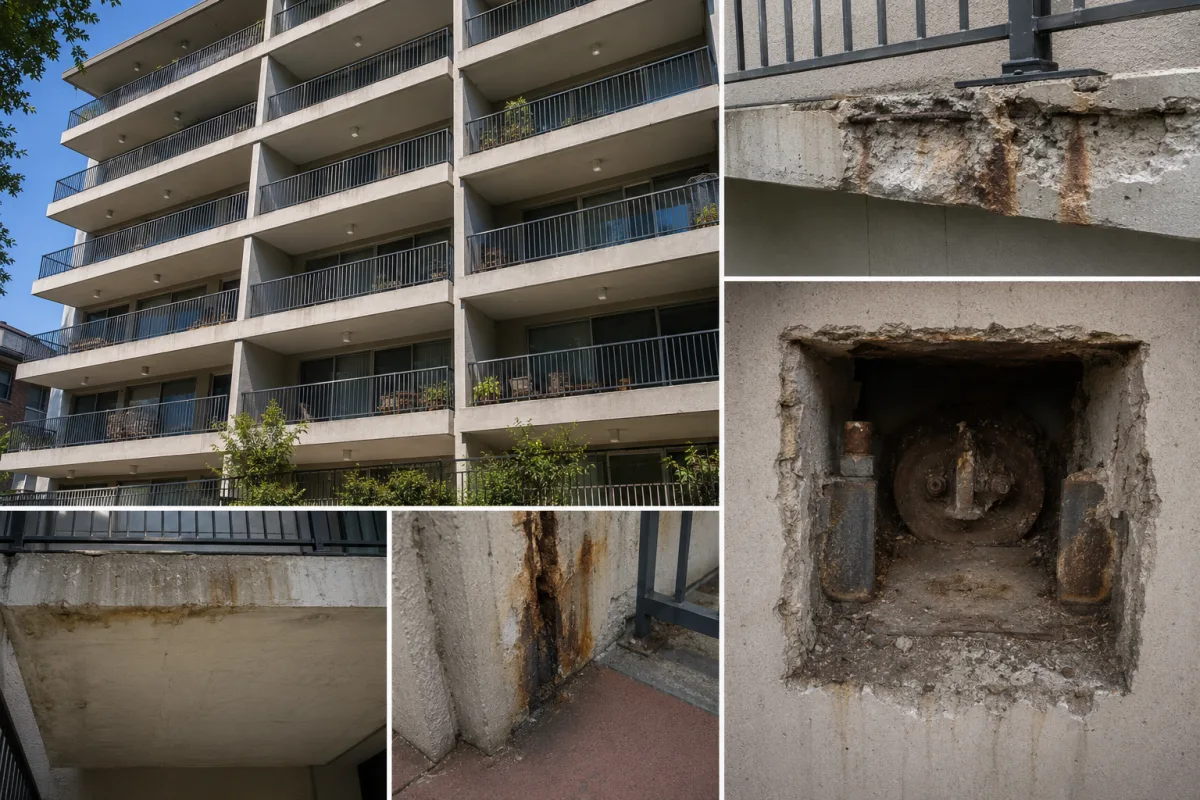
Rot at ledgers, corroded connections and compromised bearing — the conditions that drive a repair scope.
07 Project example
A recent structural assessment in Oakland
A condominium association in Oakland received an SB 326 inspection report that flagged a row of balconies on a post-tension slab for “further investigation required” — distress at the slab edge and corrosion staining at the anchorage. That language put the board’s liability, the association’s insurance, and a pending refinance all in play at once, and none of those parties would move on a contractor’s opinion. We brought in a licensed California structural engineer, performed a visual and probe assessment over two days, and ran the load analysis on the affected slabs. The stamped report — PE seal, calculations, photo plates — confirmed post-tension distress at the anchorage and defined the required retrofit. We translated it into a constructible scope and budget the board could act on, and coordinated the document directly with the association’s attorney, carrier, and lender so the refinance and coverage stayed on track.
Our SB 326 report said “further investigation required” and suddenly our attorney, our insurer, and our lender all needed answers. D&B delivered a stamped report that satisfied all three — and a retrofit scope we could actually build from. HOA Board President · Oakland condominium community
08 Case studies
Recent Projects, Documented
Real commercial properties — what the building needed, what we did, and what it delivered.
 Deck RepairCoastal Shared Deck & Walkway Restoration — Daly CityA large shared elevated deck on the coast — surface, framing and connections all degraded by years of…View case study
  Deck ConstructionPatio Deck & Post Base Replacement Across a Bungalow Community — San RafaelDeck-by-deck replacement across a courtyard community, driven by the one detail that failed first — posts set straight…View case study
  Deck RepairMulti-Level Ocean-View Deck & Stair Replacement — San MateoStepped decks cascading down a bluff, replaced surface and stairs first — because on a multi-level deck the…View case study
 09 Client feedback
What property owners say
The SB 721 inspection escalated to “further investigation” and our carrier wanted a stamped report before renewal. D&B’s PE-sealed assessment and load calcs were accepted without a single follow-up.
We needed an engineering report our lender would accept and a repair scope we could build from. Most firms give you one or the other. D&B delivered both in one package.
The post-tension distress on our slabs was beyond a visual call. They brought in the PE, ran the analysis, and gave the board a stamped report and a real retrofit budget. That’s what the situation required.
10 FAQ
Structural assessment questions
When do I need an engineering-grade structural assessment instead of a standard inspection?
When liability is on the line. Visible deflection, hardware corrosion, or post-tension distress — or an SB 721 / SB 326 inspection that flagged “further investigation required” — are the signals. At that point a visual opinion doesn’t protect you; you need a load analysis and a stamped report from a licensed engineer.
My SB 721 / SB 326 report says “further investigation required.” What does that mean?
It means the inspector found a condition that can’t be cleared by visual assessment alone and requires engineering-level analysis. It’s an escalation, not a closeout — and until it’s resolved with a stamped report and any required retrofit, the finding stays open and your liability, insurance, and lending exposure stay open with it.
Is the report actually stamped by a licensed engineer?
Yes. D&B partners with licensed California structural engineers (PE). The deliverable is a stamped report carrying the PE seal, with supporting load calculations and photo plates — the document your attorney, carrier, lender, and building department will accept.
What does the load analysis cover?
Dead load, live load, snow and wind load, and occupancy — the full set required to determine whether the assembly carries what it’s supposed to. This is what separates an engineering-grade assessment from a visual one.
Can you assess post-tension balconies and slabs?
Yes. Where applicable, the assessment includes a post-tension cable evaluation alongside the hardware and connection audit. Post-tension distress is precisely the kind of condition that requires engineering analysis rather than a visual call.
How much does a structural assessment cost and how long does it take?
Typically $2,500–$12,000 depending on the complexity of the assembly and the depth of analysis, including the engineer’s stamped report. On-site work is usually 1–2 days, with the stamped report delivered in 2–4 weeks.
Do you also do the retrofit, or just the report?
Both — and that’s the advantage. A stamped report diagnoses; it doesn’t build. We translate the engineering findings into a constructible retrofit scope and budget, and as a CSLB-licensed contractor we can perform the work — so you go from stamped report to completed repair without assembling a new team.
Will you coordinate with our attorney, insurer, and lender?
Yes. When liability, coverage, or financing is involved, we coordinate the assessment and documentation with your attorney, insurance carrier, and lender as required — because they’re usually the reason the stamped report is needed in the first place.
11 Start here
Commission a stamped structural assessment
Seeing deflection, corrosion, or post-tension distress — or holding an inspection report that says “further investigation required”? That’s the point to bring in engineering, not another opinion. Tell us the situation and we’ll pair an experienced contractor with a licensed California PE to deliver a stamped report, load calculations, and a constructible retrofit scope. No obligation.
CSLB #1060736 · PE-stamped reports (licensed CA structural engineers) · Insured & Bonded · Serving the Bay Area, Central Valley & Sacramento