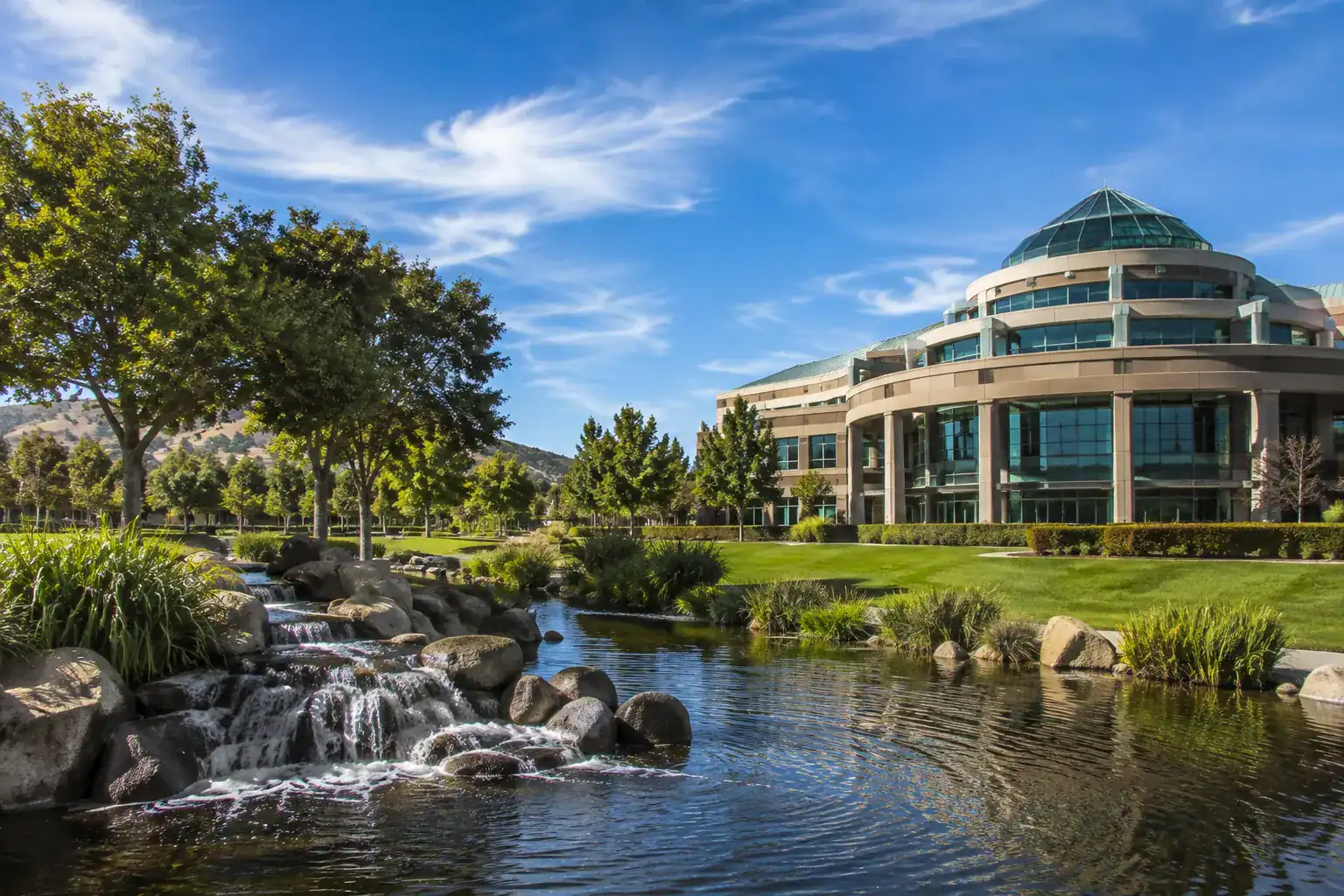
Climate considerations in San Ramon
San Ramon is the first city on our list where the ocean actually reaches the balcony. It sits at 486 feet in the San Ramon Valley with Mount Diablo to the northeast and the Las Trampas ridge to the northwest, and marine air funnels in from San Francisco Bay through one gap – the eastern mouth of Crow Canyon, by way of Castro Valley. Fog is infrequent, but when it comes it settles on the western reaches of the city and burns off by mid-to-late morning. That matters more than it sounds. A Central Valley balcony gets one long wet season and one long dry one. A west-side San Ramon balcony gets a damp surface most mornings and a dry one by noon, over and over, and it is that daily cycle – not any seasonal total – that works a sealant joint loose and lifts a membrane edge at the threshold. Summers are warm to hot and dry; winters are cool, wet and short.
Common building stock we work on
San Ramon is two cities with a twenty-year gap between them. The older half is central San Ramon, built out after Bishop Ranch broke ground in the early 1980s and turned a bedroom community into an employment center of 585 acres and nearly six million square feet of office. The city incorporated in 1983 on the back of that. The newer half is Dougherty Valley – Gale Ranch and Windemere – which took the population from 44,722 in 2000 to 72,148 in 2010, a 61% jump in a single decade, and it is all association-governed, down to the sub-HOA level. That is the part that matters for compliance: Gale Ranch and Windemere are dense with attached townhome and condo tracts, many with their own pools and clubhouses, and attached units under an HOA are SB 326 Inspection territory on the nine-year cycle. Worth knowing if you are scoping work here: the city classifies Dougherty Valley as an Engineered Grading Development with its own design guidelines, and its ordinary permit exemptions do not carry over the way they do elsewhere in San Ramon.
Neighborhoods served
Dougherty Valley, Gale Ranch, Windemere, The Bridges, Canyon Lakes, Bishop Ranch, City Center, Central San Ramon, Bollinger Canyon, Crow Canyon, Twin Creeks, Country Club, Montevideo, Old Ranch, and Norris Canyon. ZIP codes 94582 and 94583.
What we typically see
In San Ramon we most often address: (1) one failed detail repeated a hundred times – these tracts were built fast by production builders, so when we find a threshold or scupper failure on one unit we plan to find it on every unit with that floor plan, which is bad news and good budgeting; (2) membrane and flashing fatigue at west-facing thresholds, worked loose by the daily morning-damp cycle off Crow Canyon rather than by any single storm; (3) community pool decks, spa surrounds, and clubhouse terraces in the attached tracts, which sit under the same waterproofing physics as the balconies and rarely make the reserve study – Pool Deck Renovation is a real line item here; (4) guards on the 1980s-90s stock in central San Ramon that predate current requirements, corrected through Railing Repair & Replacement in the same mobilization rather than a second trip across the valley.