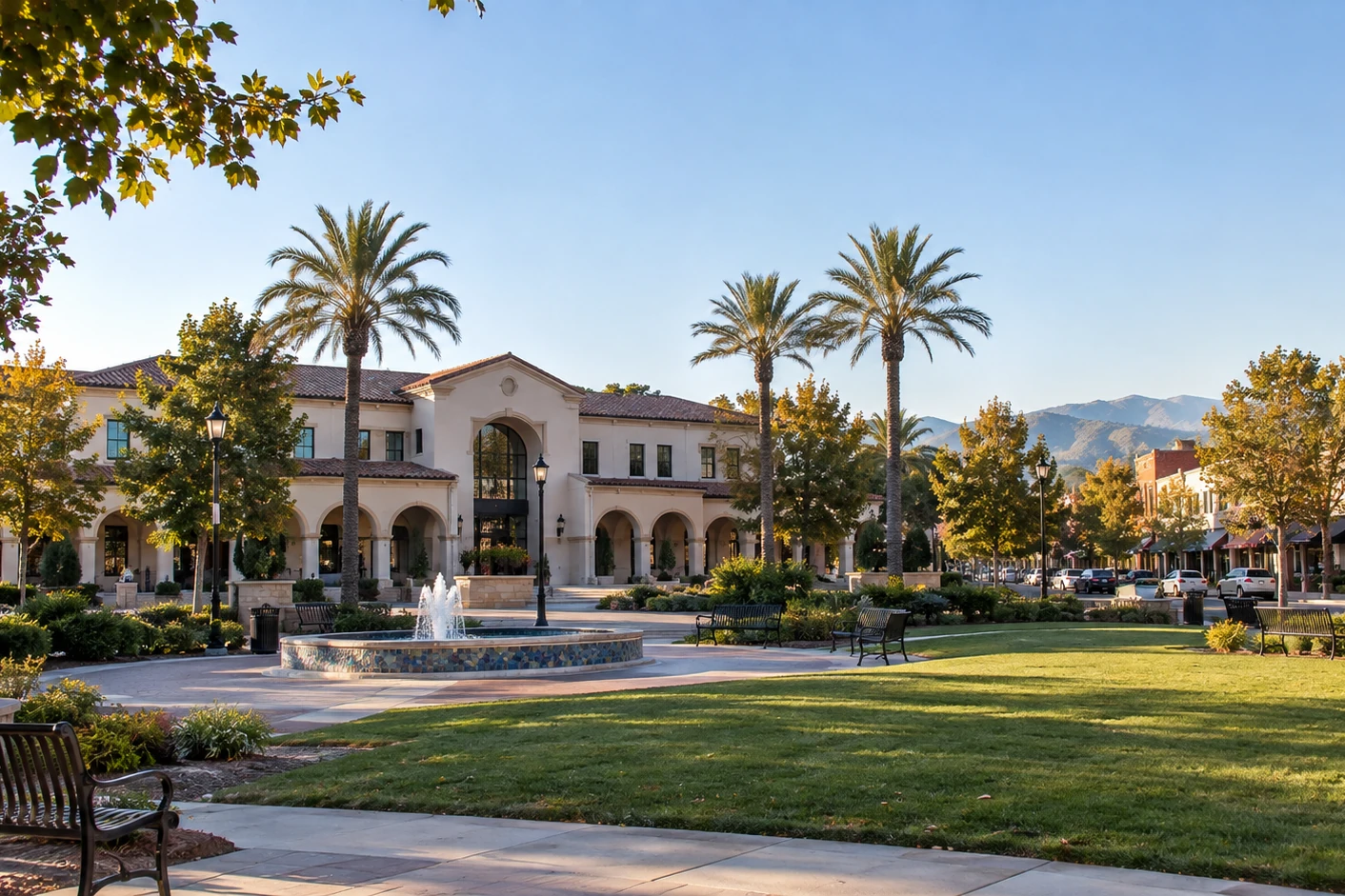
Climate considerations in Brentwood
Brentwood sits at the eastern end of the region, far enough from coastal influence that the marine layer rarely reaches it, with the hills to the west cutting off what little would. Summers are long, dry, and genuinely hot — afternoons routinely at or above 100°F through July and August, with evening Delta breeze providing the only relief. Annual rainfall is around 13–14 inches, among the lowest anywhere we work, falling almost entirely between November and March. For most of our service area the governing problem is moisture finding its way into a structure and staying there. Brentwood is the opposite case, and it produces a different set of failures entirely.
The driest market: what dryness actually does
Wood is dimensionally unstable with moisture content, and in a climate this dry it spends most of the year losing moisture it will not get back. The practical consequences accumulate quietly. Boards shrink across the grain, so gaps open between decking and joints that were tight on installation no longer are. Surface checking and splitting develop, particularly on south and west elevations taking full sun. Most consequentially, framing members shrink away from the screws and nails holding them — a fastener that was driven into wood at one moisture content is sitting in noticeably smaller wood a decade later, and it loses grip. The seasonal cycle makes it worse: slight re-wetting in winter, severe drying through summer, repeated year after year, works fasteners progressively looser. Owners read this as a maintenance lapse and respond by tightening, which holds until the next summer. Where withdrawal has become chronic the durable answer is through-bolted connections rather than repeated re-fastening, and we price both so the choice is an informed one.
The seam in the housing stock
Brentwood grew from a small farming town into a city of tens of thousands in roughly a generation, with the great majority of its housing going up from the mid-1990s onward. That growth was not uniform, and the most useful dividing line runs through the late 2000s. Housing completed during the boom years went up under the most intense schedule and labour-supply pressure the industry saw in that period — an industry-wide condition of the time rather than a reflection on any particular builder. Housing completed after the downturn was built under different market conditions, often by different firms, and frequently under a later code cycle with different detailing requirements. For deck and balcony work this means build year narrows expectations usefully before anyone opens anything: what generation of flashing and connection hardware is likely present, what the original waterproofing system probably was, and roughly where it sits in its service life. It does not replace inspection, which is why we still open assemblies and verify. It makes the inspection faster and more complete, and it is why we ask the build year before the site visit rather than after.
Built on converted farmland
Most of Brentwood’s residential development sits on land that was orchard or row crop within living memory, and conversion leaves the ground different from undisturbed soil. Removing established orchards leaves root masses that decompose and consolidate over years; deep ripping, grading, and redistributed fill alter the soil profile; and decades of irrigation change how the ground holds and sheds water. The result on some sites is differential settlement that shows up slowly — footings moving at different rates across a property, posts going gradually out of plumb, deck framing racking out of square. None of this is universal, and plenty of converted ground performs perfectly well; what it means is that when we see movement on a Brentwood property we look at the site history before assuming a framing fault, because correcting the footing detail is a different job from correcting the frame. Which of the two you are dealing with is a site-specific question, and it is one the assessment is there to answer.
Common building stock we work on
Brentwood’s inventory is unusually concentrated by era. A modest amount of pre-war and mid-century stock sits around the historic downtown, carrying original wood porches and decks with connection details predating current standards. Everything else is essentially post-1995: large master-planned subdivisions across Deer Ridge, Shadow Lakes, Brentwood Hills, Garin Ranch, and Apple Hill, plus gated active-adult communities including Summerset, plus apartment and HOA-managed townhome stock along the main corridors forming the SB 721 and SB 326 inventory. The older end of that post-1995 range is now at or past the point where builder-grade flashing and first-generation waterproofing reach end of service life, and all of it is working in the dry-climate conditions described above. Our certified construction crew scopes every project to the build year, the ground history, and the code in effect at installation.
Neighborhoods served
Our certified Brentwood crew covers Downtown Brentwood, Deer Ridge, Shadow Lakes, Brentwood Hills, Garin Ranch, Apple Hill, Summerset, Rose Garden, Sand Creek, the Balfour Road corridor, the Lone Tree Way corridor, the Brentwood Boulevard corridor, and the wider Brentwood community. ZIP code 94513 covers the city.
What we typically see
Across our Brentwood inspections, our company most often documents: (1) fastener withdrawal and loose connections caused by wood shrinkage rather than by neglect — a Brentwood-specific pattern from the driest conditions in our service area, and one owners routinely treat by tightening; (2) surface checking, splitting, and open joints on south and west elevations from sustained 100°F summers; (3) failed builder-grade ledger flashing on the older end of the post-1995 stock, with rot established behind it; (4) differential footing movement on converted agricultural ground, showing as posts gradually out of plumb; (5) railings on the earliest subdivisions that fall short of the current CRC 42-inch height and 4-inch sphere rule; (6) UV breakdown of finishes within two to three years where re-coating has lapsed. Every finding is captured in a written assessment with prioritized repair, replacement, or restoration recommendations.
Emergency response & remodeling
For Brentwood properties with acute safety issues — sagging framing, railings that move under load, visible rot at load-bearing connections, red-tagged decks, or storm damage — our emergency repair crew responds within 24–48 hours with temporary shoring and code-compliant stabilization. Railing movement is worth taking seriously here rather than tightening again, because in this climate it is frequently a connection that has lost its grip rather than a fastener that has worked loose. We also handle full deck remodeling for owners modernizing older outdoor spaces, with connections and finishes specified for a climate that pulls moisture out of wood rather than driving it in.