Climate considerations in Castro Valley
Castro Valley sits far enough inland to run warmer than the shoreline but still catches marine influence through the gaps in the surrounding hills. Summers are warm and dry, winters are cool and wet, and annual rainfall runs roughly 20–22 inches concentrated November through March. Those numbers are unremarkable on their own. What makes them consequential here is the terrain: rain that falls on a flat lot soaks in more or less where it lands, while rain that falls on a Castro Valley hillside runs, collects, and concentrates — and every deck, roof, and hard surface on the slope decides where it concentrates. The wet season is when hillside structures here take their damage, and it is rarely from the rain hitting the deck. It is from what the water does after.
Mapped landslide hazard & slope stability
Much of the high ground around Castro Valley falls inside state-mapped earthquake-induced landslide hazard zones, and the hills also contain older dormant slide areas that predate any mapping. The practical effect for deck and balcony work is threefold. First, projects on mapped ground commonly require geotechnical input before the county will approve a design — and finding that out after the drawings are done costs a season. Second, footing design has to avoid adding load near the head of a slope where surcharge is exactly what you do not want. Third, and least understood by owners: concentrated water is one of the most reliable ways to reactivate dormant ground movement. A deck collects several hundred square feet of rainfall and, if it simply sheds over the downhill edge, delivers all of it to one narrow band of soil, week after week through the wet season. We have assessed Castro Valley decks that had been shimmed and re-leveled repeatedly, where the actual cause was the structure quietly saturating the ground it stood on. Our certified firm looks at drainage discharge before it looks at framing on any hillside property here.
Canyon position & local exposure
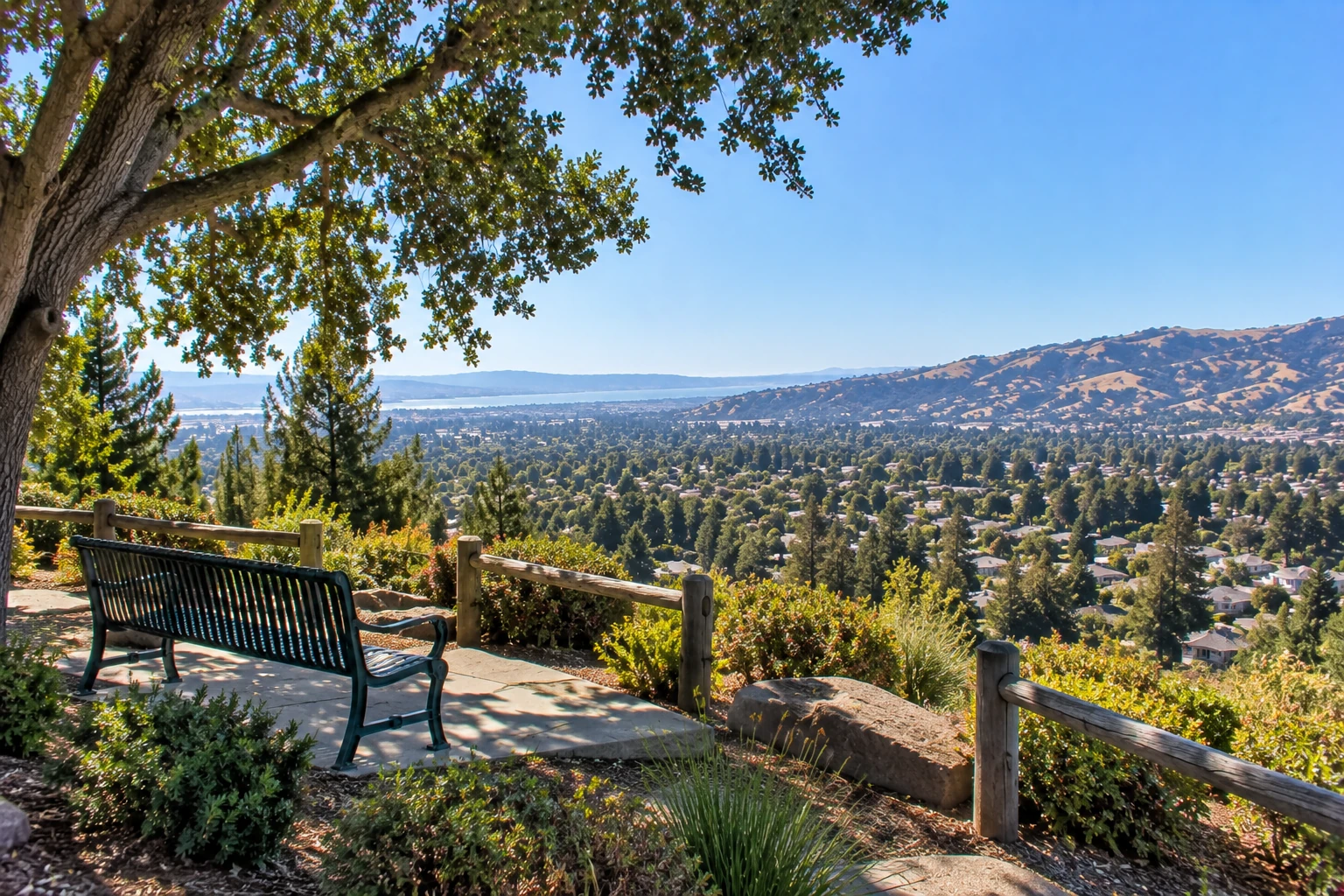
Castro Valley is not one environment. Several canyons feed into the valley bowl, and where a property sits within that system determines how its deck weathers. Upper hillside properties in the Five Canyons and Palomares Hills areas get strong sun and wind exposure — those decks fail from above, with UV breakdown of finishes, surface checking, and sealant fatigue leading the way. Canyon-bottom and lower-slope properties along Cull Canyon, Crow Canyon, and the shaded drainages sit in cold air that pools overnight and in shade that blocks drying, so those structures fail from within, with slow concealed decay in framing that stays damp for weeks. Valley-floor properties sit between the two. Canyon-mouth sites add funneled wind that works fasteners loose over time. The same maintenance interval does not serve all of these, and a contractor who quotes the whole community the same way has not looked at the site.
Unincorporated status & county review
Castro Valley is one of California’s larger unincorporated communities — a Census Designated Place with no municipal government and no city building department. Every permit for structural deck and balcony work, every SB 721 and SB 326 filing, and every geotechnical or hazard-zone review goes through the County rather than a city. That matters more here than it would in a flat community, because hillside projects on mapped ground draw a more involved review than a routine repair permit: geotechnical reports, structural calculations, and drainage plans may all be part of the submittal. Our licensed construction firm works to the County’s requirements from the first estimate, identifies what review the site will trigger before design work starts, and handles the submittal process end-to-end.
Common building stock we work on
Castro Valley’s stock is predominantly single-family, with a multi-family component concentrated along the Boulevard corridor. Post-war and 1950s–1960s tract homes across the valley floor — Proctor, Stanton, Columbia, and the older central neighborhoods — carry original and added-on wood decks with connection details predating modern standards. 1970s–1990s hillside subdivisions feature elevated decks on long posts, many built before current lateral-bracing and drainage practice, and most now at the age where footings have been through enough wet seasons to show whether the original detailing worked. Master-planned hill communities in Five Canyons, Palomares Hills, and Jensen Ranch date to the 1990s–2000s and are reaching the point where builder-grade flashing and first-generation waterproofing reach end of life. Apartment and HOA-managed townhome stock along the Boulevard corridor forms the SB 721 and SB 326 inventory. Our certified construction crew scopes every project to the era, original materials, slope position, and code in effect at installation.
Neighborhoods served
Our certified Castro Valley crew covers Castro Valley Village, the Castro Valley Boulevard corridor, Five Canyons, Palomares Hills, Jensen Ranch, Columbia, Proctor, Stanton, the Cull Canyon and Crow Canyon areas, Palomares Canyon, Redwood Canyon, the Lake Chabot area, and the wider Castro Valley community. ZIP codes include 94546 and 94552.
What we typically see
Across our Castro Valley inspections, our company most often documents: (1) hillside decks discharging concentrated runoff directly onto the slope below their own footings — a Castro Valley-specific concern given how much local high ground sits in mapped hazard zones; (2) repeated shimming and re-leveling of structures whose footings are moving because of that saturation, treated as a carpentry problem rather than a ground problem; (3) inadequate lateral bracing on 1970s–1990s elevated hillside decks built before current practice; (4) concealed decay in canyon-bottom and shaded lower-slope framing that never gets a sustained dry stretch; (5) UV breakdown, surface checking, and sealant fatigue on exposed upper-hillside decks; (6) railings on pre-2000 structures that fall short of the current CRC 42-inch height and 4-inch sphere rule. Every finding is captured in a written assessment with prioritized repair, replacement, or restoration recommendations.
Emergency response & remodeling
For Castro Valley properties with acute safety issues — sagging or visibly settling framing, loose railings, visible rot at load-bearing connections, deck movement following heavy rain, red-tagged structures, or storm-driven damage — our emergency repair crew responds within 24–48 hours with temporary shoring and code-compliant stabilization. Where movement is involved we assess whether the ground or the structure is the cause before recommending a permanent repair. We also handle full deck remodeling for property owners modernizing older outdoor spaces while bringing the structure up to current safety code with slope-appropriate footings and controlled drainage.