Climate considerations in Galt
Galt has a Central Valley climate at its most pronounced: hot dry summers with afternoons regularly at or past 100°F, low annual rainfall of around seventeen inches falling almost entirely between November and March, and some of the heaviest tule fog anywhere in the valley through the winter months. Summer heat drives UV degradation of finishes, surface checking, and thermal stress at connections, so exposed decks here want re-sealing every one to two years rather than every three or four. The wet season arrives compressed, putting every flashing seam and drainage route under load in a short window. Between the two sits a five or six month dry stretch in which something accumulates on every exterior surface in this town, which the next section covers.
Which side of the line your property is on
Galt is a compact incorporated city with unincorporated county land beginning immediately outside it — there is no gradual suburban fade, the town simply stops and the farmland starts. For a deck or balcony project that boundary matters, because it determines which building department handles the permit and which authority receives an SB 721 or SB 326 inspection report. Inside the limits that is the City of Galt; outside it, Sacramento County. The complication is that the line follows parcel boundaries rather than anything visible from the street, so a property on a residential-looking road with a Galt mailing address can sit outside the city, and owners are frequently surprised to learn it. Submitting to the wrong authority does not fail quietly — it fails after the wait, and the process starts again with the other office. We check the record against the address before anything is filed. It takes a few minutes and it removes a problem that is tedious rather than difficult.
Five months of field dust
Galt is ringed by working agricultural land, and the dry season here runs from roughly May into October without meaningful interruption. Through those months dust from field operations, harvest, and unpaved access roads settles continuously onto every exterior surface in town. On a deck it does two things that matter and one that does not. What does not matter much is the surface layer, which washes or sweeps off. What does matter is where the rest of it goes: packed down into the gaps between boards, into sealant joints, and into the junction at the ledger, where it compacts over several seasons into a dense fill that holds water against wood once the rain arrives and keeps holding it. The second effect is abrasive — grit under foot traffic wears coatings faster than weather alone would, so finishes in walking paths fail earlier than on the same deck a metre away. Owners who pressure-wash the surface annually and never address the gaps are cleaning the part that was not the problem. We check and clear those junctions as part of the work, and it is worth doing before the wet season rather than after.
Distance, and why we scope carefully
Galt sits well away from the major supply houses, which changes the economics of getting a scope wrong. In a metropolitan area a forgotten item is a thirty-minute errand; here it can be most of a working day, and on a crew that has travelled to be on site that is a real cost to somebody. The consequence is that we spend longer at the assessment stage here than we would closer in, and we would rather open something up and find nothing than skip it and discover it mid-job. It is also why we schedule Galt work in dedicated blocks rather than sending a crew down for a single afternoon — the efficiency of that is what keeps local pricing where it is. The practical version for an owner: expect a thorough assessment, and expect the estimate to be the number.
Common building stock we work on
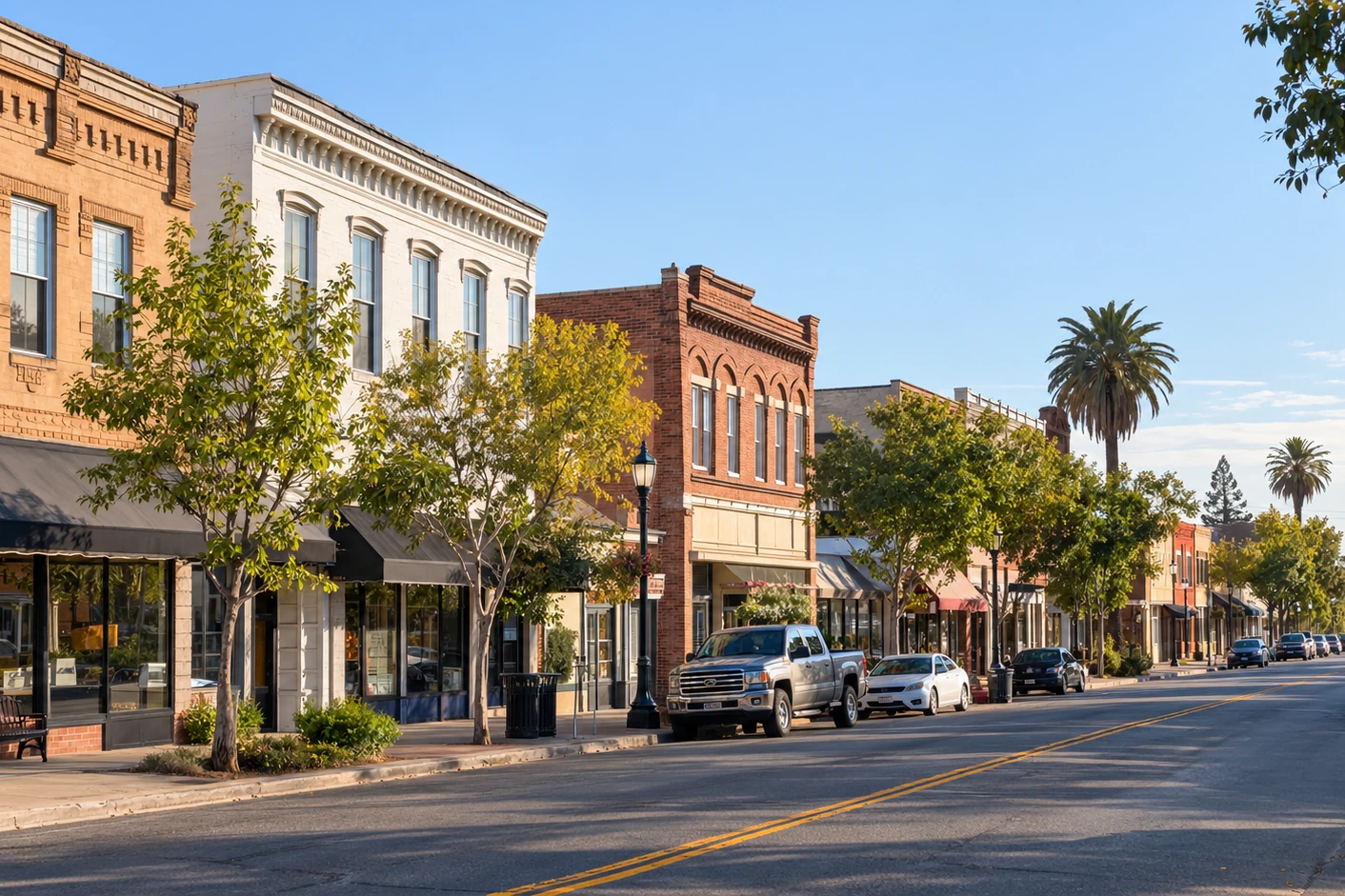
Galt’s inventory spans a century with a heavy concentration in one recent stretch. The historic downtown around Fourth Street carries early twentieth-century brick commercial buildings with upper floors, original stairs, and connection details predating current standards entirely. Post-war and mid-century housing fills the older residential streets. The great bulk of the town, though, went up during the growth of the 1990s and 2000s across Lake Canyon, Cobblestone, Vintage Oaks, and the newer neighbourhoods, which puts it squarely at the age where builder-grade ledger flashing, caulked joints, and first-generation waterproofing reach end of service life. Apartment and HOA-managed townhome stock forms the SB 721 and SB 326 inventory. Properties out past the limits on county land range widely in age and construction. Our certified construction crew scopes every project to the era, the exposure, and the code in effect at installation.
Neighborhoods served
Our certified Galt crew covers Downtown Galt, the Fourth Street district, Lake Canyon, Cobblestone, Vintage Oaks, North Galt, the Twin Cities Road corridor, the Carillion Boulevard corridor, the Caroline Avenue area, the Chabolla Avenue area, and the surrounding county properties. ZIP code 95632 covers the city and the area around it.
What we typically see
Across our Galt inspections, our company most often documents: (1) owners who assumed their jurisdiction from their mailing address rather than from the record, including some who had already submitted to the wrong authority — a Galt-specific problem created by how abruptly the city ends; (2) board gaps, sealant joints, and ledger junctions packed with compacted field dust holding water against wood through the wet season; (3) coatings worn through along walking paths by abrasive grit while the same finish survives elsewhere on the deck; (4) builder-grade ledger flashing failing on the 1990s and 2000s subdivisions, with rot established behind it; (5) heat-driven surface checking and sealant breakdown from 100°F-plus summers; (6) railings on pre-2000 stock that fall short of the current CRC 42-inch height and 4-inch sphere rule. Every finding is captured in a written assessment with prioritized repair, replacement, or restoration scope.
Emergency response & remodeling
For Galt properties with acute safety issues — sagging framing, loose railings, visible rot at load-bearing connections, red-tagged decks, or storm damage — we offer expedited scheduling within 5–7 business days, ahead of our normal block scheduling for this part of the service area. We also handle full deck and balcony remodeling for owners replacing structures that have reached the end of worthwhile repair, specified for a climate that alternates between sustained heat and sustained damp with very little in between.