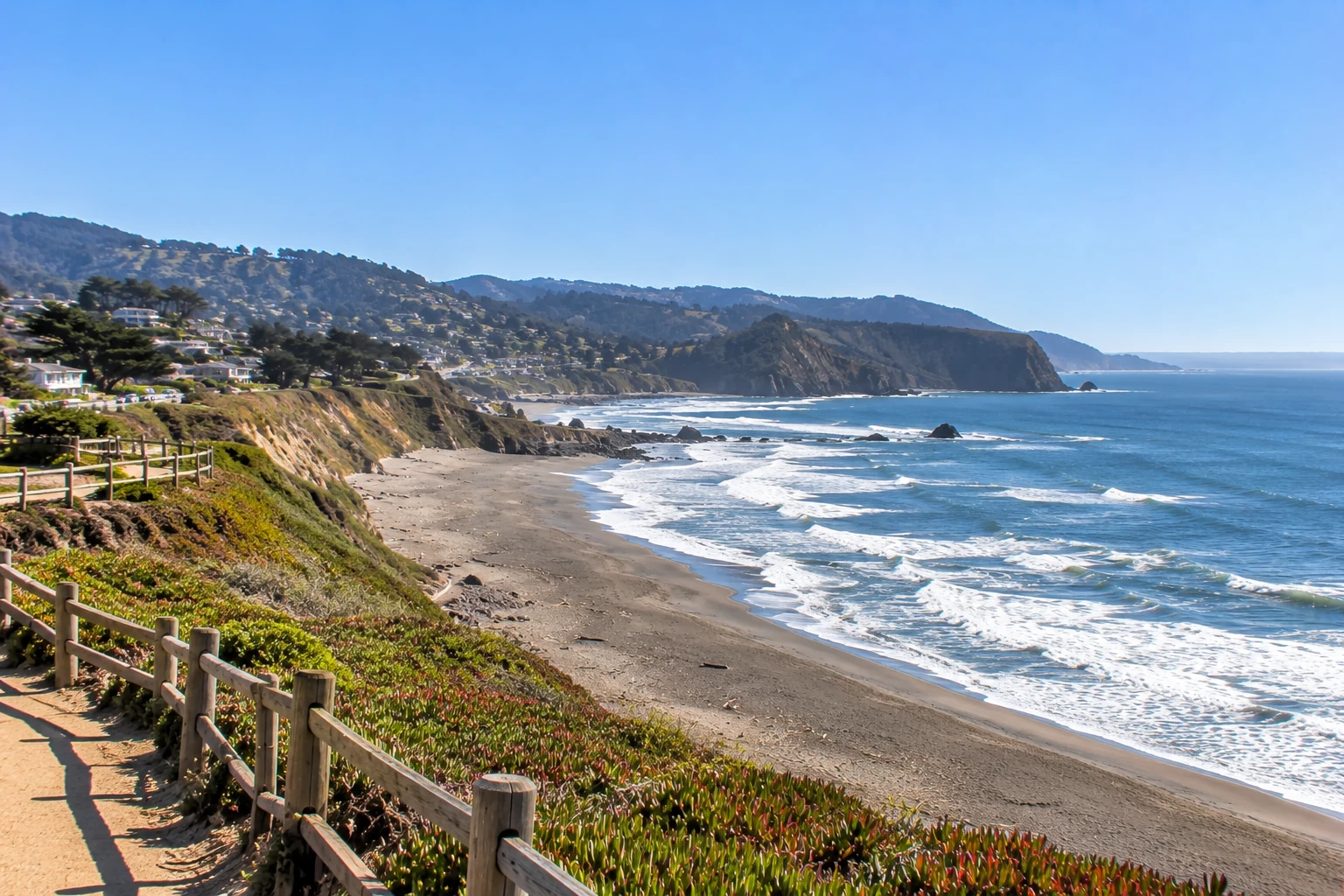
Climate considerations in Pacifica
Pacifica has a true maritime climate and almost no seasonal range — summer afternoons often stay in the sixties, winters are mild, and fog and marine layer are a normal condition rather than an event. Annual rainfall runs roughly 25–30 inches concentrated November through March, and it arrives on wind rather than falling straight down, which drives it into flashing seams, sealant joints, and fastener penetrations that would shed vertical rain without difficulty. The critical absence here is a drying season. Inland structures get a hot dry summer that pushes accumulated moisture back out of framing; Pacifica structures do not. Humidity stays high year-round, wood that takes on water holds it, and decay progresses steadily and quietly instead of announcing itself. Probing inspection rather than visual-only review is the appropriate standard on any older Pacifica stock.
Coastal Zone jurisdiction & development permits
Pacifica lies within California’s Coastal Zone, and that is the permitting fact most property owners here are least prepared for. Development in the Coastal Zone is governed by the California Coastal Act, administered locally through the City’s Local Coastal Program, with the Coastal Commission involved in certain circumstances. Exterior work that an owner reasonably assumes is a routine building permit can require a coastal development permit, and whether it does depends on the nature of the work, the property’s location, and the specifics of the local program — not on how large the job feels. We have joined projects where design was substantially complete before anyone raised the question, which is an expensive place to discover it. Our licensed construction firm raises Coastal Zone questions at the assessment stage and puts the answer in writing, so that the permitting path is established before drawings are produced rather than after.
Bluff-top properties: what a contractor can and cannot say
Pacifica’s coastal bluffs retreat. That is a documented, ongoing physical process driven principally by wave attack at the base and by water moving through the bluff from above, and no deck or balcony repair changes it. It is worth being direct about this, because owners of bluff-adjacent property are sometimes offered work framed as though it addresses the underlying condition. It does not, and anyone suggesting otherwise should be treated with caution. What is genuinely in our scope is the structure itself: whether the framing, connections, and railings are sound, what the assembly needs to be safe, and how the deck handles and discharges water — because concentrating roof and deck runoff toward a bluff edge is one thing a property owner does control. What sits outside our scope, and outside any contractor’s, is determining permissible setbacks or evaluating bluff stability. Those rest with the City through its Local Coastal Program and, where it applies, the Coastal Commission, decided on site-specific geotechnical evidence. When a project needs that determination first, we say so plainly and stop rather than proceeding around it.
Nine valleys, nine exposures
Pacifica was formed by joining nine separate communities, each occupying its own coastal valley between ridges, and that geography still governs how buildings weather here. Ocean-facing properties in Rockaway Beach, Linda Mar, Pedro Point, and along the exposed frontage take direct salt spray and the full force of sustained onshore wind — their hardware corrodes on a genuinely accelerated schedule and their flashing takes wind-driven water constantly. Properties set back in the inland valleys, in Park Pacifica and the sheltered pockets behind the ridges, sit in noticeably milder conditions: still humid, still fog-influenced, but without the spray and with meaningfully reduced wind loading. Sharp Park and the flat coastal terrace fall between the two. The practical point is that a single specification applied across the whole city is wrong in both directions — under-specified on the ocean frontage and wasteful in the sheltered valleys. We scope to the actual exposure of the actual property.
Common building stock we work on
Pacifica’s residential stock is concentrated in the post-war decades. 1940s–1960s construction across Sharp Park, Pacific Manor, Edgemar, and Westview includes original wood-framed decks, stairs, and balconies with connection details predating modern standards, most now needing ledger restoration, hardware replacement, and railing upgrades to current height and geometry requirements. 1960s–1980s tract development across Linda Mar, Fairway Park, Vallemar, and Park Pacifica forms the bulk of the inventory, with original hardware that was rarely specified for the exposure it sits in. Apartment and HOA-managed townhome stock along the Highway 1 corridor makes up the SB 721 and SB 326 inventory. Later infill is comparatively limited. Across all of it, the variable that matters most is not the decade but the distance from the water and the direction the property faces. Our certified construction crew scopes every project to the era, original materials, actual exposure, and code in effect at installation.
Neighborhoods served
Our certified Pacifica crew covers Linda Mar, Rockaway Beach, Sharp Park, Pacific Manor, Westview, Fairway Park, Vallemar, Edgemar, Pedro Point, Park Pacifica, Sun Valley, Fairmont, the Highway 1 corridor, and the inland valleys behind the coastal ridge. ZIP code 94044 covers the city.
What we typically see
Across our Pacifica inspections, our company most often documents: (1) corroded joist hangers, anchor bolts, and railing connections on ocean-facing properties, concealed inside assemblies that still look sound from outside — a Pacifica-specific concern from direct spray exposure rather than ordinary coastal air; (2) replacement hardware specified for coastal conditions generally rather than for spray, failing years earlier than the owner expected; (3) wind-driven water intrusion at flashing seams, transitions, and penetrations on exposed elevations; (4) slow, steady dry rot in framing that never gets a drying season; (5) railings on pre-2000 buildings that fall short of the current CRC 42-inch height and 4-inch sphere rule; (6) deck and roof runoff concentrated toward a slope or bluff edge where directing it elsewhere would be straightforward. Every finding is captured in a written assessment with prioritized repair, replacement, or restoration recommendations.
Emergency response & remodeling
For Pacifica buildings with acute safety issues — sagging framing, loose railings, visible rot or corrosion at load-bearing connections, red-tagged structures, or winter storm damage — our emergency repair crew responds within 24–48 hours with temporary shoring and code-compliant stabilization. Winter storms here do real damage to exposed elevations, and we prioritize accordingly during the season. We also handle full balcony and deck remodeling for property owners modernizing older outdoor spaces while bringing the structure up to current safety code with hardware and detailing matched to the property’s actual exposure.