SB 721 deadline has passed. Penalties run $100–$500/day per building — schedule your inspection today. SB 721 past due Get compliant 

Licensed California Contractor · CSLB #1060736 · Insured & Bonded

Decks Balcony Request an Inspection

HomeService AreasRiverbank

Commercial Balcony & Deck Specialists  ·  CSLB #1060736

SB 721 Compliance & Balcony Repair for Riverbank Commercial Properties

When summers run past 100°F a covered deck is the only outdoor room worth having, so almost every deck in Riverbank has something built over it. That cover is a roof — it carries weight, it catches wind, and the framing underneath was usually designed before anyone thought of putting it there. Checking what the deck is actually holding up is the first thing we do here. Licensed California construction contractor serving Downtown Riverbank, the Santa Fe district, Crossroads, Riverbank Village, the river corridor, and the Patterson Road and Claribel Road corridors with SB 721 inspections, structural repair, railing replacement, and waterproofing services.

9+ YearsCalifornia Licensed 240+Riverbank properties SB 721 / 326Compliance Specialists

02 / Local Presence

  • 240+ jobs in Riverbank area
  • 88 mi from our North Highlands HQ
  • 24 hrs avg response time
  • $0 on-site assessment fee

03 / Why D&B for Riverbank

Local response. Compliance experts.

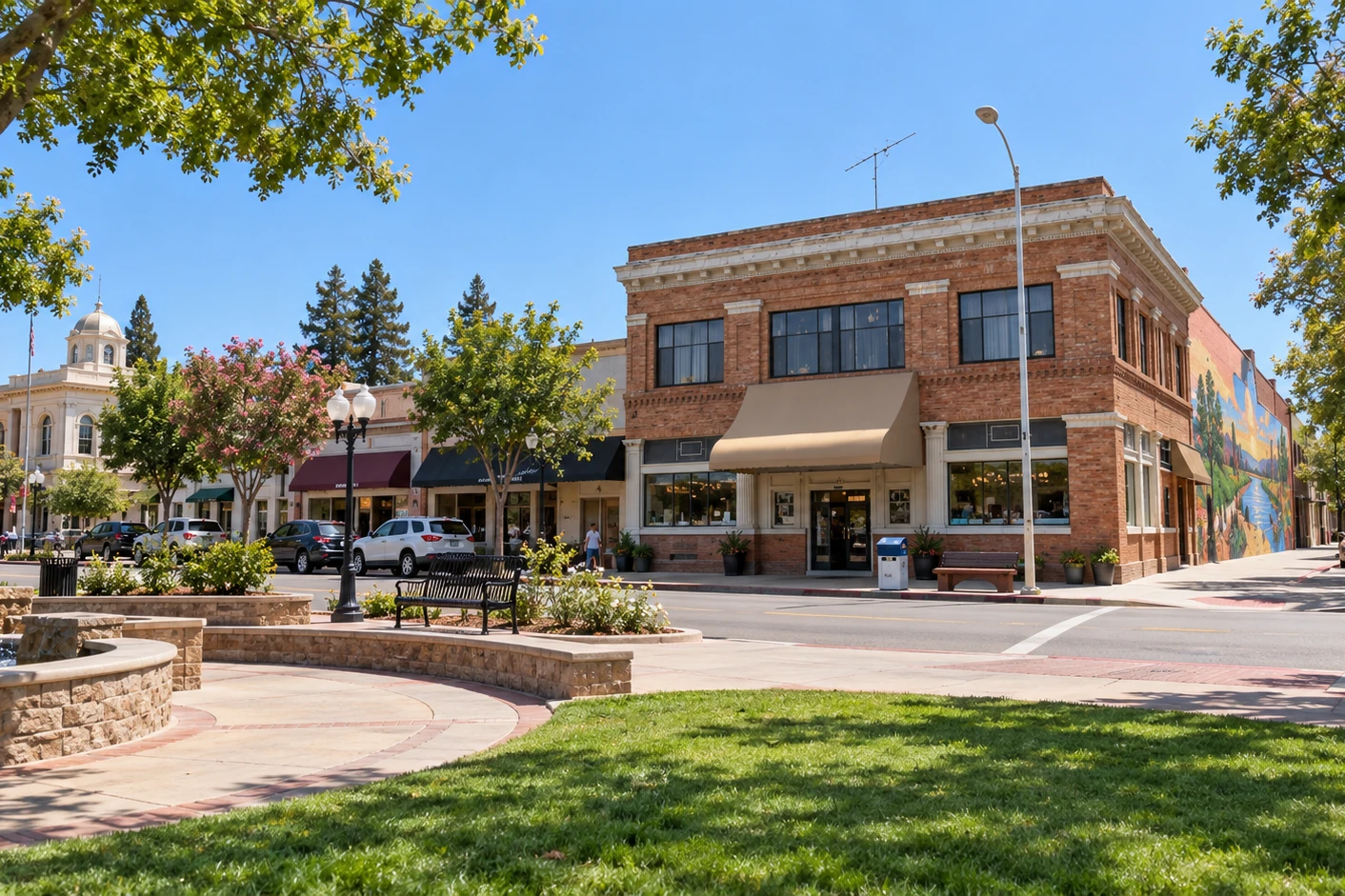
Downtown Riverbank, California

Scheduled Riverbank coverage

Same-day callback for Riverbank property owners and managers. Because Riverbank sits at the southern edge of our service area, we schedule work here in dedicated blocks to keep crews efficient — typically starting within 2–3 weeks of estimate approval, with expedited scheduling for urgent safety work.

Riverbank familiarity

Our construction company has inspected, repaired, and restored decks and balconies across Riverbank's full residential range — from the brick stock downtown to the subdivisions built through the 1990s and 2000s, small multi-family buildings on the central streets, and properties along the river corridor.

Attached-structure & small-portfolio specialists

SB 721 and SB 326 inspection reports filed with the City of Riverbank when required. Our certified firm checks what a deck is carrying overhead as well as what is carrying the deck, and talks plainly to owners who are making the decision themselves rather than taking it to a board.

04 / Free Assessment

Get a free deck & balcony assessment in Riverbank

Tell us about your property — we'll send scheduling that accounts for the travel, transparent pricing, and handle SB 721 / SB 326 compliance filing end-to-end with the City of Riverbank. If you own the building yourself, you will get a plain answer about what has to happen this year and what can wait.

  • SB 721 / SB 326 inspection reports filed with the City of Riverbank — we handle the paperwork
  • Attached covers and shade structures assessed for the load they add to the deck below
  • Findings separated into this year and later, with the reasoning explained rather than asserted
  • Professional licensed CA contractor · Insured & Bonded

Or call us now: (916) 848-2728

05 / Process

From your message to a finished property

  1. Reach out

    Same business day

    Submit the form or call us. We answer questions, ask whether anything has been built over or added to the deck, and schedule a free on-site assessment with a licensed contractor.

  2. On-site assessment

    Within 24–48 hours

    A licensed contractor walks the property, photographs every deck, balcony, and EEE element, traces how any attached cover transfers its load into the structure below, and identifies SB 721 / SB 326 issues, water-damaged framing, or railing concerns. ~60 minutes.

  3. Written report & estimate

    Within 2–3 business days

    Itemized scope, transparent pricing, repair-vs-replacement options, with findings split into what needs doing now and what can reasonably wait a season or two. Where an attached structure is loading framing that was not sized for it, the report says so and sets out what correcting it involves.

  4. Schedule and execute

    Most jobs start 2–3 weeks

    Permits pulled through the City of Riverbank Building Division when required, work executed by our in-house CSLB-licensed construction crew. Final walkthrough, photo documentation, warranty paperwork.

07 / Investment Ranges

Typical pricing for Riverbank commercial jobs

Final estimate after on-site visit. Ranges below reflect 90% of recent Riverbank work. Pricing here sits toward the lower end of our service area and we schedule in blocks so travel is not loaded onto single jobs. Where an attached cover has to be supported or re-anchored as part of a deck repair, that is quoted as its own line so you can see what it is adding.

Required compliance

SB 721 / SB 326 Inspection

$400–$800per building

On-site visual + structural review, written report filed with City Code Enforcement.

Most common

Balcony / Deck Repair

$2,500–$8,000per balcony

Joist replacement, ledger fix, railing reinforcement, board replacement, cover re-support. Waterproofing recoat $3K–$12K.

Highest value

Full Balcony Rebuild

$15,000–$45,000per balcony

Complete tear-down, new framing sized for what it will actually carry, waterproofing, code-compliant custom railings. Volume pricing for 5+ buildings.

We never quote a final price without an on-site visit. Free assessment takes ~60 minutes — no commitment, no pressure.

09 / Client Voices

From Riverbank property managers

My father built the cover over the deck in the nineties and it has been fine ever since, so I was surprised when their licensed contractor team said the posts underneath were carrying more than the original deck was built for. They were careful to say the cover itself was well made — the issue was what it was sitting on. They added proper support rather than taking it down, which I appreciated.

T.P. · Property Owner · Claribel Road Corridor · Sep 2026

I own a fourplex and I am the owner, the manager, and the person who pays for it. Their certified construction company explained what had to happen this year and what could wait two, with the reasoning, rather than handing me one number and leaving me to guess. First time anyone has talked to me like the decision was mine to make.

G.H. · Fourplex Owner · Callander Avenue Area · Aug 2026

Our place backs onto the river corridor and the growth comes back faster than we can keep up with. Their insured team pointed out what was actually sitting against the posts and the ledger, cleared it properly as part of the job, and told us which parts mattered and which were just untidy.

P.A. · Property Owner · River Corridor · Jul 2026

10 / Local Context

Climate, added structures & building stock in Riverbank

Climate considerations in Riverbank

Riverbank has a San Joaquin Valley climate at full strength: long hot summers with afternoons regularly past 100°F, low annual rainfall of around twelve to thirteen inches concentrated almost entirely between November and March, and heavy tule fog through much of the winter. Exposed surfaces take sustained UV and thermal stress for a third of the year and then sit damp for weeks at a stretch under fog with very little actual rain to show for it. Re-sealing intervals here are shorter than general guidance assumes. The heat also explains something about how people here use their outdoor space, which shapes most of the structures we are called to look at.

What the deck is holding up

In a climate like this an uncovered deck is unusable for a large part of the year, so almost every deck in Riverbank has a patio cover, shade structure, pergola, or similar built over it — often added years after the deck itself, frequently by the owner or a previous one. A great deal of that work is competently done and this is not a criticism of it. The issue is structural arithmetic. A cover is a roof: it has weight, and under wind it generates uplift, both of which have to go somewhere. Where the cover is carried on its own posts bearing on independent footings, nothing much changes for the deck. Where it is fastened to the deck’s posts, beams, or ledger — which is the common and easier approach — the deck’s framing is now carrying load it was not sized for, and on a windy day it is also resisting uplift it was never detailed for. That rarely fails dramatically. It shows up as sagging under the cover’s bearing points, as a ledger working loose at one end, or as fasteners that have withdrawn under cyclic uplift. The first thing we do on a Riverbank deck is work out how anything overhead transfers its load, because that determines what the repair actually has to address.

The river corridor and the town

Riverbank sits above the river, and properties along that corridor sit in genuinely different conditions from those a few streets inland. Riparian vegetation — cottonwoods, willows, and the rest — grows fast and drops heavily, so a structure near the corridor accumulates far more organic material than one in town and gets vegetation growing against posts, skirting, and ledger junctions within a single season rather than over several. Humidity in the corridor runs higher year-round, so the drying that the rest of the town gets through the long dry season is reduced there. The practical consequence is that corridor properties want a shorter clearing and inspection interval, and that growth against the structure is a maintenance item rather than a tidiness one — it holds moisture against wood and keeps the framing from drying out. Four streets away none of that applies, which is why we scope to the property rather than to the city.

Who we are usually talking to

The multi-family inventory in Riverbank is predominantly small — fourplexes, six and eight-unit buildings, modest complexes — and much of it is held by individual local owners rather than by management companies or institutional operators. That changes what a useful report looks like. A professionally managed portfolio has staff to interpret a condition assessment and a board or an owner elsewhere to approve spending. A local owner is often the manager, the decision-maker, and the person whose money it is, all at once, and has frequently never commissioned an engineering report before. What serves them is not a shorter report — it is a clearer one: findings separated into what has to be done this year and what can reasonably wait, with the reasoning stated so the owner can weigh it themselves rather than take it on faith. We write that way here as a matter of course, and we will say when something can wait. That is not a smaller job; it is an honest one.

Common building stock we work on

Riverbank’s inventory spans a century with most of the volume recent. The historic downtown around the Santa Fe district carries early twentieth-century brick commercial buildings with upper floors and original stairs, with connection details predating current standards entirely. Post-war and mid-century housing fills the older residential streets, generally with decks and covers added over subsequent decades. The bulk of the town went up during the growth of the 1990s and 2000s, which puts it at the age where builder-grade ledger flashing, caulked joints, and first-generation waterproofing reach end of service life. Small multi-family buildings across the central streets form most of the SB 721 inventory. Our certified construction crew scopes every project to the era, what has been added to it since, and the code in effect at installation.

Neighborhoods served

Our certified Riverbank crew covers Downtown Riverbank, the Santa Fe district, Crossroads, Riverbank Village, North Riverbank, the river corridor, the Patterson Road corridor, the Claribel Road corridor, the Callander Avenue area, Terminal Avenue, and the wider Riverbank community. ZIP code 95367 covers the city.

What we typically see

Across our Riverbank inspections, our company most often documents: (1) patio covers and shade structures fastened into deck framing that was never sized to carry them, showing as sag at bearing points, ledgers working loose at one end, or fasteners withdrawn under wind uplift — a Riverbank-specific concentration given how necessary a cover is in this climate; (2) vegetation and organic debris packed against posts, skirting, and ledger junctions on river corridor properties, growing back within a season; (3) builder-grade ledger flashing failing on the 1990s and 2000s subdivisions with rot established behind it; (4) heat-driven surface checking and sealant breakdown from 100°F-plus summers, with shaded areas under covers holding damp instead; (5) railings on pre-2000 stock that fall short of the current CRC 42-inch height and 4-inch sphere rule; (6) small rental properties whose owners were unaware SB 721 reaches buildings of three units. Every finding is captured in a written assessment with prioritized repair, replacement, or restoration scope.

Emergency response & remodeling

For Riverbank properties with acute safety issues — sagging framing, a cover that has shifted or lifted, loose railings, visible rot at load-bearing connections, red-tagged decks, or storm damage — we offer expedited scheduling within 5–7 business days, ahead of our normal block scheduling for this part of the service area. Where a cover is involved we establish whether the cover or the deck beneath it is the failing element before proposing a permanent repair. We also handle full deck and cover rebuilds designed as one structure from the start, which is considerably cheaper than correcting two that were never meant to work together.
12 / Common Questions

Riverbank commercial balcony & deck FAQ

What does a typical deck or balcony inspection cost in Riverbank?

For a small Riverbank multi-family building (3–8 units), our SB 721 inspection service runs $400–$800 per building, which covers most of the local inventory. Pricing here sits toward the lower end of our service area and we schedule in blocks so travel is not loaded onto individual jobs. Free initial site visits are included.

We have a patio cover over the deck. Does that matter?

It depends how it is carried, and it is worth establishing. A cover is a roof — it has weight, and under wind it generates uplift. If it stands on its own posts and footings, the deck below is unaffected. If it is fastened into the deck's posts, beams, or ledger, which is the easier and more common approach, the deck's framing is carrying load it was not sized for and resisting uplift it was never detailed for. That usually shows up slowly: sag at the bearing points, a ledger working loose at one end, fasteners backing out. None of this means the cover was badly built — plenty are excellent. It means the structure underneath is doing a job nobody specified it for.

Our property backs onto the river. Is that different from the rest of town?

Noticeably. Riparian growth along the corridor is fast and heavy, so vegetation reaches posts, skirting, and ledger junctions within a single season rather than over several, and organic debris accumulates far quicker than it does inland. Humidity in the corridor also runs higher year-round, so you get less of the drying the rest of the town gets through the long dry season. Corridor properties want a shorter clearing and inspection interval, and growth against the structure counts as a maintenance item rather than an untidiness one — it holds moisture against wood and keeps it from drying out. Four streets away, none of that applies.

I own my building myself. How does this work without a management company?

The same way, with a report written for you rather than for a board. Most multi-family property here is small and locally owned, so the person we are talking to is usually the owner, the manager, and the one paying. What that calls for is not a shorter report but a clearer one — findings split into what has to happen this year and what can reasonably wait, with the reasoning stated so you can weigh it yourself. We will tell you when something can wait. That means a smaller invoice now and an owner who calls us back later, which suits us fine.

Are Riverbank HOA condos under SB 326 or SB 721?

HOA-managed condominiums fall under SB 326 (re-inspection every 9 years). Non-HOA multi-family rental buildings of 3+ units fall under SB 721 (every 6 years) — which covers fourplexes and small complexes, not just large properties, and catches a lot of local owners by surprise. Our certified inspection firm files the appropriate report with the City of Riverbank either way.

13 / Free Property Inspection

Free balcony & deck inspection for Riverbank commercial properties

No commitment. Same-day callback. Licensed, insured, and bonded. Our certified construction company files SB 721 / SB 326 reports with the City of Riverbank on your behalf, checks what your deck is holding up as well as what is holding it, and tells you plainly what can wait.

Privacy controls

Cookie preferences

Choose which optional technologies may be used. Necessary tools remain active.

Change or withdraw permission any time using Cookie settings in the footer.

Closing does not save changes.

Your privacy choices

Opt out of the sale or sharing of personal information for advertising. You can still request a quote.

No account needed for this browser choice. Other privacy requests: see Privacy Policy.

📞
Call Now!