Climate considerations in Windsor
Windsor sits in the inland valley, far enough from the coast to run considerably warmer than the shoreline in summer, with afternoons regularly in the nineties through July and August. Winters are cool and genuinely wet — this is one of the higher-rainfall parts of our service area, with the great majority of it arriving between November and March. That compression is what matters for structures: a large volume of water over a short season puts every waterproofing termination, flashing seam, and drainage route under sustained load, and anything marginal shows up quickly. Through the dry months the pattern reverses entirely, with heat and UV working on finishes and vegetation around structures drying out completely. The two halves of the year make quite different demands, and a specification that handles one well can handle the other badly.
The deck is part of the structure
Fire exposure is a planning reality across this area, and the part most relevant to our trade is the one owners think about least. For fire purposes an attached deck is not a separate garden feature — it is part of the structure, and the zone immediately around and beneath it matters. What gets stored under a deck tends to be exactly the wrong thing: timber offcuts, garden furniture, cardboard, dry material that nobody looks at from one year to the next. Vegetation grows against posts and skirting. Leaf litter and needles collect on the surface, in board gaps, and in the junction at the ledger, where they stay through the dry season. None of that is complicated to address, and all of it is routinely overlooked because it sits outside what people think of as deck maintenance. We note these conditions during every Windsor assessment and list them separately in the report. To be clear about scope: the governing requirements are set by the state and the local fire authority, they have been tightening in recent years, and owners should confirm the current rules with them. We build and repair — we do not perform defensible-space inspections and we do not certify compliance. What we can do is tell you what we saw and make sure the structure itself is detailed to shed debris rather than collect it.
Balconies over a working public space
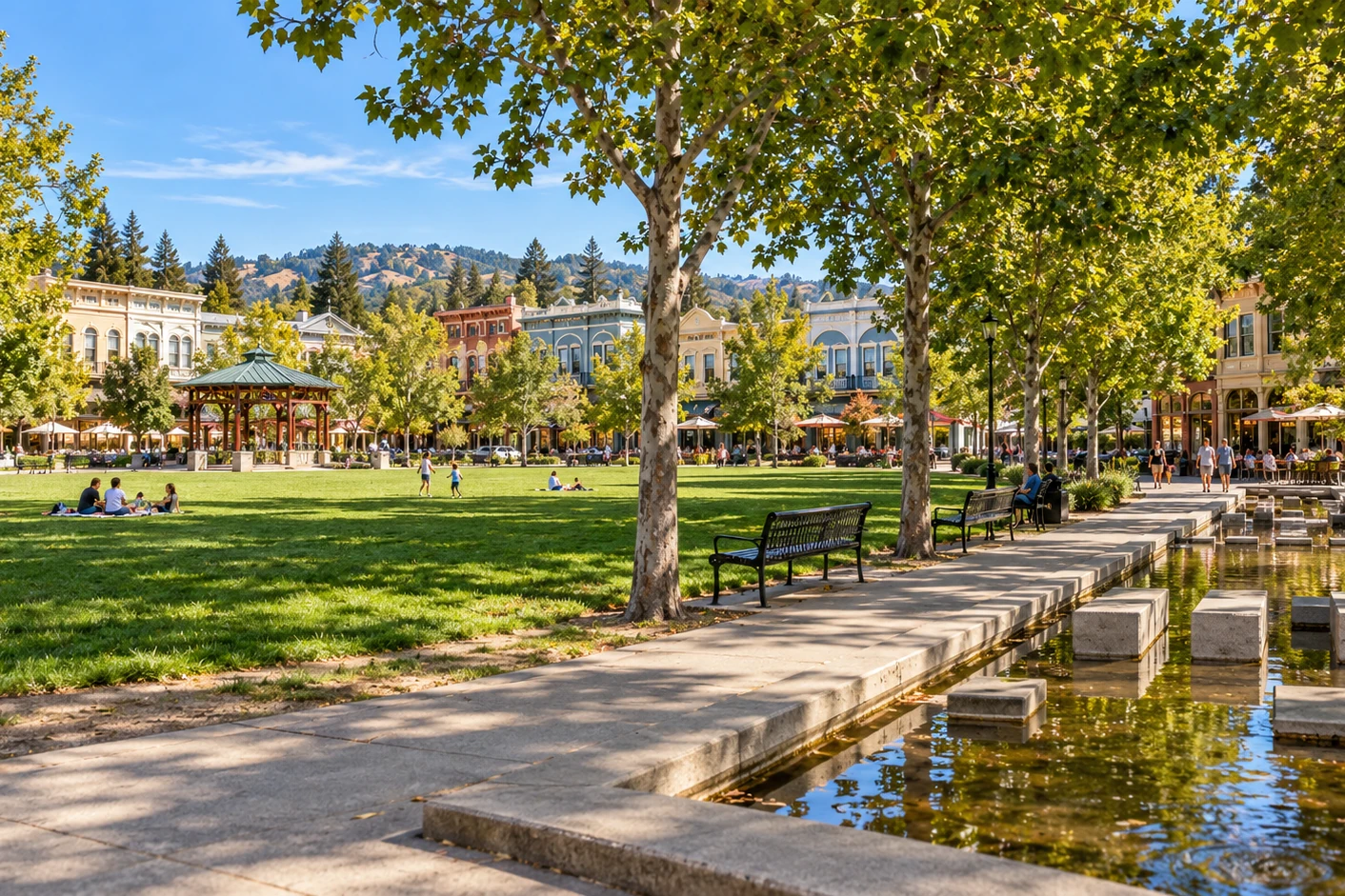
The Town Green is a genuine civic space with a calendar — markets, concerts, and community events through much of the year — and the mixed-use buildings around it have residential above ground-floor retail, with balconies looking directly onto it. Two consequences follow for the elevated structures there. Occupancy is real: a Green-facing balcony during an event holds considerably more people at once than the same balcony on an ordinary evening, which makes guardrail capacity and ledger connection integrity a live question rather than a nominal one, and we assess them against the loading those structures actually see. And scheduling is constrained from two directions at once — the businesses trading below, and the events on the Green itself. Work that would be routine elsewhere needs sequencing around both. We ask about the calendar before quoting a schedule rather than discovering it in week two.
A town built in one generation
Windsor incorporated in 1992 and the overwhelming majority of its housing went up from the 1990s onward, so the building stock is young by the standards of most of our service area. That does not mean there is nothing to find. Original ledger flashing, caulked joints never intended as permanent seals, and first-generation waterproofing membranes all reach end of service life somewhere between twenty and thirty years — and under a wet season as concentrated as this one, at the earlier end of that range rather than the later. Communities built in the late 1990s are squarely in that window now; those from the 2000s are entering it. Boards here routinely assume their buildings are too new to need attention, and the ones that inspect ahead of visible failure end up spreading the work across funding cycles instead of meeting it all at once.
Common building stock we work on
Windsor’s inventory divides cleanly. A modest amount of older stock sits along Windsor Road and the original town, with original porches and connection details predating current standards. The Town Green district is purpose-built mixed-use from the late 1990s and 2000s, with residential above retail and the balcony and walkway considerations set out above. The subdivisions across Vintage Greens, the Esposti Park and Foothill Park areas, and the surrounding neighbourhoods are 1990s through 2010s construction, now at first and second-cycle waterproofing renewal. Apartment and HOA-managed townhome stock throughout forms the SB 721 and SB 326 inventory. Our certified construction crew scopes every project to the era, the exposure, and the code in effect at installation.
Neighborhoods served
Our certified Windsor crew covers the Town Green district, Old Downtown Windsor, Vintage Greens, the Esposti Park area, the Foothill Park area, the Windsor Road corridor, the Old Redwood Highway corridor, the Shiloh Road area, the Arata Lane area, Lakewood Drive, and the wider Town of Windsor. ZIP code 95492 covers the town.
What we typically see
Across our Windsor inspections, our company most often documents: (1) combustible material stored under decks and vegetation grown against posts and skirting, overlooked because it sits outside what owners think of as deck maintenance — a Windsor-specific priority given the local fire exposure; (2) leaf litter and needles packed into board gaps and ledger junctions, holding moisture through the wet season and fuel through the dry one; (3) guardrails on Green-facing balconies assessed historically against nominal loading rather than the occupancy those structures see during events; (4) original flashing and first-generation waterproofing reaching end of life on late-1990s and 2000s stock, earlier than the build date suggests because of the concentrated wet season; (5) railings on the older Windsor Road stock that fall short of the current CRC 42-inch height and 4-inch sphere rule; (6) drainage terminations overwhelmed by the volume this season delivers in a short window. Every finding is captured in a written assessment with prioritized repair, replacement, or restoration scope.
Emergency response & remodeling
For Windsor properties with acute safety issues — sagging framing, loose railings, visible rot at load-bearing connections, red-tagged structures, or storm damage — our emergency repair crew responds within 24–48 hours with temporary shoring and code-compliant stabilization. A compromised railing on a Green-facing balcony is handled as urgent regardless of how it reads on a condition report, for the occupancy reasons set out above. We also handle full balcony and deck remodeling, detailed to shed debris rather than collect it and specified for both halves of the local year.