Climate considerations in American Canyon
American Canyon sits in a gap at the southern end of the valley where marine air moves inland, which gives it cool summers, mild winters, persistent humidity, and wind for much of the year. Annual rainfall is around 20–22 inches, concentrated between November and March, and wind drives it sideways into junctions and seams that would shed vertical rain without difficulty. There is no sustained hot dry stretch to push accumulated moisture back out of a structure, so decay progresses slowly and quietly rather than dramatically. That is the city-wide picture. On the western edge there is a second moisture source that does not follow the seasons at all.
Moisture that never leaves
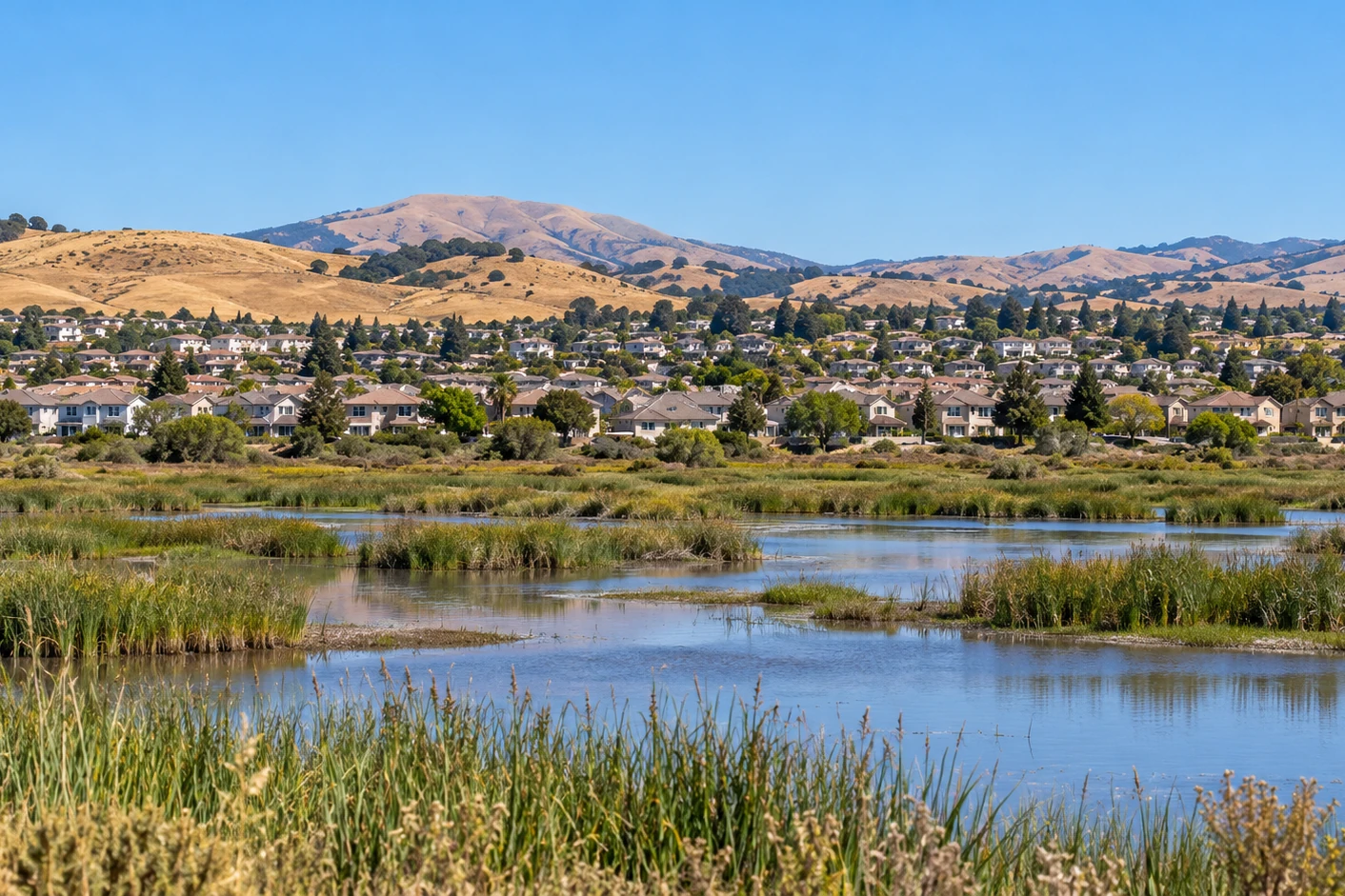
The western edge of American Canyon runs along tidal wetland, and a substantial amount of housing sits directly against it. For a timber structure that is a materially different proposition from a seasonally wet site. Elsewhere in our service area, ground beside a property dries out for several months a year, and that dry stretch limits how far water damage can progress. Here it does not happen — there is standing water beside the property through summer and winter alike, the soil stays damp, and humidity at ground level stays elevated year-round. Two consequences follow. Framing near grade never gets a dry season to recover, so on these lots it stays wet continuously rather than in bursts. And a permanently damp boundary keeps feeding moisture into framing at grade in a way a dry site does not. Neither shows from above: the damage starts at post bases, skirting, stair stringers at their lowest point, and anything in contact with or close to grade, and by the time it is visible on the surface it is usually well established. We probe those locations on wetland-side properties rather than assessing them by eye, because visual inspection on this kind of site is close to meaningless. Anything outside our trade goes to the right licensed specialist; our scope is repairing water-damaged framing and the water source.
Two miles, two environments
The city covers a short distance and crosses a genuine divide. The western neighbourhoods sit on the wetland edge in the conditions described above. The eastern ones rise into dry grassland hills, where the ground does dry out, exposure is sunnier, and the failures look completely different — UV degradation of finishes, surface checking, sealant breakdown, and thermal stress at connections rather than decay from below. Two properties a couple of miles apart in this city need genuinely opposite specifications: on the wetland side the priority is ground-contact detailing, clearance, and material durability, while on the hill side it is coating systems, re-seal intervals, and connection hardware. We have met owners and managers holding property on both sides who were specifying them identically, which means one of the two was always getting the wrong specification. We scope to the property, not to the city.
Living next to protected habitat
Development adjacent to protected wetland habitat generally carries buffer and setback requirements established when the development was approved, often recorded against the properties, and sometimes involving agencies beyond the city. For routine deck repair none of this arises. It becomes relevant on anything that extends a structure’s footprint toward the boundary, on new construction near the rear property line, or on work that would disturb ground in that zone. Whether anything applies to a particular property, where any boundary runs, and what is permitted within it are matters of record and questions for the city and the relevant agencies rather than for a contractor. What we do is raise it before design work starts on a rear-boundary project, because establishing it early costs nothing and discovering it after drawings are complete costs a redesign.
Common building stock we work on
American Canyon incorporated in 1992 and the overwhelming majority of its housing was built from the 1990s onward, so the inventory is young and unusually uniform — there is very little older stock here to work from. The 1990s and 2000s developments across Wetlands Edge, Vintage Ranch, Canyon Estates, and the surrounding neighbourhoods make up the bulk of it and are now at the age where original ledger flashing, caulked joints, and first-generation waterproofing reach end of service life. Newer construction including Watson Ranch is at first-cycle renewal. Apartment and HOA-managed townhome stock along the corridors forms the SB 721 and SB 326 inventory. Because so much went up in a narrow window, what we find on one property is a reasonable basis for what to expect on its contemporaries — which makes a portfolio here more plannable than most. Our certified construction crew scopes every project to the era, the side of town, and the code in effect at installation.
Neighborhoods served
Our certified American Canyon crew covers Wetlands Edge, Vintage Ranch, Canyon Estates, Watson Ranch, East American Canyon, the American Canyon Road corridor, the Donaldson Way area, the Eucalyptus Drive area, the Newell Drive area, the Broadway corridor, and the wider American Canyon community. ZIP code 94503 covers the city.
What we typically see
Across our American Canyon projects, our company most often encounters: (1) water damage well established at post bases, skirting, and stair stringers on wetland-side properties while everything above looks sound — an American Canyon-specific pattern driven by ground beside the property that never dries out, and invisible to visual inspection; (2) portfolios specified identically across both sides of the city when the two halves need opposite specifications; (3) UV degradation, surface checking, and sealant breakdown on the eastern hillside properties showing the reverse pattern; (4) original ledger flashing and first-generation waterproofing reaching end of life across the 1990s and 2000s developments more or less together; (5) railings that fall short of the current CRC 42-inch height and 4-inch sphere rule on the earliest stock. Every finding is captured in a written assessment with prioritized repair, replacement, or restoration scope.
Emergency response & remodeling
For American Canyon properties with acute safety issues — framing that has moved or settled, loose railings, a post base that has given way, visible decay at load-bearing connections, red-tagged structures, or storm damage — our emergency repair crew responds within 24–48 hours with temporary shoring and code-compliant stabilization. On wetland-side properties we check the condition of what remains at grade before rebuilding, because replacing wood into the same conditions with the same detailing simply restarts the clock. We also handle full deck and balcony remodeling, specified for the side of the city the structure actually stands on.