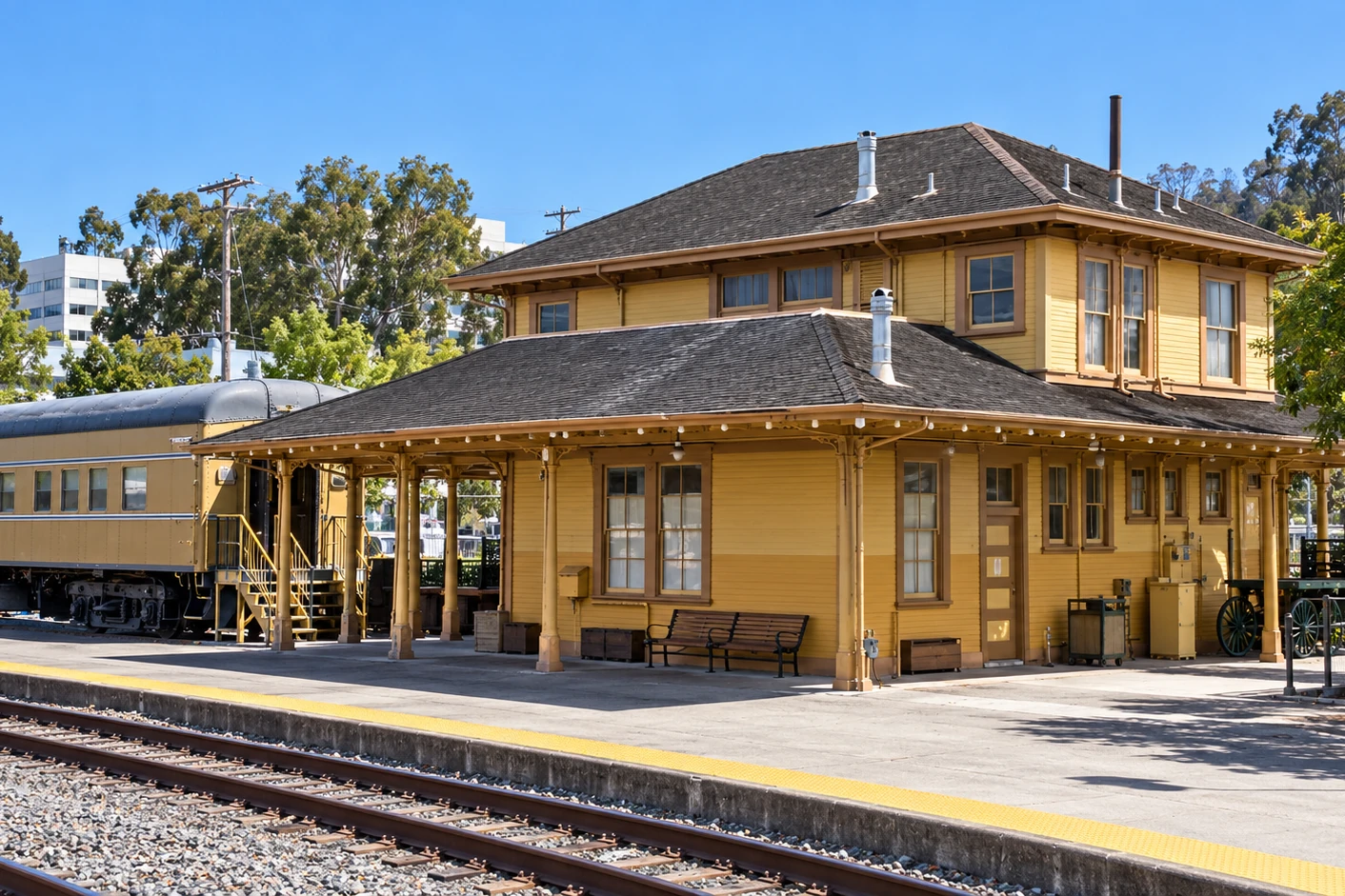
Climate considerations in Millbrae
Millbrae sits on the bay side of the Peninsula with a mild marine climate — cool summers, mild winters, persistent fog and humidity, and roughly 20 inches of rain between November and March. Wind comes through the gap in the hills to the west for much of the year, which drives rain sideways into junctions and seams that would shed vertical rain without difficulty. The city runs from flat bayside ground up into genuinely steep hillside, so exposure and slope both vary within a short distance. What matters most for structures, though, is the absence of a hot dry stretch: moisture that gets into an assembly here is not driven back out, so decay progresses slowly and quietly and is usually further along than it looks.
What envelope work leaves behind
A substantial amount of housing in this part of the Peninsula has had windows and doors replaced over the years under residential noise insulation programmes associated with the airport. The work itself is a sensible thing to have done and this is not a comment on it. The point is narrower and specific to our trade: a sliding door onto a deck or balcony is one of the elements such work replaces, and removing and reinstalling that door disturbs the threshold, the pan flashing beneath it, and the junction where the deck meets the wall. That junction is the single most consequential detail on a balcony. Water that gets past it does not run off the edge — it goes into the framing and into the wall, and it does so out of sight. Where the detail was properly reinstated, nothing follows from any of this. Where it was not, the result is intrusion that presents as a waterproofing failure on the deck surface and is nothing of the kind, so resurfacing the balcony fixes nothing and the owner pays twice. If your property has had door or window replacement, that junction is worth inspecting specifically, and we check it on every Millbrae assessment as a matter of course.
Why preparation matters more than product here
Exterior surfaces close to major transport infrastructure accumulate a film that behaves differently from the mineral dust most of our service area deals with. It is finer, it is slightly oily rather than gritty, and it adheres — rain does not rinse it away and a quick wash does not remove it. As a surface condition that is cosmetic and unremarkable. As a substrate for a coating it is not, because coatings bond to what they are applied to, and a film of this kind between the coating and the deck means the bond is to the film. The usual result is a finish that looks correct on completion and lifts or peels within a couple of years, which owners generally attribute to a poor product. It is almost always preparation. We specify and price surface preparation as its own line on Millbrae work rather than absorbing it into a coating figure, partly because it is real work and partly because an owner is entitled to see on the invoice that it was done.
Bayside to hillside
Millbrae covers a short distance and a lot of elevation, running from flat ground near the bay up into the steep streets of the Highlands. The lower neighbourhoods are conventional flat-lot work with the drainage and ground-contact considerations that implies. The hillside properties are a different proposition: decks on long posts stepping down slopes, lateral bracing and guardrail capacity in play alongside the usual questions, and access that varies from straightforward to awkward depending on the street. Both halves sit in the same climate, so they share the moisture behaviour described above, but they do not share much else. We scope to the lot rather than to the city, and on hillside properties we treat bracing and railing capacity as priority items ahead of anything cosmetic.
Common building stock we work on
Millbrae developed heavily in the post-war decades and that stock still dominates. Single-family housing across Millbrae Highlands, Mills Estate, Green Hills, Capuchino, and Lomita Park dates largely from the 1940s through the 1960s, with decks and balconies added and replaced over the decades and connection details and railing geometry from whichever era each one belongs to. Apartment and small multi-family buildings along the Broadway and El Camino Real corridors form much of the SB 721 inventory, with original waterproofing and hardware well past service life. Newer mid-rise and mixed-use construction near the Station is post-2000 and at first-cycle waterproofing renewal, where a membrane failure reaches occupied space below. Our certified construction crew scopes every project to the era, the slope, and the code in effect at installation.
Neighborhoods served
Our certified Millbrae crew covers Millbrae Highlands, Mills Estate, Green Hills, Capuchino, Lomita Park, the Meadows, the Millbrae Station area, the Broadway district, the El Camino Real corridor, the Murchison Drive area, and the wider Millbrae community. ZIP code 94030 covers the city.
What we typically see
Across our Millbrae inspections, our company most often documents: (1) water intrusion traced to the threshold and pan flashing at a replaced door rather than to the balcony waterproofing, with owners about to pay for a resurfacing that would not have touched it — a Millbrae-specific pattern given how much local envelope work has been done; (2) coatings that lifted within a year or two because the surface film was never properly removed before application; (3) slow concealed decay in a climate that never dries a structure out, well advanced before anything is visible; (4) lateral bracing and guardrail capacity overlooked on hillside decks on long posts; (5) railings on pre-2000 stock that fall short of the current CRC 42-inch height and 4-inch sphere rule; (6) first-cycle waterproofing wear at perimeter terminations on the newer Station-area construction. Every finding is captured in a written assessment with prioritized repair, replacement, or restoration recommendations.
Emergency response & remodeling
For Millbrae properties with acute safety issues — sagging framing, loose railings, visible rot at load-bearing connections, active intrusion into space below a balcony, red-tagged structures, or storm damage — our emergency repair crew responds within 24–48 hours with temporary shoring and code-compliant stabilization. Where intrusion is involved we establish where the water is actually entering before recommending a permanent repair, because the deck surface is the obvious suspect and frequently the wrong one. We also handle full deck and balcony remodeling, with the wall junction detailed properly as part of the work rather than left as the weak point.