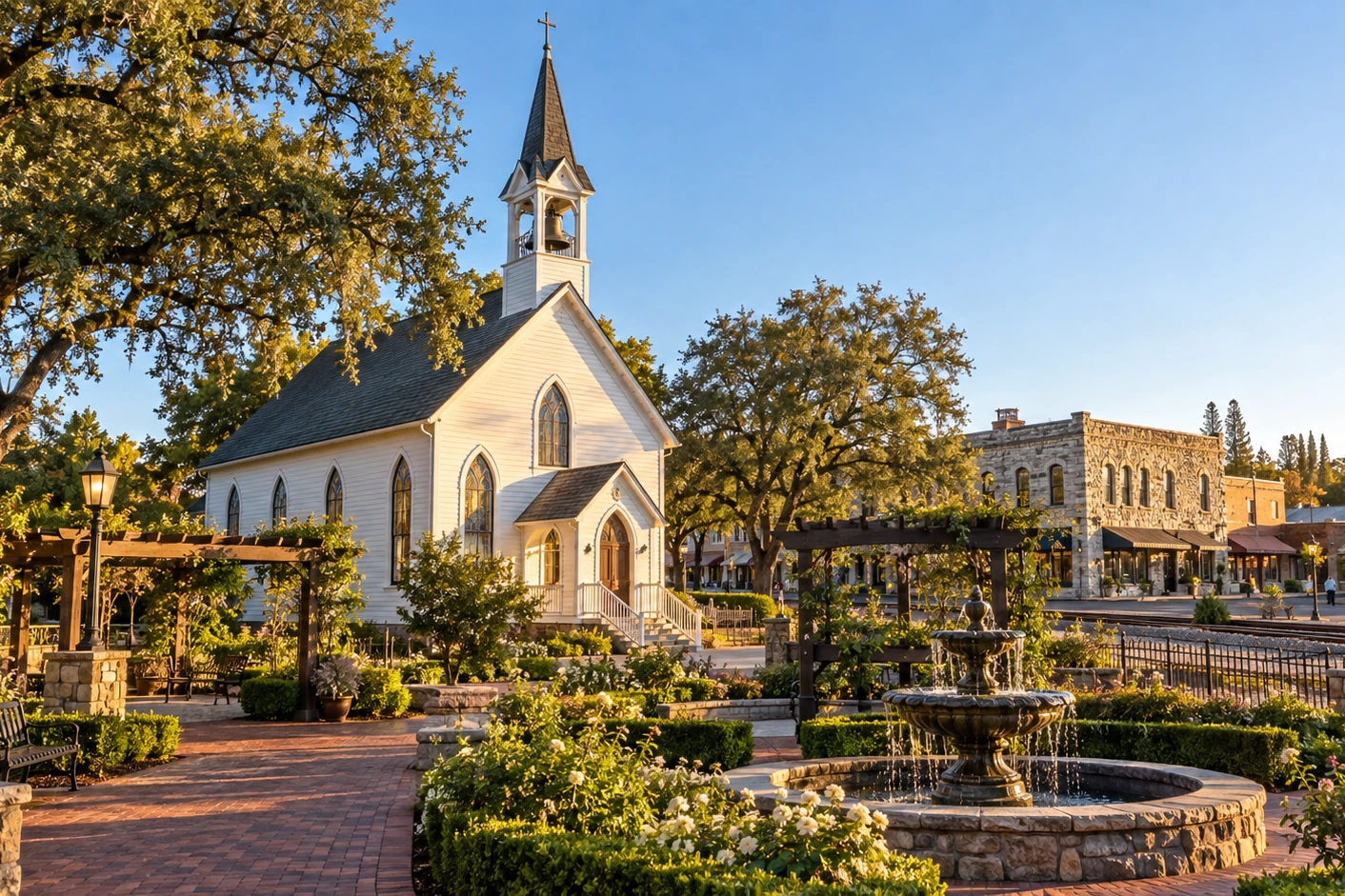
Climate considerations in Rocklin
Rocklin sits where the valley floor begins to rise into the foothills, and that position shows up in the numbers. Summers run hot and dry with afternoon temperatures regularly reaching 95–100°F, driving UV degradation of sealants and finishes, surface checking, and thermal stress at every connection — exposed decks here generally want re-sealing every one to two years. Winters bring 24–26 inches of rain, noticeably more than the flat country to the west, concentrated almost entirely between November and March, with tule fog holding moisture against surfaces in between. The oak woodland that covers much of the city adds shade that slows drying on many lots. What matters most, though, is not how much rain falls but where it goes afterwards, and in Rocklin that is governed by what is under the soil.
Granite: why footings are different here
Rocklin began as a granite quarrying town and sits on the rock that gave it the name. Across much of the city the granite is shallow — sometimes a few feet down, often far less — under a thin mantle of soil. For deck and balcony work this is the single most consequential local fact, and it is routinely discovered at the wrong moment. A standard post footing assumes you can excavate to depth. When the excavation stops at ten inches on solid rock, standard practice is simply unavailable, and the job needs a different approach: drilling and anchoring into the rock, engineered surface-mounted bases, or a redesigned support layout that works with the bedrock rather than against it. All of these are entirely workable. What is not workable is finding out after a price has been agreed. We establish bedrock conditions during the assessment and price the footing approach as its own line item, because a contractor who quotes Rocklin footings at standard excavation rates is either going to come back for a change order or going to lose money, and neither of those is good for the person who hired them.
Water that cannot soak in
The second consequence of the rock is drainage, and it catches people out because the symptom looks like a drainage problem on a lot that appears to drain fine. Granite is effectively impermeable. Rain falling on a Rocklin lot does not percolate down and away — it saturates the shallow soil layer over the rock and then has to leave across the surface. Where grading does not actively move it, it sits in that thin wet layer right where post bases and ground-contact wood are. Owners regrade, see the surface water disappear, and find the posts rotting anyway, because the water is not standing on top any more but the soil below is still holding it. The answer is standoff detailing that keeps wood clear of ground that will be wet all winter regardless, combined with surface drainage that actually conveys water off the site rather than relying on percolation that is never going to happen.
The post-1990 build-out
Rocklin grew enormously from the 1990s onward, adding large master-planned communities including Stanford Ranch, Whitney Ranch, and the surrounding developments, and the city’s population expanded several times over in a generation. That housing is now twenty to thirty-five years old, which is precisely the window where builder-grade construction starts showing its limits: original ledger flashing, caulked joints never intended as long-term seals, and first-generation waterproofing membranes all reach end of service life around now. Because the subdivisions were built quickly and at scale, how the original builder dealt with the rock varies from tract to tract, and so does how those footings have held up. Owners frequently assume a house of this age is too new to have a structural issue, so the failure progresses unseen — water tracks behind failed ledger flashing and rot establishes in the rim joist well before anything shows at the surface. Any Rocklin deck built in that period is worth a proper look now rather than after the damage is visible.
Common building stock we work on
Rocklin’s residential stock spans an unusual range for its size. Nineteenth and early twentieth-century buildings in Historic Old Town and the Quarry District — many built from the local granite itself — carry original wood porches, stairs, and small decks with connection details predating every modern standard. Mid-century and 1970s–1980s housing across the older central neighborhoods needs ledger restoration, post-base rebuild, and railing replacement to current height and geometry requirements. The 1990s–2010s master-planned communities across Stanford Ranch, Whitney Ranch, Springfield, and Clover Valley make up the bulk of the inventory and sit in the builder-grade failure window described above. Apartment and HOA-managed townhome stock along the main corridors forms the SB 721 and SB 326 inventory. Our certified construction crew scopes every project to the era, the ground conditions on that particular lot, and the code in effect at installation.
Neighborhoods served
Our certified Rocklin crew covers Historic Old Town, the Quarry District, Stanford Ranch, Whitney Ranch, Sunset Whitney, Springfield, Clover Valley, Rocklin Heights, Southside, the Pacific Street corridor, the Granite Drive corridor, the Rocklin Road corridor, and the wider Rocklin community. ZIP codes include 95677 and 95765.
What we typically see
Across our Rocklin inspections, our company most often documents: (1) footing and post-base problems on lots where shallow granite made the original installation a compromise — a Rocklin-specific condition that also drives change orders when a repair is quoted without checking the ground first; (2) post-base and ground-contact rot on lots that appear to drain well, because the water is held in the shallow soil over the rock rather than standing visibly; (3) failed builder-grade ledger flashing with established rot behind it on the 1990s–2010s subdivisions; (4) heat-driven surface checking and sealant breakdown from 95–100°F summer stretches, with shaded oak-woodland lots failing from moisture instead; (5) railings on pre-2000 structures that fall short of the current CRC 42-inch height and 4-inch sphere rule; (6) original connection details on Historic Old Town stock that predate modern fastener standards entirely. Every finding is captured in a written assessment with prioritized repair, replacement, or restoration recommendations.
Emergency response & remodeling
For Rocklin properties with acute safety issues — sagging or settling framing, loose railings, visible rot at load-bearing connections, red-tagged decks, or storm damage — our emergency repair crew responds within 24–48 hours with temporary shoring and code-compliant stabilization. We also handle full deck remodeling for property owners modernizing older outdoor spaces while bringing the structure up to current safety code, with footings and drainage detailed for the ground the deck actually stands on.