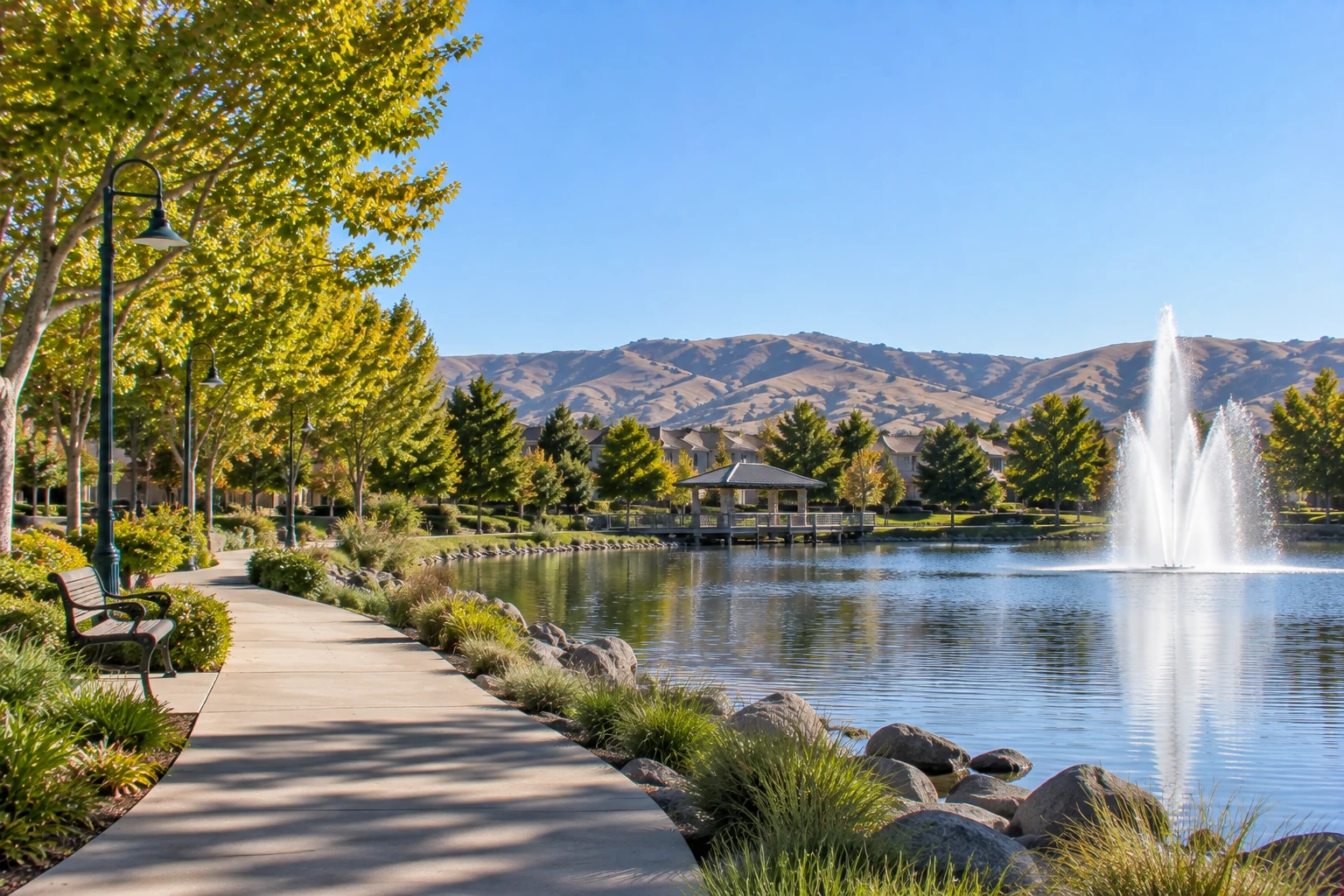
Climate considerations in Union City
Union City has a mild bay-moderated climate — summer afternoons that rarely push far into the eighties, cool winters, persistent marine layer and morning fog, and roughly 15–17 inches of annual rainfall concentrated November through March. Temperature extremes are not the problem here. The problem is that mild, humid conditions never give framing a sustained hot dry stretch, so moisture that gets into an assembly stays there and decay progresses slowly and quietly rather than announcing itself. Wind-driven winter rain forces water into flashing seams and fastener penetrations, and the western flats hold that moisture longer than the eastern slopes because the ground underneath drains poorly. Probing inspection rather than visual-only review is the right standard for older Union City stock.
Reclaimed bay margin & saline ground
The western third of Union City sits on reclaimed bay margin — former tidal marsh and salt-flat land brought into use over the last century. That history left two conditions behind that matter more here than almost anywhere else we work. The first is a shallow water table with poorly draining bay-margin soils, so ground around footings stays saturated through the wet season. The second, and the one most contractors miss, is soil salinity. Residual salts in reclaimed salt-flat ground make the soil itself chemically aggressive toward metal, and standard galvanized hardware in ground contact corrodes from soil exposure rather than from air. The distinction matters because the damage runs the opposite direction from what people expect: post bases, anchor bolts, and footing hardware degrade from below while the decking, railings, and framing above them still look perfectly sound. We have seen properties where the same post base was replaced two and three times because the specification was never corrected. Our certified firm specifies hardware rated for saline ground contact on western Union City work and uses standoff detailing that lifts wood and hardware clear of wet soil.
Alvarado and Decoto: two historic townsites
Union City is younger than the places it is made of. The city incorporated in 1959 by merging two separate 19th-century townsites — Alvarado, a bayside settlement that became an early industrial center and gave the Sugar Mill Landing area its name, and Decoto, a railroad town that grew up around the tracks. Both predate the city by roughly a century, and both retain pockets of pre-1900 and early-1900s building stock with original wood-framed porches, balconies, stairways, and decorative railing work. These structures predate modern fastener standards, guardrail geometry requirements, and connection hardware entirely, and the two districts do not even share construction traditions — they grew up around different industries with different builders. Repair work in Alvarado and Decoto has to bring structures to current California Building Code for load capacity and railing geometry while preserving the detailing that gives the districts their character. Our licensed construction firm scopes historic-district work to hold both requirements at once.
The Station District & podium construction
The Station District is Union City’s transit-oriented core, developed through the 2000s and 2010s as compact mixed-use and multi-family housing — much of it built as podium construction, with residential levels and their decks and courtyards sitting over structured parking or ground-floor commercial space. Podium assemblies change the stakes of a waterproofing failure completely. On a conventional balcony, a leak damages the balcony. On a podium deck, water that gets past the membrane enters occupied or operational space below, and the repair involves coordinating access, protecting what is underneath, and often working around vehicles or tenants. Most Station District stock is now reaching first-cycle waterproofing renewal, which is the right moment to address transition details — perimeter terminations, drain assemblies, and planter edges — before intrusion starts. Those transitions, not the field membrane, are where podium decks almost always fail.
Common building stock we work on
Union City’s residential stock spans well over a century. Pre-1900 and early-1900s homes and small buildings in the Alvarado and Decoto districts need porch and balcony framing restoration, period-appropriate railing replacement to current height and geometry standards, and connection hardware that did not exist when they were built. 1960s–1980s apartment communities along Alvarado Boulevard, Whipple Road, and the central corridors form the bulk of the SB 721-eligible inventory — aging connectors, undersized connections, waterproofing decades past service life, and on the western flats, corroded at-grade hardware. 1980s–2000s HOA-managed townhome and condominium developments across Dry Creek, Cabello, and the eastern neighborhoods fall under SB 326. Station District podium construction is post-2000 and at first-cycle renewal. Hillside homes on the eastern side carry conventional custom decks on better-draining ground. Our certified construction crew scopes every project to the era, original materials, ground conditions, and code in effect at installation.
Neighborhoods served
Our certified Union City crew covers Old Alvarado, Decoto, the Station District, Union Landing, Dry Creek, Mission Hills, Sugar Mill Landing, Cabello, Del Rey, the Alvarado Boulevard corridor, the Whipple Road corridor, the Dyer Street area, and the eastern hillside neighborhoods. ZIP code 94587 covers the city.
What we typically see
Across our Union City inspections, our company most often documents: (1) corroded post bases, anchor bolts, and at-grade hardware on western-side properties, degrading from soil contact while everything above looks sound — a Union City-specific concern from reclaimed salt-flat ground; (2) repeat replacement of the same hardware because the corrosion rating was never corrected to match the ground conditions; (3) slow concealed dry rot in framing that never gets a sustained dry stretch under the marine layer; (4) original pre-1900 porch and balcony framing in the historic districts with connection details that predate every modern standard; (5) railings on historic and pre-2000 structures that fall short of the current CRC 42-inch height and 4-inch sphere rule; (6) transition-detail failures on Station District podium decks, typically at perimeter terminations and drain assemblies rather than in the field membrane. Every finding is captured in a written assessment with prioritized repair, replacement, or restoration recommendations.
Emergency response & remodeling
For Union City buildings with acute safety issues — sagging framing, loose railings, visible rot or corrosion at load-bearing connections, active intrusion into space below a podium deck, red-tagged structures, or storm-driven damage — our emergency repair crew responds within 24–48 hours with temporary shoring and code-compliant stabilization. We also handle full balcony, deck, and porch remodeling for property owners modernizing the function of older outdoor spaces while bringing the structure up to current safety code with correctly rated hardware for the site.