Climate considerations in Carmichael
Carmichael has an inland Mediterranean climate: hot dry summers with afternoon temperatures regularly reaching 95–105°F, and cool wet winters delivering roughly 20–23 inches of rain concentrated between November and March. On exposed decks that heat drives UV degradation, surface checking, and sealant breakdown within two to three years without maintenance. But much of Carmichael is not exposed — the community’s heavy native oak canopy shades a large share of its decks, and shaded framing behaves differently. It never gets the sustained hot dry stretch that drives accumulated moisture back out of wood, so it stays damp longer after each storm cycle and decay establishes more readily. Winter tule fog extends that damp period further. The practical result is two different maintenance profiles on the same property: sun-exposed sections failing from above, shaded sections failing from within.
Carmichael Colony: large lots & staged construction
Carmichael was subdivided in 1909 as orchard tracts, and the parcel pattern that created still defines much of the community — half-acre and larger lots are common, particularly in Carmichael Colony, Del Dayo, and the older river-side neighborhoods. Large lots produce large decks, and large decks here were rarely built all at once. The typical Carmichael deck we assess has been extended two or three times across decades: an original 1960s structure with a 1980s addition and a 2000s expansion, each built to the standards and often the skill level of its own era, joined at connections that were never designed as structural transitions. Load paths get ambiguous, older sections carry demand they were not sized for, and permit history is frequently incomplete. Our certified firm assesses what is actually carrying load before scoping anything, and documents a clear path to current code rather than patching around the problem.
Native oak protection & county requirements
Carmichael’s mature valley oaks and other native oak species are a defining feature of the community — and they are protected. Sacramento County maintains tree preservation requirements covering native oaks above a specified trunk size in unincorporated areas, and work that disturbs the root zone, excavates within the drip line, or stages heavy equipment near a protected tree can require review and an arborist assessment before it starts. Because Carmichael’s decks so often sit directly among mature oaks, this comes up on a large share of projects. Setting new footings in a root zone is the usual flashpoint: it is both a compliance issue and a reliable way to damage a tree that took a century to grow. Our licensed construction firm designs around root zones where possible, uses protective fencing during work, and coordinates arborist review where the scope requires it.
The American River bend: water table & flood hazard
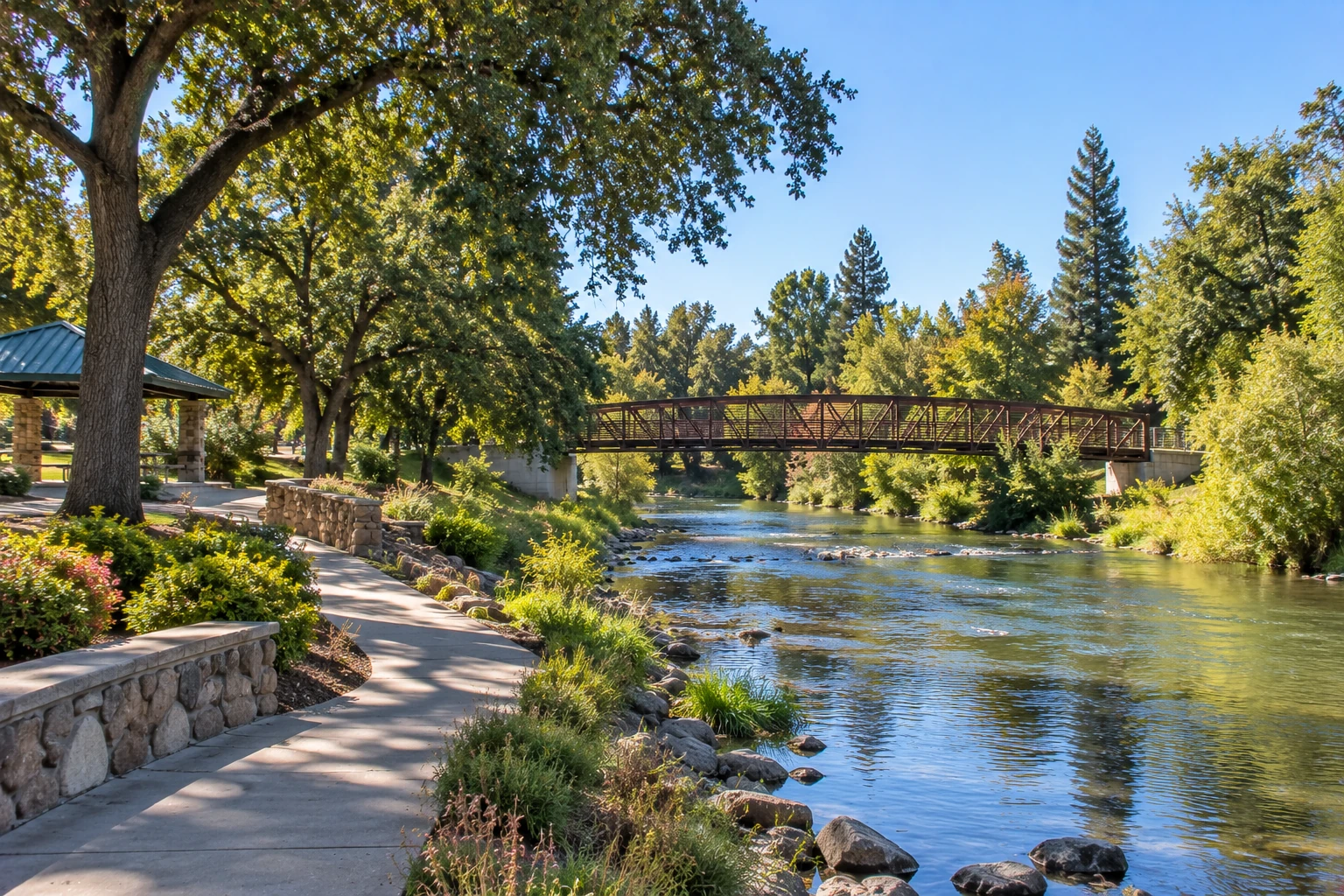
The American River curves through Carmichael, giving the community extensive river frontage and a series of lower terraces stepping down toward the channel. Properties on those lower terraces sit closer to the water table than the rest of the community, and some fall within mapped flood hazard areas — which affects both structural detailing and what county review a project requires. For elevated structures, the practical consequences show up at ground contact: post bases wick moisture from saturated soil, footings sit in ground that never fully drains through the wet season, and repeated rot at the same post base is the classic symptom of a site problem being treated as a materials problem. Repairs here need proper standoff detailing that keeps wood clear of wet ground, footings designed for the actual soil conditions, and drainage that moves water away from the structure. We check the water-table and drainage picture on every river-adjacent Carmichael assessment before specifying a repair.
Common building stock we work on
Carmichael’s stock is predominantly single-family, with a meaningful multi-family component along the main corridors. Post-war and 1950s–1970s ranch homes across Carmichael Colony, Jan Park, Deterding, and Mission Oaks typically carry large custom decks built and extended over decades, needing ledger restoration, post-base rebuild, railing replacement to current height and geometry standards, and resolution of staged-construction load paths. Larger custom and estate properties in Del Dayo and the river-side neighborhoods feature multi-level decks, long spans, and structures built around mature trees. Apartment communities along the Manzanita Avenue, Marconi Avenue, and Winding Way corridors form the SB 721-eligible inventory, most with aging connectors and waterproofing past service life. 1990s–2000s HOA-managed townhome developments fall under SB 326. Our certified construction crew scopes every project to the era, original materials, site conditions, and code in effect at installation.
Neighborhoods served
Our certified Carmichael crew covers the Old Carmichael business district, Carmichael Colony, Del Dayo, Jan Park, Deterding, Mission Oaks, the Manzanita Avenue corridor, the Marconi Avenue corridor, Winding Way, Garfield Avenue, Kenneth Avenue, the American River bend neighborhoods, and the wider Carmichael community. ZIP codes include 95608 and 95609.
What we typically see
Across our Carmichael inspections, our company most often documents: (1) ambiguous load paths and undersized original framing where decks were extended in stages across decades — a Carmichael-specific concern from the large-lot parcel pattern; (2) concealed dry rot in oak-shaded framing that never gets a sustained dry stretch; (3) footings or structures encroaching on protected oak root zones, sometimes from prior repair work done without review; (4) repeated post-base rot on lower river terraces where a high water table is the actual cause; (5) railings on pre-2000 structures that fall short of the current CRC 42-inch height and 4-inch sphere rule; (6) heat-driven surface checking and sealant breakdown on the sun-exposed portions of decks whose shaded sections are failing from moisture instead. Every finding is captured in a written assessment with prioritized repair, replacement, or restoration recommendations.
Emergency response & remodeling
For Carmichael properties with acute safety issues — sagging framing, loose railings, visible rot at load-bearing connections, red-tagged decks, or storm-driven damage — our emergency repair crew responds within 24–48 hours with temporary shoring and code-compliant stabilization. We also handle full deck remodeling for property owners consolidating decades of staged additions into a single coherent structure, modernizing the look and function of older outdoor spaces while bringing everything up to current safety code.