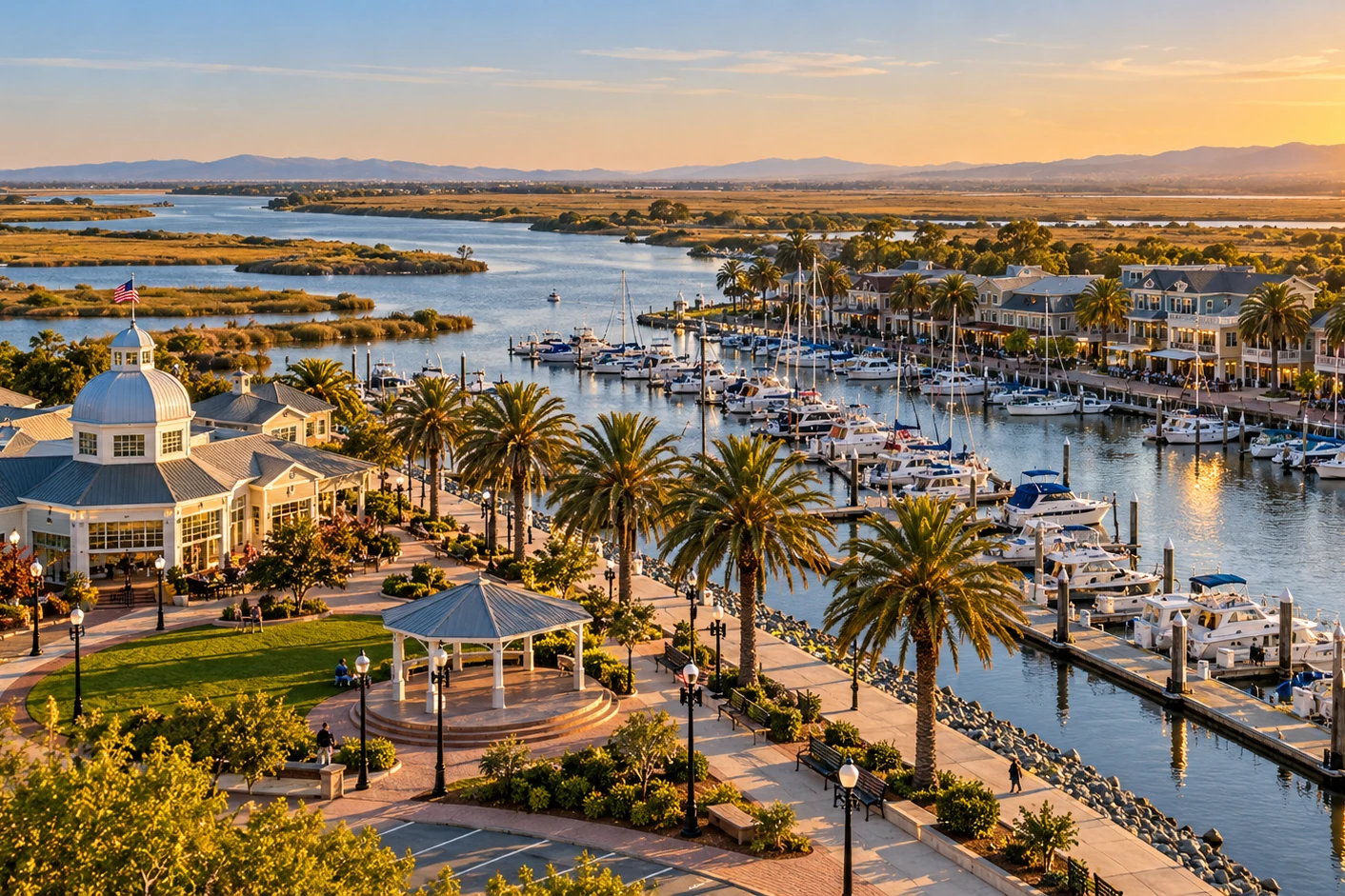
Climate considerations in Suisun City
Suisun City sits low and flat at the edge of the marsh, with warm dry summers that reach the low nineties, cool wet winters delivering roughly 18–20 inches of rain concentrated between November and March, and afternoon wind coming through for much of the year. Humidity stays elevated year-round because of the marsh, so even away from the water there is no long dry stretch to push accumulated moisture out of framing, and decay progresses quietly rather than obviously. Those are the conditions across the city generally. Within a few dozen feet of the slough they are replaced by something considerably more demanding.
The waterline moves twice a day
Suisun Slough is tidal, and that single fact separates waterfront work here from almost everything else we do. On a structure near the water there is a band — typically a few feet of height — that gets wetted and dried as the tide rises and falls, roughly seven hundred times a year. Cyclic wetting and drying is substantially more aggressive than either constant immersion or constant dryness, for timber and for metal alike: wood swells and shrinks continuously, coatings are worked loose, and the repeated evaporation leaves brackish salts concentrated right at the upper limit of the wetting. Metal connectors in that band corrode on a schedule that bears no relation to the same hardware a few feet higher on the same structure. The practical consequences are worth stating plainly. That band is a separate inspection zone and we handle it as one. Hardware there needs specifying for cycling in brackish water rather than for general coastal exposure, which is a different and more demanding duty than most people assume. And findings in that band belong on their own line in a report, because they carry a different replacement interval from everything above them.
Marsh-edge ground
The city sits on the edge of the marsh, and ground conditions reflect that. Soils here can include soft, highly compressible and in places organic material, which behaves quite differently from the mineral soils found further inland — lower bearing capacity, more settlement under load, and in some conditions continued movement long after construction. How much of this applies at any given property varies considerably across the city, which is exactly why we check at the post locations rather than assuming from the address. The ground is also low and nearly flat, so there is very little fall available for surface drainage. Water does not run away from a Suisun City lot so much as sit on it until it soaks in or evaporates, which puts the emphasis on standoff detailing that keeps wood clear of ground that will be damp for months rather than on grading that the terrain cannot really deliver.
Old Town: the oldest stock we work on
Suisun City was incorporated in the 1860s, which makes Old Town among the oldest building stock anywhere in our service area. The commercial and residential buildings there include nineteenth-century construction with original porches, stairs, and connection details that predate not just current standards but most of the intermediate ones as well. Repair work on this stock means bringing load capacity and railing geometry to current code while preserving what gives the buildings their character, and it means expecting connection methods that have no modern equivalent rather than assuming anything about what is behind the finish. The waterfront redevelopment of the 1990s and 2000s added a newer layer immediately alongside it, so Old Town and the Waterfront district sit adjacent with well over a century between their construction dates.
Common building stock we work on
Suisun City’s inventory spans an unusually wide range for a city of its size. Nineteenth-century stock in Old Town carries original porches, stairs, and balconies as described above. The Waterfront and Marina districts are largely 1990s and 2000s construction, including mixed-use buildings with residential above ground-floor commercial, now at first and second-cycle waterproofing renewal and carrying the tidal exposure considerations set out above. Residential development across Lawler Ranch, Victorian Harbor, and Heritage Park dates mostly from the 1980s through the 2000s. Apartment and HOA-managed townhome stock along the main corridors forms the SB 721 and SB 326 inventory. Our certified construction crew scopes every project to the era, the exposure band it sits in, and the code in effect at installation.
Neighborhoods served
Our certified Suisun City crew covers Old Town Suisun, the Waterfront District, the Marina District, Victorian Harbor, Lawler Ranch, Heritage Park, the Main Street corridor, Railroad Avenue, the Sunset Avenue corridor, the Walters Road corridor, and the wider Suisun City community. ZIP code 94585 covers the city.
What we typically see
Across our Suisun City inspections, our company most often documents: (1) deterioration concentrated in a narrow band near the waterline while the structure above it remains sound — a Suisun City-specific pattern from twice-daily tidal cycling, and one that gets misread as general failure; (2) replacement hardware specified for coastal exposure generally rather than for brackish wet-dry cycling, failing years earlier than expected; (3) post-base and ground-contact deterioration on low, flat lots where there is too little fall for drainage to carry water away; (4) footing settlement on soft marsh-edge ground where conditions were not established before construction; (5) nineteenth-century connection details in Old Town with no modern equivalent; (6) first and second-cycle waterproofing wear on the 1990s and 2000s waterfront stock. Every finding is captured in a written assessment with prioritized repair, replacement, or restoration scope.
Emergency response & remodeling
For Suisun City properties with acute safety issues — sagging framing, loose railings, visible rot or corrosion at load-bearing connections, a waterfront stairway showing deterioration at the tidal band, red-tagged structures, or storm damage — our emergency repair crew responds within 24–48 hours with temporary shoring and code-compliant stabilization. Note on scope: docks, floats, gangways, and bulkheads are a separate marine trade, and our work is the decks, balconies, stairs, and elevated walkways attached to buildings. We will tell you which you are dealing with rather than quoting work that belongs to somebody else. We also handle full deck and balcony remodeling, with materials matched to the exposure band each element actually occupies.