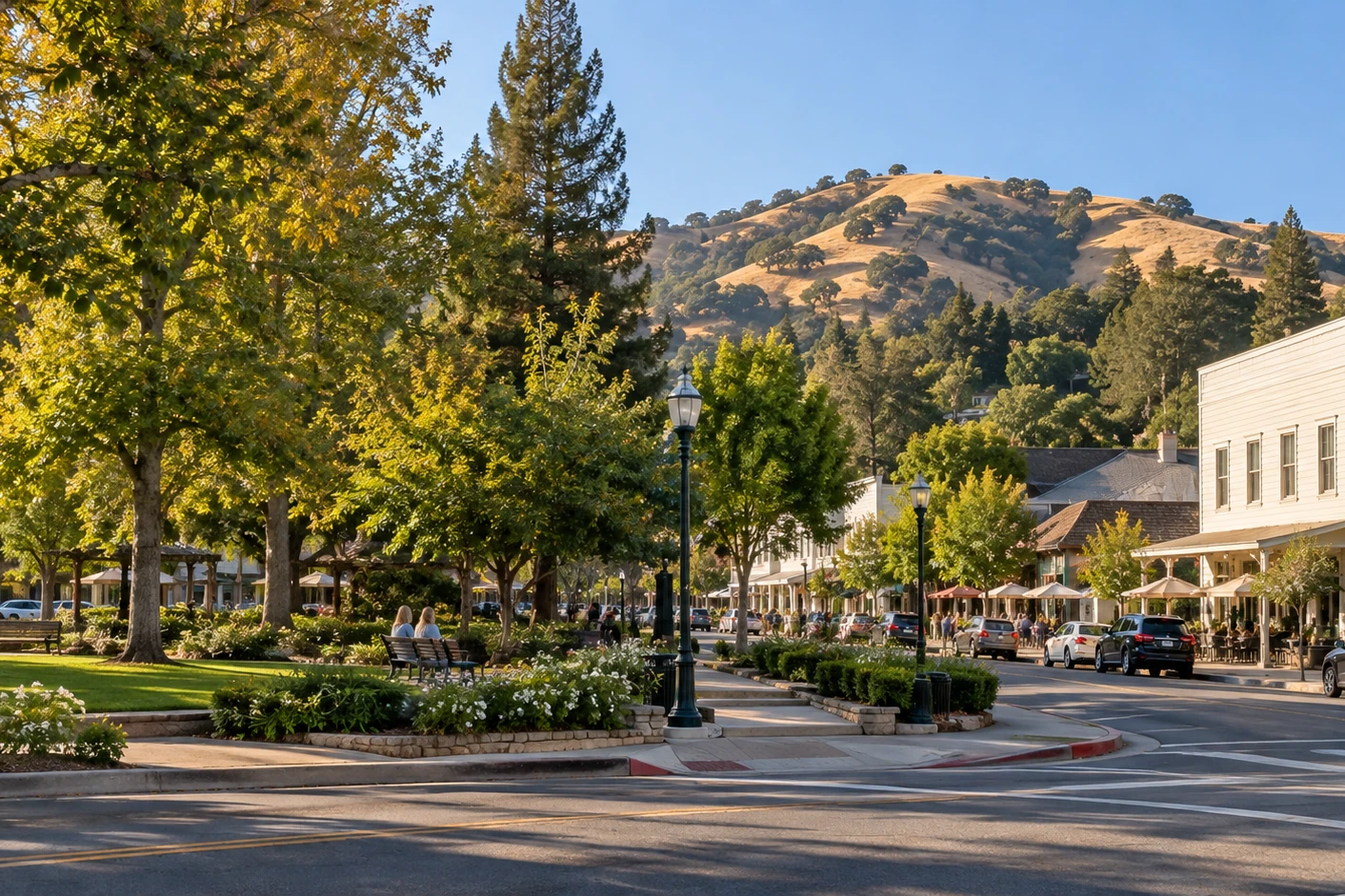
Climate considerations in Lafayette
Lafayette sits in a valley between ridges, far enough inland that summer afternoons run through the nineties and occasionally higher, with cool wet winters delivering roughly 22–25 inches of rain concentrated between November and March. Heavy oak canopy covers much of the residential area, and it produces the same split we see wherever mature trees shade structures: sun-exposed sections failing from above through UV and sealant breakdown, shaded sections failing from within because they never get the drying that would shed accumulated moisture. Debris collects in board gaps and at ledger junctions year-round. These are familiar conditions and familiar remedies. The parts of a Lafayette job that are genuinely different are the ones below.
Getting there is part of the job
A great many Lafayette properties sit on narrow hillside roads that were never widened — no shoulder, no turnaround, occasionally barely room for two vehicles to pass — reached by driveways that are steep, tight, or both. For routine maintenance that is irrelevant. For a deck rebuild it is central, because a rebuild means getting a meaningful quantity of material onto the property and a meaningful quantity of debris off it. Where a delivery truck cannot park, turn, or climb, material has to be broken down and shuttled in smaller loads, or set down at the road and carried, or in some cases lifted. Demolition leaves the same way, which is the half people forget. None of this is unusual to deal with and all of it costs time. The problem is not the difficulty, it is the discovery: a price quoted without looking at the approach is a price that will change, and the change always lands on the owner. We assess the route on the site visit and quote handling as its own line — which also means that where a property has perfectly good access, as many here do, it is not carrying a cost it does not need.
Decks below the road
Lafayette’s hillside houses are frequently built downward from the street, so the front door is at the top and the living space and its decks step down the slope from there. Three consequences follow. The structure is often tall — long support posts carrying a deck well above the ground below it — which puts lateral stability and bracing in play alongside the usual vertical questions. The drop beneath a guardrail can be substantial, which makes railing capacity and connection integrity the highest-consequence items on any findings list rather than something to schedule after the surface work. And the deck is invisible from the street, so unlike a front porch it is seen by nobody except the people using it — which means deterioration here goes unremarked for longer, and a condition that would have been noticed early on a visible structure is often well advanced by the time anyone calls. We treat railings and connections on these structures as the priority regardless of what the owner called about.
Water on a steep lot with nowhere to send it
Lafayette’s residential areas are substantially semi-rural by design, which among other things means limited curb, gutter, and storm drainage outside the downtown. On flat ground that is manageable. On a slope it is not, because water does not sit — it runs, and it takes material with it. A deck collects several hundred square feet of rainfall, and a structure that sheds over its downhill edge delivers all of that in a concentrated line onto the slope below, every wet season. What that produces is soil loss beneath and behind the structure, scour at footings, and over time a hollow where the ground used to support something. Owners usually notice it as a bare patch or an exposed footing rather than as a drainage problem. Collection at the deck edge and a deliberate route to somewhere the water can actually leave is cheap relative to rebuilding a footing, and it is the thing most previous repairs here never addressed.
Common building stock we work on
Lafayette’s residential stock is predominantly single-family on generous lots, much of it from the 1950s through the 1980s with substantial custom and remodelled work layered on since. Hillside homes across Happy Valley, Upper Happy Valley, Reliez Valley, Burton Valley, Springhill, and Glenside carry the multi-level, long-post structures described above, with ledger details and railing geometry frequently predating current requirements. Older stock near the centre and the Trail neighborhood includes smaller pre-war and post-war homes with original porches. The downtown corridor holds mixed-use buildings with residential above ground-floor commercial, and apartment and HOA-managed townhome stock near the centre forms the SB 721 and SB 326 inventory. Our certified construction crew scopes every project to the era, the slope, the access, and the code in effect at installation.
Neighborhoods served
Our certified Lafayette crew covers Downtown Lafayette, Happy Valley, Upper Happy Valley, Reliez Valley, Burton Valley, Springhill, Glenside, the Trail neighborhood, the Lafayette Reservoir area, the Deer Hill Road area, the Oak Hill Road area, and the wider Lafayette community. ZIP code 94549 covers the city.
What we typically see
Across our Lafayette inspections, our company most often documents: (1) jobs previously quoted without anyone assessing the access route, where the price changed once work started — a Lafayette-specific problem created by the road network rather than by the structures; (2) railings and connections on tall below-road decks assessed at routine priority despite a significant drop beneath them; (3) soil loss and scour below and behind structures that have been shedding runoff onto a slope for years; (4) deterioration further advanced than expected because the structure is invisible from the street and nobody sees it; (5) concealed decay in oak-shaded sections alongside UV and sealant failure on exposed sections of the same deck; (6) railings on pre-2000 structures that fall short of the current CRC 42-inch height and 4-inch sphere rule. Every finding is captured in a written assessment with prioritized repair, replacement, or restoration recommendations.
Emergency response & remodeling
For Lafayette properties with acute safety issues — a railing that moves on a structure with a drop beneath it, sagging or settling framing, visible rot at load-bearing connections, soil loss at a footing, red-tagged structures, or storm damage — our emergency repair crew responds within 24–48 hours with temporary shoring and code-compliant stabilization. Tell us about the approach when you call and we will bring what the site can actually take. We also handle full deck remodeling for owners replacing older hillside structures, with bracing, railings, and drainage designed for the slope rather than adapted to it afterwards.