Climate considerations in Dublin
Dublin sits in the same Tri-Valley air as Pleasanton to the south and San Ramon to the north: hot dry summers, mild wet winters, and rainfall that normals under fifteen inches six miles east at Livermore. Nothing about the weather here is unusual, and we won't pretend otherwise. What's unusual is how it lands. Dublin fits 72,589 people into 15.23 square miles – tighter than anywhere else in the Tri-Valley – and it got there by building up rather than out. Ordinary weather does something different to a four-storey wood-frame building over a concrete podium than it does to a detached tract. More elevations, each with its own sun and wind exposure. Balconies stacked four high on the same wall, drying at completely different rates depending on which floor they're on and what's above them. The top floor bakes, the bottom floor never dries, and the assembly in between fails in the middle where nobody is looking. Average weather. Non-average geometry.
Common building stock we work on
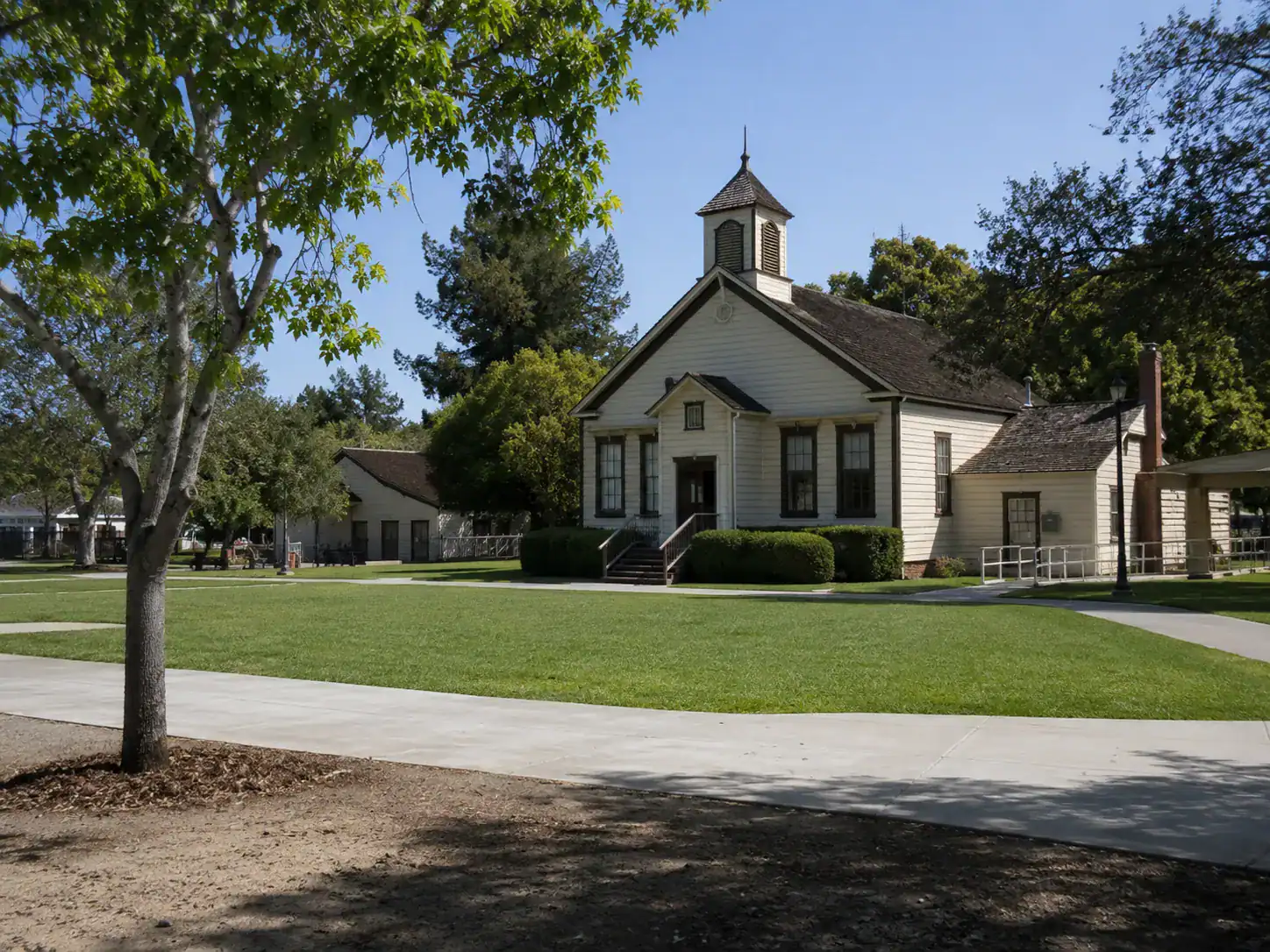
Dublin is the fastest-growing city in this region and it isn't close. It incorporated on February 1, 1982 with roughly 14,350 residents; the state now counts 74,769, and the city's own build-out projection is 89,595 by 2040. West Dublin is the old part, and "old" here means 1960 – the first tracts went in that year, and the genuine history is a handful of buildings at Dublin Boulevard and Donlon Way where the Murray Schoolhouse has stood since 1856 and Green's Store since 1860. Everything else is east, and everything east is master-planned: Dublin Ranch and the Tassajara corridor, then the transit-oriented stacking around the two BART stations, where the pattern is retail on the ground floor and apartments above it. That last type is why this page exists. Wood-frame over a podium, four and five storeys, dozens to hundreds of balconies built in a single year by a single builder off a single detail – the exact configuration the state wrote SB 721 Inspection around. When a detail fails in Dublin it does not fail once.
Neighborhoods served
West Dublin, Downtown Dublin, Dublin Boulevard, Donlon Way, Dublin Ranch, Tassajara, Fallon, Emerald Glen, Transit Center, Hacienda Crossings, Persimmon Place, Grafton Station, Tralee, Waterford, and Camp Parks. One ZIP code covers the entire city: 94568.
What we typically see
In Dublin we most often address: (1) one detail, repeated – the threshold, scupper or ledger flashing that the builder used on every unit of a floor plan, which means the finding on unit 204 is a forecast for units 304, 404 and every other stack on that elevation; (2) the vertical gradient on stacked balconies, where the top unit's membrane is UV-cooked and the ground unit's never fully dries, and the failure starts on the floor nobody complains from – which is the argument for Annual Maintenance Plans on a building like this, since the top and bottom of the same stack want different recoat intervals; (3) guards at scale – a single elevation can carry sixty identical guards, which makes Railing Repair & Replacement an elevation-level job rather than a unit-level one and prices very differently when it's scoped that way; (4) the West Dublin exception – 1960s tract stock with none of the above, where the standard Dublin scope simply doesn't apply and we price it as its own building.