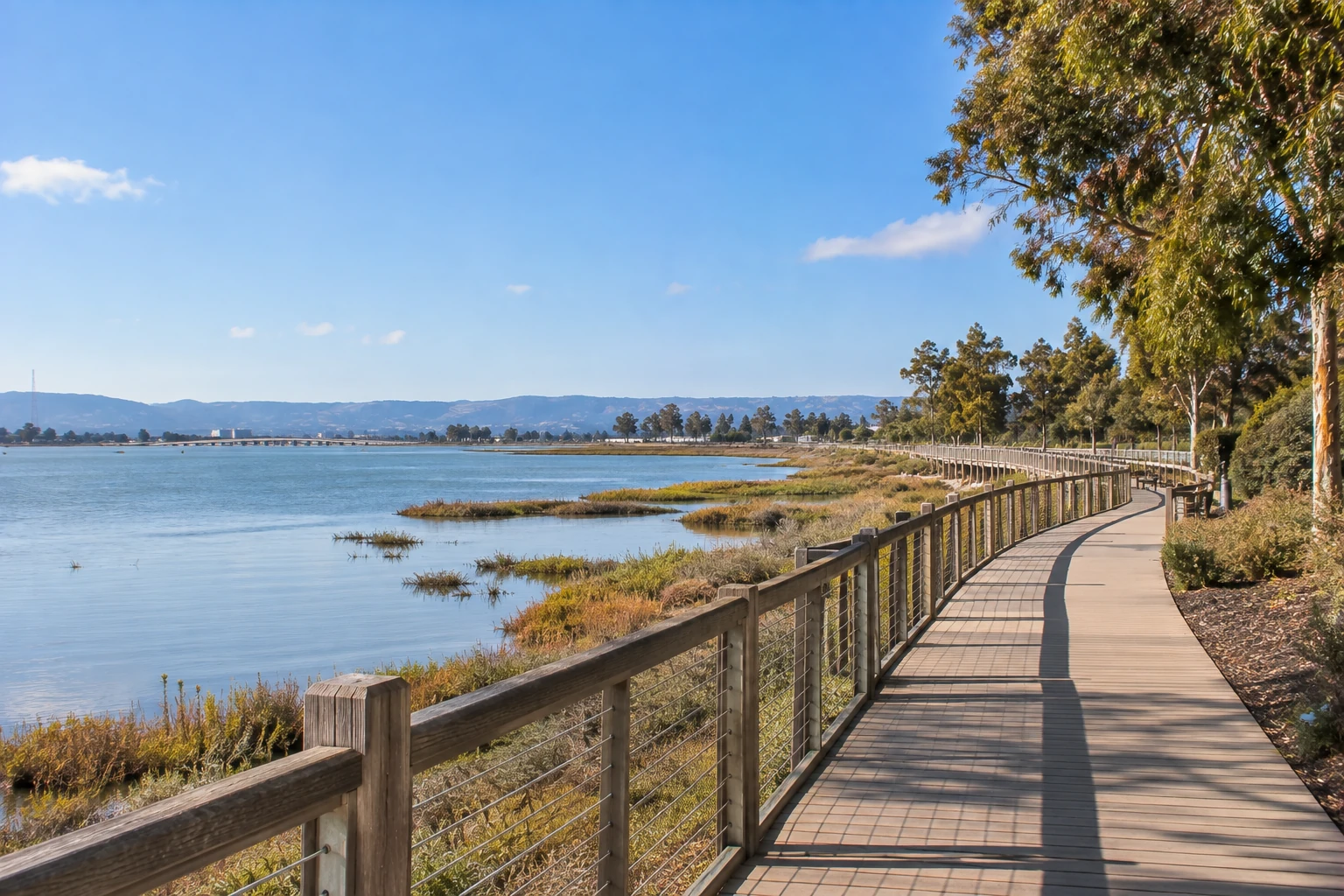
Climate & ground conditions in East Palo Alto
East Palo Alto has a mild bay-moderated climate with cool summers, mild winters, persistent marine influence, and relatively low annual rainfall — roughly 13–15 inches, concentrated November through March. Mild does not mean easy. Humidity stays up year-round and there is no sustained hot dry stretch to push accumulated moisture back out of framing, so decay progresses slowly and quietly under surfaces that still look sound. The city sits low on the bayfront on former marshland, with a water table close to the surface and soils that hold moisture, which puts sustained pressure on post bases, footings, and any wood set near grade. San Francisquito Creek runs along the city’s edge. For elevated structures the practical consequence is that probing inspection rather than visual-only review is the right standard, and that ground-contact detailing matters more here than the rainfall figures suggest.
Compliance in a rent-stabilized market
East Palo Alto is a majority-renter city operating under a rent stabilization ordinance administered by the City’s Rent Stabilization Board. That creates a situation owners in most markets never face: SB 721 obliges the inspection and the resulting repairs on a fixed cycle, while a separate framework governs how capital costs are treated. The two things do not coordinate themselves. We are contractors, not advisors on rent regulation — what is recoverable, on what terms, and through what process is determined by the Board on the facts of each case, and any contractor who tells you otherwise is overstepping. What we control is the quality of the record. A repair programme documented properly from the start is in a materially better position than one reconstructed after the fact from invoices and memory, whatever process it eventually goes through.
Documentation that holds up
This is where most of the difference gets made, and it costs nothing extra to do right the first time. A minimum-compliance inspection report — a short summary, a general condition statement, one number at the bottom — satisfies the filing requirement and is close to worthless for anything afterwards. What serves an owner here is a report built element by element: every balcony, walkway, and stairway photographed and identified individually, its condition described, the recommended action stated, and the cost attributed to it separately rather than absorbed into a building total. Repairs then get documented the same way as they are completed. The result is a record where any individual element’s history can be pulled out on its own. That is what a compliance filing wants, what an insurer wants, what a lender wants, and what any petition process wants. Producing it once, properly, is far cheaper than assembling it later from fragments.
Working in occupied buildings
Almost all of our East Palo Alto work happens in buildings that stay fully occupied throughout, and on a great many of them the balcony or exterior walkway is not an amenity — it is how residents reach their front door. Taking it out of service is not a matter of inconvenience but of access, which sets real constraints on how work can be sequenced. We phase by stack and by building so that no unit loses its route in and out, stage materials to keep walkways passable, coordinate notice timelines with management rather than assuming them, and keep temporary access provisions in place for the duration rather than as an afterthought. Where the only workable sequence would genuinely displace a resident, we say so during scoping so that management can plan for it, instead of discovering it mid-project. None of this is optional here, and a schedule built without it is a schedule that will slip.
Common building stock we work on
East Palo Alto’s inventory is heavily multi-family. Post-war and 1950s–1970s apartment buildings across the Gardens, Woodland Park, University Village, and the central neighborhoods make up most of the SB 721-eligible stock, typically with original connection hardware, ledger details predating current standards, and waterproofing well past service life. Ownership ranges from single-building owner-operators to some of the larger single-ownership rental portfolios in the region, plus nonprofit-held housing, which means inspection programmes here run at very different scales within the same few square miles. Smaller multi-unit properties — triplexes, fourplexes, and converted houses — sit right at the three-unit SB 721 threshold and are frequently held by owners who were not aware the requirement reached them. Newer construction near the Bay Road and University Avenue corridors and toward the bayfront is comparatively limited and generally at first-cycle waterproofing renewal. Our certified construction crew scopes every project to the era, ownership structure, occupancy, and code in effect at installation.
Neighborhoods served
Our certified East Palo Alto crew covers the Gardens, Woodland Park, University Village, Ravenswood, Weeks, Kavanaugh, Westside, the Cooley Landing area, the Bay Road corridor, the University Avenue corridor, the Pulgas Avenue area, and the wider East Palo Alto community. ZIP code 94303 covers the city.
What we typically see
Across our East Palo Alto inspections, our company most often documents: (1) prior inspection reports written to minimum compliance — summary-level, lump-sum, without element-by-element evidence — leaving owners without a usable record for anything that came afterwards; (2) exterior walkways serving as primary access that cannot be taken out of service without a phasing plan, on jobs originally scoped as though they could; (3) dry rot and hardware corrosion progressing quietly in a climate with no drying season, concealed beneath sound-looking surfaces; (4) post-base and ground-contact deterioration where the shallow water table was never accounted for in the detailing; (5) railings on pre-2000 buildings that fall short of the current CRC 42-inch height and 4-inch sphere rule; (6) small multi-unit properties whose owners were unaware SB 721 applies at three units. Every finding is captured in a written assessment with prioritized repair, replacement, or restoration recommendations.
Emergency response & remodeling
For East Palo Alto buildings with acute safety issues — sagging framing, loose railings, visible rot or corrosion at load-bearing connections, a red-tagged walkway that residents depend on for access, or storm damage — our emergency repair crew responds within 24–48 hours with temporary shoring, code-compliant stabilization, and temporary access provisions where a route in and out has been compromised. We also handle full balcony and walkway replacement programmes for owners bringing older buildings up to current safety code, phased and documented so the work is defensible after the fact as well as sound at the time.