Deck Rebuilding · CSLB #1060736
Commercial Deck Rebuilding in California
We rebuild decks across California — structure out, structure back, from the footings up. A rebuild is more work than any other option and it buys something none of them can: it’s the only job that reaches the foundations. Everything else — repair, refinishing, re-decking, even a full remodel — works around the posts and piers that are already in the ground.
- CSLB #1060736 Licensed California contractor
- 9+ yrs Rebuilding decks from the footings up
- Reaches the footings The one job that corrects the foundations
- Commercial Bay Area, Central Valley & Sacramento properties
01 Why it matters
A rebuild is the only job that reaches the footings
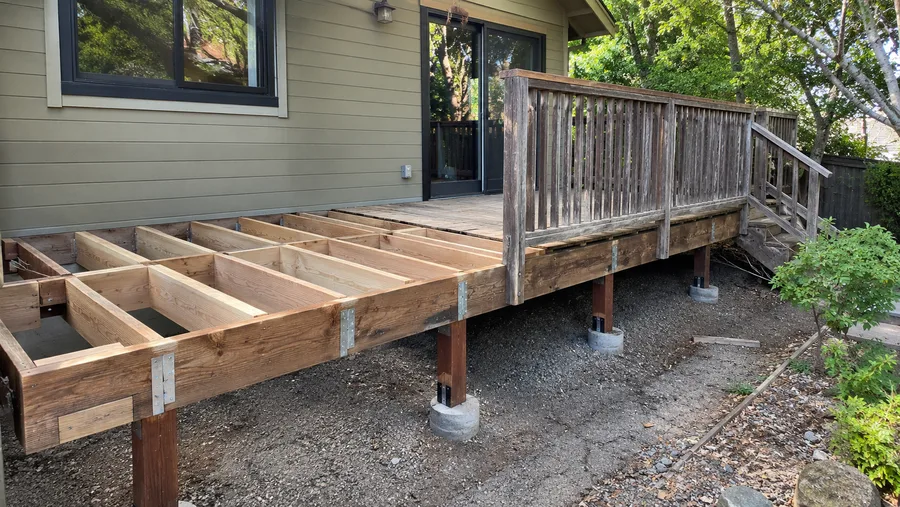
Almost every deck problem gets solved above ground. Boards get replaced, railings get upgraded, joists get sistered, ledgers get re-flashed. All of it useful, and all of it working around a set of posts and footings that were put in the ground once and have never been touched since. On older decks that’s where the real deficiencies usually are: footings too shallow or too small for the loads, posts set directly into soil with no metal base, piers in the wrong positions for the span they’re carrying, and nothing corrected because correcting it means taking the deck apart.
A rebuild is the moment that becomes possible. The structure comes out, the ground is visible, and footings can be sized, positioned, and poured for the deck you’re actually building rather than the one somebody built in 1994. Posts go back on metal bases holding timber clear of soil. Spans get set correctly instead of inherited. It’s the difference between a deck with another twenty years in it and a new surface sitting on the same original problem.
That’s also why a rebuild costs what it does. The money on this job is underground and in getting the old deck out — footings, excavation, demolition, disposal, and access — not in the boards on top, which are the cheapest part of any deck. Owners who compare a rebuild quote to a re-decking quote are comparing two entirely different projects.
Every other fix works around the footings. This is the one job where they’re finally in reach.

02 The D&B difference
What rebuilding a deck properly involves
We rebuild to today’s standard rather than back to the original drawing, because the original is the thing that failed.
Footings sized and set for the deck being built
Not reused, not assumed. Positions, depths, and sizes worked out for the actual spans and loads, with metal bases keeping timber clear of the ground.
Demolition, disposal and access shown as their own lines
Getting an old deck out is a substantial share of the cost, and access on a tight or elevated site is a real constraint. Both appear in the estimate rather than being folded into a square-foot rate.
What’s salvageable gets salvaged, honestly
Sometimes the footings are sound and the structure isn’t. Sometimes railings or stairs can carry over. We assess what genuinely reuses and say so, rather than replacing everything by default or reusing something that shouldn’t be.
03 · Service Areas
Where We Work in California
Every city links to a dedicated local page — crews, recent projects and compliance details for that area.
Sacramento Metro
14 cities
East Bay
21 cities
Don’t see your city? We likely still cover it — call (916) 848-2728.
04 How a project runs
How rebuilding a deck runs, start to finish
-
01
Assessment
Existing structure, footings, ledger, and the ground surveyed, with what’s salvageable identified rather than assumed.
-
02
Scope & estimate
A written scope separating demolition and disposal, footings and structure, and finish, so you can see the three parts of the number.
-
03
Engineering & permitting
Stamped engineering where the structure requires it, then through plan review, which on a full rebuild is generally required.
-
04
Demolition & clear-out
Deck removed, material sorted and hauled, and the ground opened up.
-
05
Footings
Piers or footings excavated, poured, and cured at sizes and positions set for the new structure, with metal post bases.
-
06
Structure
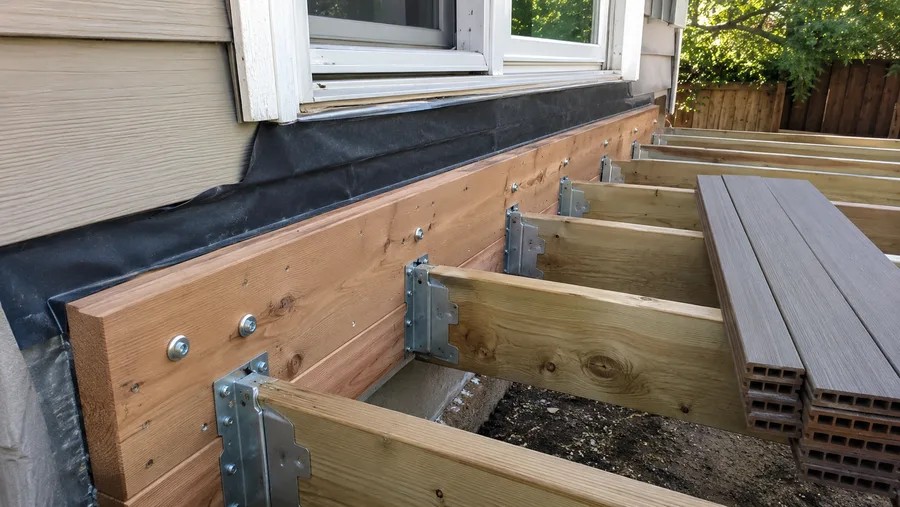
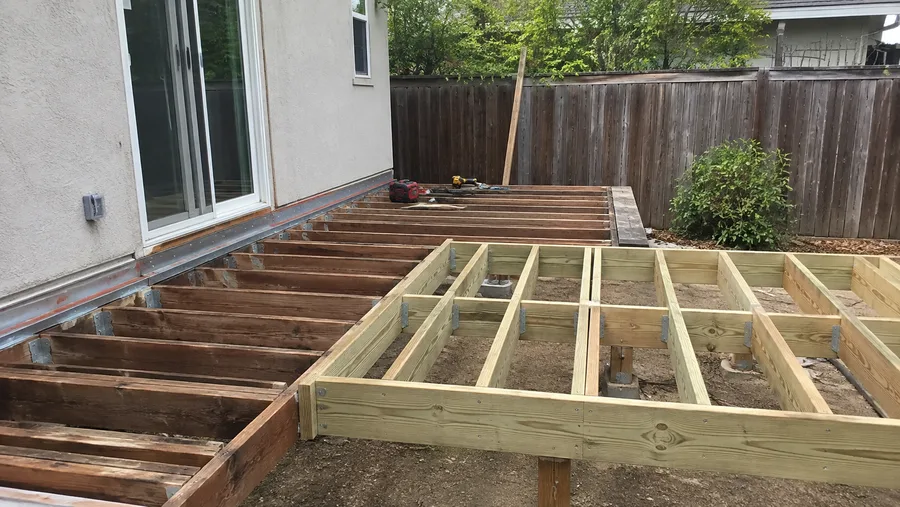
Posts, beams, joists, and ledger built to current code, flashed and connected with rated hardware, joist tops taped.
-
07
Finish & handover
Decking, railings, stairs, documentation, and on commercial property the compliance file material.
05 Scope
What’s included in a D&B deck rebuild
Complete deck rebuilding — ground up — from one CSLB-licensed crew.
- Assessment of the existing structure, footings, and ground conditions
- Honest identification of what can genuinely be reused
- Stamped structural engineering and permit coordination
- Demolition of the existing deck, railings, and stairs
- Disposal and haul-away, priced as its own line
- Footings and piers excavated, poured, and sized for the new spans
- Metal post bases holding timber clear of soil
- Pressure-treated framing — posts, beams, and joists sized for span and load
- Ground-contact treatment ratings where framing sits near grade
- New ledger connection flashed and fastened per CBC 1604.8.1
- Rated connectors and structural fasteners throughout
- Joist tape and flashing over joist tops and beams
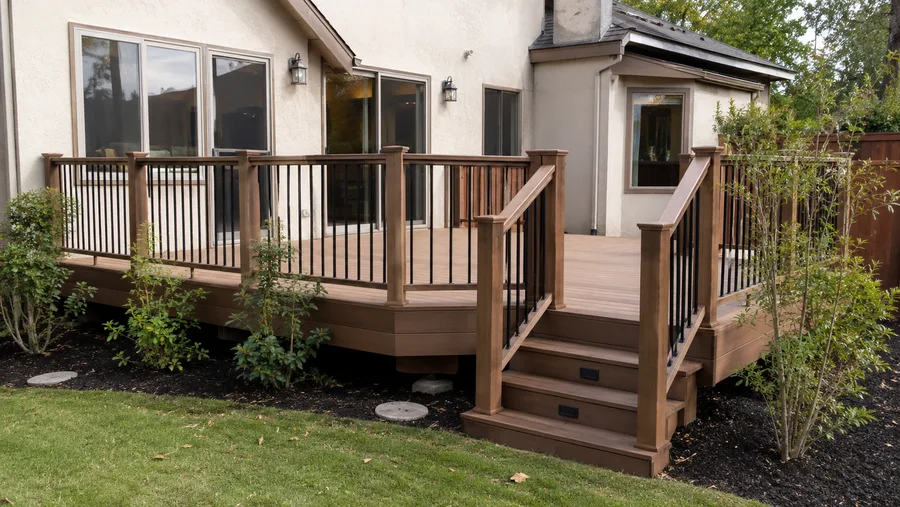
- Decking in timber, composite, or hardwood
- Guardrails to current height and spacing, stairs with graspable handrails
- As-built documentation, plus SB 721 / SB 326 material on commercial property
Built to current code: CBC 1604.8.1 ledger connections · ASCE 7 load criteria · foundation provisions · guardrail and stair requirements
06 Investment
What it costs to rebuild a deck
Rebuilds are quoted after the site is assessed, and the honest framing is that most of the cost isn’t visible in the finished deck.
What drives the number
- Footings — number, depth, size, and what the ground turns out to be
- Demolition and disposal of the existing deck, charged by volume and weight
- Access — whether concrete and material can reach the site or have to be pumped, conveyed, or carried
- Elevation and span, which drive framing size and post count
- Ledger work and any repair to the building where the old deck was attached
- Decking material, railings, and stairs
- Permits and engineering, which a full rebuild generally requires
Why rebuild quotes and re-deck quotes aren’t comparable: they’re different projects. Re-decking keeps the footings, the structure, and usually the railings, so it prices at a fraction. A rebuild replaces all of that and includes getting the old one out. If you’ve been quoted both, the gap isn’t a contractor being expensive — it’s two different scopes of work with the same finished appearance. What the extra buys: a full service life instead of a few more years, footings that suit the deck rather than the one before it, and a structure built to how decks are built now. On a deck whose frame is genuinely at the end, that’s better value than the cheaper option — and where it isn’t, we’ll say so and quote the smaller job. Final pricing follows an on-site assessment — request a free estimate, no obligation.
In the field
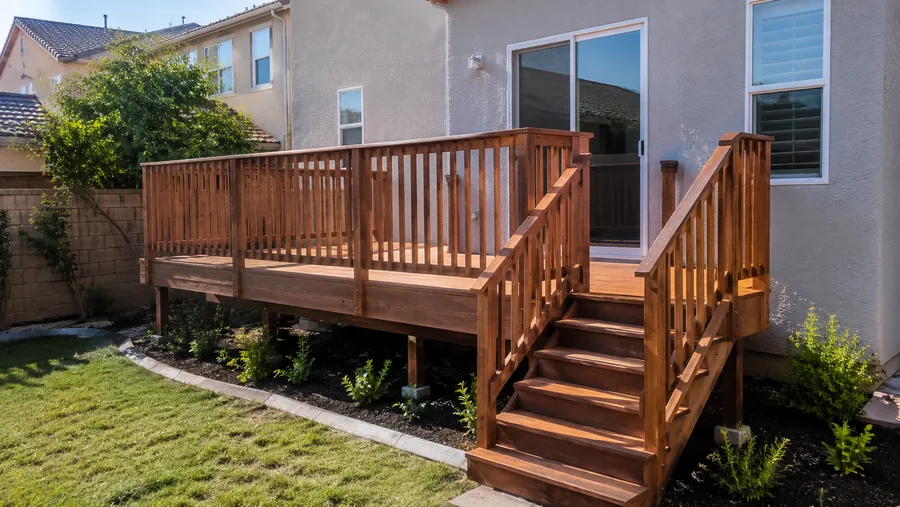
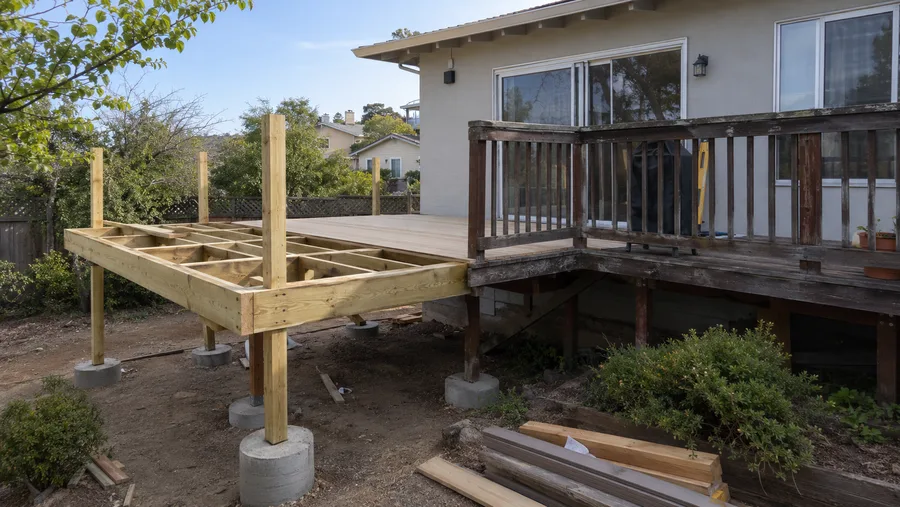
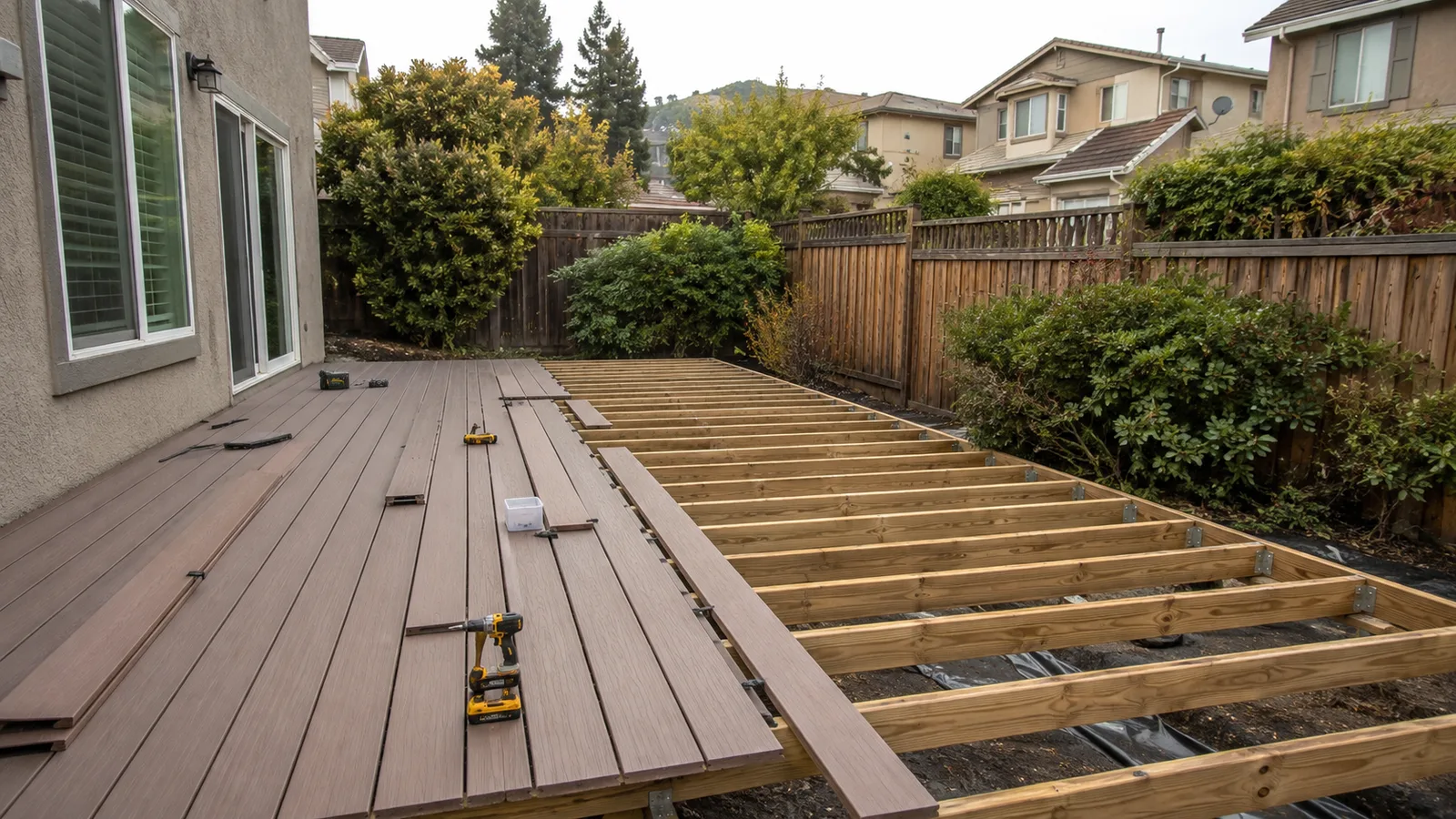
Deck rebuild detail
The half of the job that ends up buried again.
07 Project example
A recent deck rebuild
A twenty-two-year-old deck had been repaired three times in six years — boards, then a section of joists, then the stairs. The assessment explained why the repairs hadn’t held. The original posts were set directly into the ground with no metal bases, and four of them had rotted where they entered the soil; the piers were undersized for the spans they were carrying, so the frame had been slowly sagging between them since it was built. None of that could be corrected without taking the deck out. D&B demolished and hauled the old structure, poured new piers sized and positioned for the actual spans, set every post on a metal base clear of the ground, and rebuilt the frame with a flashed ledger, rated connectors, and taped joists before the new surface went down.
We’d paid for three repairs in six years. Every one of them was fixing something the footings were causing. Client · California
08 Case studies
Recent Projects, Documented
Real commercial properties — what the building needed, what we did, and what it delivered.
 Deck ConstructionCommunity-Wide Elevated Deck Replacement — San RamonEvery elevated deck across a hillside townhome community rebuilt to a single spec in one managed program —…View case study
  Deck ConstructionPatio Deck & Post Base Replacement Across a Bungalow Community — San RafaelDeck-by-deck replacement across a courtyard community, driven by the one detail that failed first — posts set straight…View case study
  Deck RepairPrivate Deck & Guardrail Rebuild Across a Residential Community — Los AltosUnit-by-unit deck replacement where the guardrail was the real finding — railing posts rotted through at the rim,…View case study
 09 Client feedback
What clients say
Three repairs in six years and none of them lasted. The footings were the problem the whole time and nobody had looked at them.
Demolition and disposal were their own line on the estimate. Two other bids had them somewhere invisible and one of them came back for more.
They reused the footings on one side because those were fine, and told us so rather than charging to replace everything.
10 FAQ
Deck rebuilding questions
How much does it cost to rebuild a deck?
More than any other option, and mostly for reasons you won’t see in the finished deck. The cost sits in footings, demolition and disposal, and access — not in the boards, which are the cheapest part of any deck. We assess the site, then quote with those three shown separately so you can see what you’re actually buying.
Why is a rebuild so much more expensive than re-decking?
Because they’re different projects that produce a similar-looking result. Re-decking keeps the footings, the structure, and usually the railings, and prices at a fraction accordingly. A rebuild replaces all of it and includes removing the old deck first. If both quotes are on your table, the difference isn’t margin — it’s scope.
When is rebuilding the right answer instead of repair?
When repairs stop holding, which usually means the problem is below the repairs. Posts set into soil, undersized or badly placed footings, and spans that were never right can’t be corrected from above, so each repair fixes a symptom and the cause carries on. If a deck has been repaired more than once in a few years, that pattern is worth investigating before paying for a third.
Can any of the existing deck be reused?
Sometimes, and we look. Footings can be sound where posts aren’t. Railings and stairs occasionally carry over if they meet current requirements. What we won’t do is reuse something marginal to keep a number down, or replace something sound to raise one. The assessment says which is which.
Do I need a permit to rebuild a deck?
Generally yes. A full rebuild is new construction in practice — new footings, new structure, new connections — and most jurisdictions require a permit and inspection. We handle permitting, and we start it early because plan review runs on the jurisdiction’s timeline rather than ours.
How long does a deck rebuild take?
Typically three to five weeks on site, depending on size, elevation, and access. Concrete needs to cure before framing goes on, which is a fixed part of the schedule regardless of crew size. Permit review sits outside that and is the least predictable element, so we start it as soon as the scope is settled.
Will the new deck have to be the same size and shape?
Not necessarily — a rebuild is the natural moment to change the layout, because the footings are being placed anyway. Changing size or shape usually affects the permit scope and the design, so it’s a conversation for the start rather than mid-build. Our deck design and remodeling pages cover that side.
Does rebuilding help with SB 721 or SB 326?
On commercial and multifamily property, substantially. A rebuilt deck is new construction and enters the inspection cycle clean, and a rebuild is frequently what closes a structural finding that repair can’t. We hand over as-built documentation for the compliance file at completion.
Are you deck rebuild contractors near me in California?
We’re a CSLB-licensed contractor (#1060736) rebuilding decks across the Bay Area, Central Valley, and Sacramento. Assessment, permitting, demolition, disposal, footings, structure, and finish come from one crew.
11 Start here
Find out whether a rebuild is what you need — free assessment
Tell us about the deck and what’s been done to it already. If it’s been repaired more than once, that’s usually the sign worth investigating. We’ll survey the structure and the footings and tell you honestly whether rebuilding is the right answer — with a price for it and for the smaller job if that’s the better call.
CSLB #1060736 · 9+ years · Insured & Bonded · Serving the Bay Area, Central Valley & Sacramento