Deck Renovation · CSLB #1060736
Commercial Deck Renovation in California — Bringing an Old Deck Up to Standard
We renovate existing decks across California — new surface, new railings, structural repairs, and the connection details brought up to how decks are built today. Renovation isn’t refinishing and it isn’t a redesign. It’s taking a deck that still works and closing the gap between the standard it was built to and the standard it would be built to now.
- CSLB #1060736 Licensed California contractor
- 9+ yrs Renovating commercial decks & balconies
- Code gaps closed Ledger, railings & hardware brought current
- Commercial Multifamily, HOA & hotel only
01 Why it matters
An old deck is legal and out of date at the same time
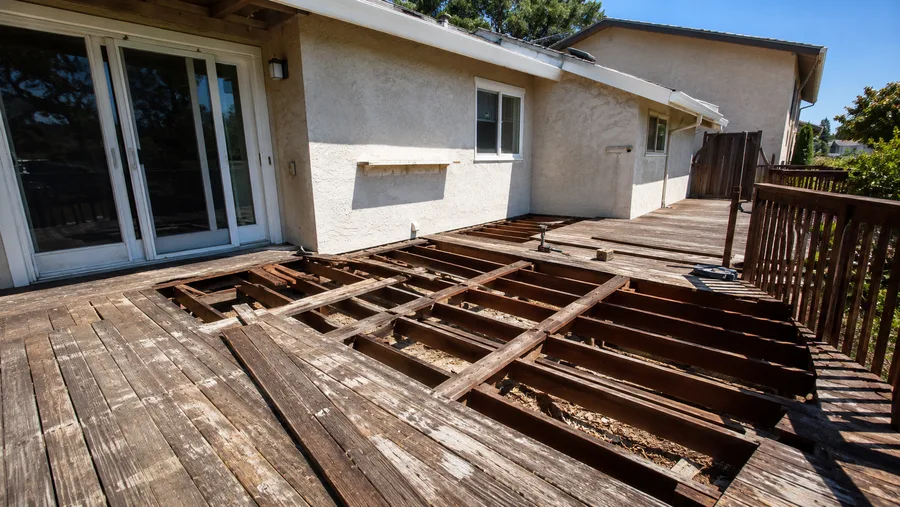
Decks built twenty or thirty years ago were built correctly — to the code of their decade. That code has moved, and almost every deck of that vintage shares the same four gaps. The railings are thirty-six inches with wide baluster spacing, which was standard then and is below what a commercial deck requires now. The ledger connecting the deck to the building was fastened without flashing, because flashing at that connection wasn’t yet routine. The joist tops have no protection, so water off the boards has been sitting on the framing for the deck’s whole life. And the connections are nails where today they’d be rated structural fasteners and metal connectors.
None of that makes the deck illegal. An existing structure doesn’t have to be rebuilt every time the code changes. What it does mean is that a deck can be perfectly sound, entirely legal, and still built to a standard nobody would specify today — and that the gap only ever closes when someone opens the deck up.
That’s what renovation is for. Refinishing makes an old deck look better and changes none of it. Renovation is the point at which the surface comes off anyway, and the four things underneath can be corrected for very little extra while there’s access. Do it then, and the frame you’re keeping gets another few decades. Skip it, and you’ve spent money on a deck that’s still carrying every deficiency it had.
The deck isn’t wrong. It was built to the rules of 1998. Renovation is the one moment when catching it up costs almost nothing.

02 The D&B difference
What deck renovation should include
We renovate to today’s standard rather than back to the deck’s original one, because the second is the cheaper job and the wrong one.
The four gaps closed while the deck is open
Ledger flashed and fastened to current requirements, joist tops taped, connections upgraded to rated hardware, and railings brought to current height and spacing. Each is inexpensive with the surface off and expensive once it’s back on.
Structure assessed, not assumed
Probe testing at joists, ledger, and post bases before the scope is set. Renovating over rot is refinishing with a bigger invoice, and we’d rather find it at the assessment than mid-job.
Honest about when renovation isn’t the answer
If the frame has reached the end of its life, we say so and price replacement instead. A renovated deck on tired structure is the most expensive way to buy a few more years.
03 · Service Areas
Where We Work in California
Every city links to a dedicated local page — crews, recent projects and compliance details for that area.
Sacramento Metro
14 cities
East Bay
21 cities
Don’t see your city? We likely still cover it — call (916) 848-2728.
04 How a project runs
How renovating a deck runs, start to finish
-
01
Assessment
Joists, ledger, post bases, and railings surveyed, with probe testing and moisture readings. This determines whether renovation is the right scope.
-
02
Gap review
We walk you through what’s below current standard on your deck and what closing each gap costs, so nothing is a surprise on the invoice.
-
03
Scope & estimate
Written scope separating structural work, code upgrades, and finish, with replacement priced alongside if the assessment suggests it.
-
04
Permitting
Structural work generally requires it; a like-for-like surface change usually doesn’t. We confirm and handle it.
-
05
Strip-out & structure
Surface removed, framing repaired or replaced where needed, ledger re-flashed and re-fastened, connections upgraded.
-
06
Protection & surface
Joist tape and flashing installed, then new decking laid.
-
07
Railings, stairs & handover
Railings to current height and spacing, stairs and handrails to code, plus documentation — and on commercial property the compliance file material.
05 Scope
What’s included in a D&B deck renovation
Complete deck renovation — structure, code, and surface — from one CSLB-licensed crew.
- Structural assessment: joists, beams, ledger, post bases, moisture readings
- Written review of what on your deck sits below current standard
- Renovation and replacement priced side by side where it’s a close call
- Removal of the existing surface and railings
- Framing repair and partial replacement where rot is found
- Ledger connection re-flashed and re-fastened per CBC 1604.8.1
- Nailed connections upgraded to rated structural fasteners and metal connectors
- Joist tape and flashing over joist tops and beams before new decking
- Post bases replaced where timber is sitting in contact with soil
- New decking — timber, composite, or hardwood, with joist spacing checked against it
- Railings replaced to current height and opening requirements
- Stairs rebuilt with code risers, treads, and graspable handrails
- Corroded hardware replaced throughout
- Permit coordination where the scope requires it
- As-built documentation, plus SB 721 / SB 326 material on commercial property
Built to current code: CBC 1604.8.1 ledger connections · ASCE 7 load criteria · current guardrail height and opening requirements · stair and handrail requirements
06 Investment
What deck renovation costs
Renovation is quoted after the structure is assessed, because the assessment determines how much of the work is structural and how much is surface.
What drives the number
- Deck size, elevation, and how much railing and stair run it carries
- Condition of the framing, and how much repair or replacement it needs
- Whether the ledger has to be opened up and re-detailed
- New surface material, and whether joist spacing suits it or needs re-spacing
- Railing material and length — this is often the largest single line
- Stair rebuild, if the existing stairs are below current standard
- Permitting where structural work is involved
Where renovation is excellent value: on a deck whose frame is sound, closing the four standard gaps costs very little relative to the whole job, because the access is already paid for. Flashing a ledger during a renovation is a fraction of what it costs as a standalone job later, and joist tape is close to free once the boards are off. That’s the argument for renovating properly rather than resurfacing cheaply. Where it stops making sense: when the framing repair grows past roughly half the deck. At that point the marginal cost of replacing outright is smaller than owners expect, and you get a full service life instead of a new surface on twenty-year-old structure. We price both and say which we’d choose. Final pricing follows an on-site assessment — request a free estimate, no obligation.
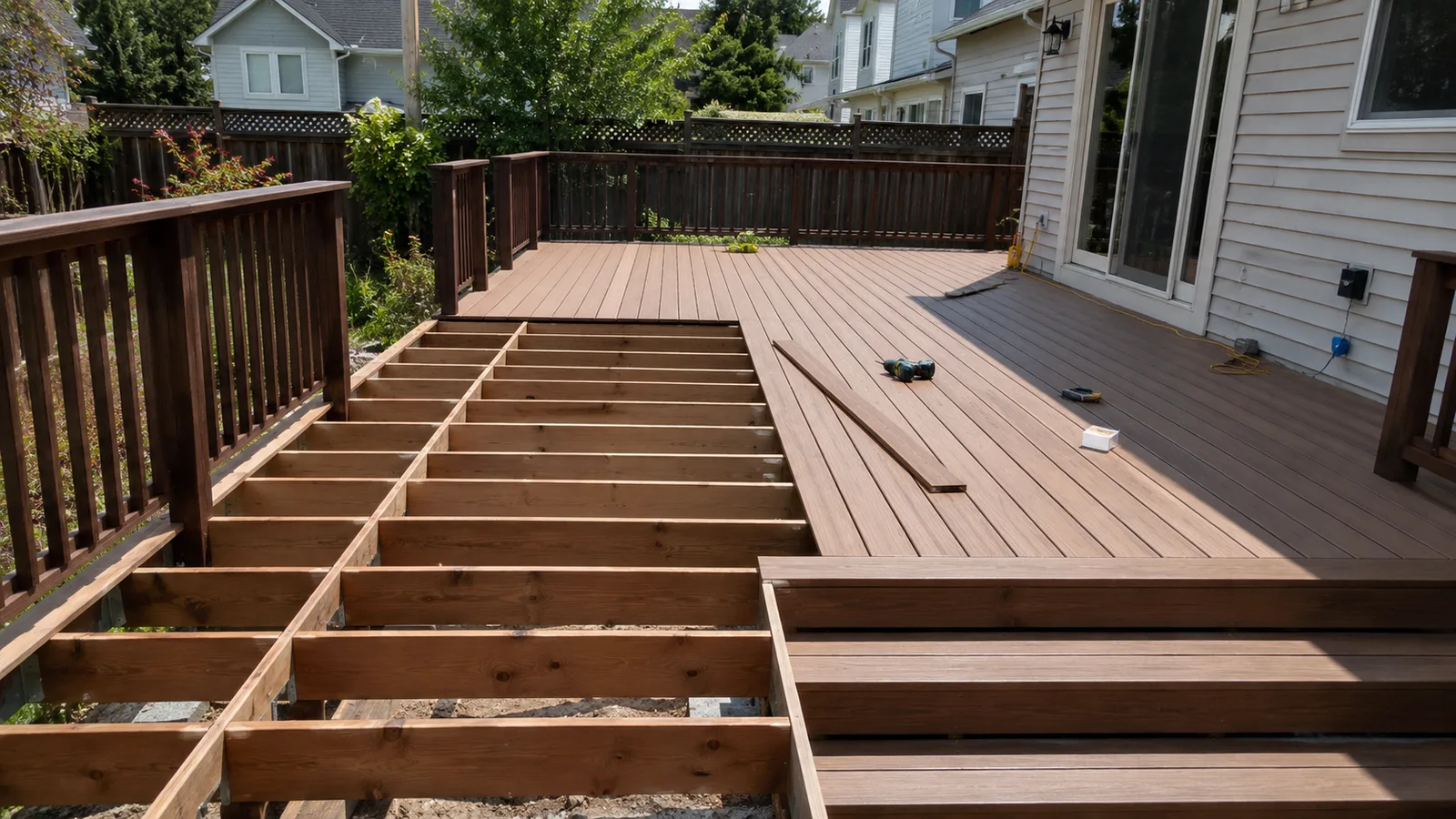
In the field
Deck renovation detail
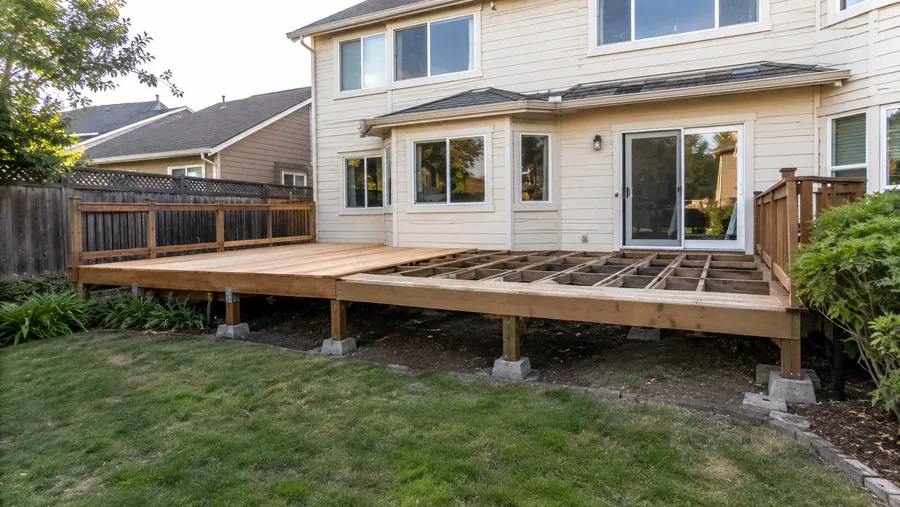
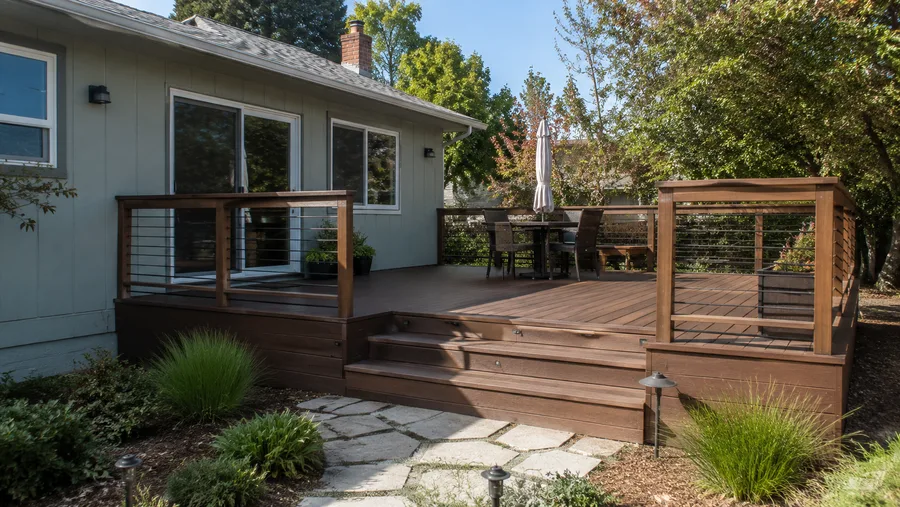
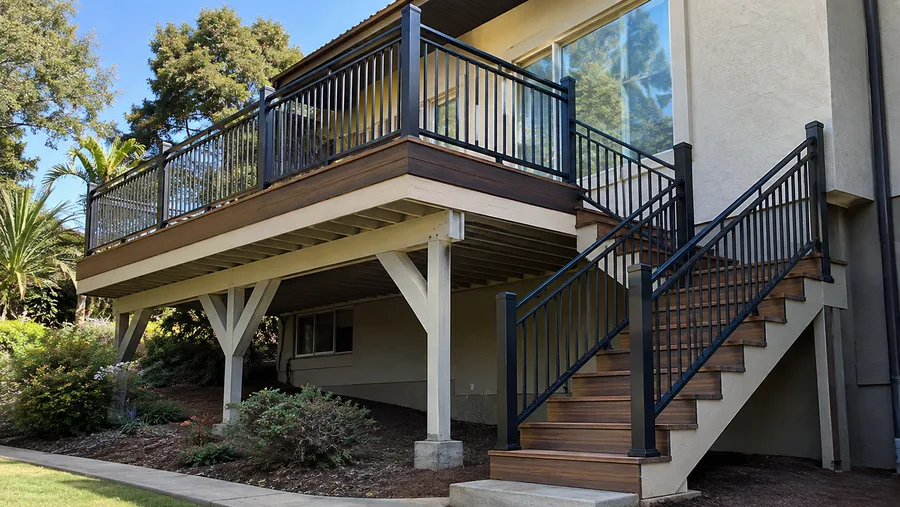
What gets corrected while the surface is off.
07 Project example
A recent deck renovation
A twenty-four-year-old deck was structurally sound and looked every one of its years. The owner asked for a new surface and new railings. The assessment found the frame in good order — and the same four things we find on almost every deck of that age: a ledger fastened without flashing, bare joist tops, nailed connections, and railings at thirty-six inches with baluster gaps closer to six. D&B stripped the deck, opened the ledger and re-detailed it flashed and bolted to current requirements, taped every joist top, replaced the nailed connections with rated connectors, and installed new decking and railings to current height and spacing. The structural upgrades added a small fraction to the total, because the access was already there.
We were buying new boards and railings. What we got was a deck that’s now built the way it would be built today, for barely more money. Client · California
08 Case studies
Recent Projects, Documented
Real commercial properties — what the building needed, what we did, and what it delivered.
 Deck RepairPool Deck Replacement at an Apartment Community — RosevilleA large wood pool deck worn to trip hazards at the water's edge — decking, steps and the…View case study
  Deck RepairElevated Restaurant Dining Deck Restoration — SaratogaA multi-level hillside dining deck taken from failing boards and moisture-damaged connections back to a sound, sealed structure…View case study
  Deck RepairPrivate Deck & Guardrail Rebuild Across a Residential Community — Los AltosUnit-by-unit deck replacement where the guardrail was the real finding — railing posts rotted through at the rim,…View case study
 09 Client feedback
What clients say
Nobody else mentioned the ledger. It’s the connection holding the deck to the house and it had never been flashed in twenty-four years.
They listed what was below current standard before quoting. Four things, four prices. We did all four because three of them were almost nothing.
The railings went from thirty-six inches to forty-two because our building requires it. That would have been a finding at the next inspection and now it isn’t.
10 FAQ
Deck renovation questions
What’s the difference between renovation, restoration, remodeling, and replacement?
Restoration renews the surface of a sound deck — cleaning, stripping, sanding, refinishing — and changes nothing structural. Renovation brings the whole deck up to current standard: new surface, new railings, structural repairs, and the connection details corrected, without changing what the deck is. Remodeling changes what it is — shape, size, levels, features. Replacement takes it out and builds again. They’re four different budgets, and knowing which one you want is the fastest way to compare quotes properly.
Does my old deck have to be brought up to current code?
Generally not simply because the code changed — an existing structure isn’t required to be rebuilt every time requirements move. What does apply is that when you carry out substantial work, current requirements apply to what you’re touching. In practice that means a renovation is when the gap closes, and it’s why renovating properly is worth more than resurfacing cheaply. On commercial and multifamily property the picture is stricter: SB 721 and SB 326 findings have to be repaired to current standard regardless of when the deck was built.
What’s typically below standard on an old deck?
Four things, on almost every deck of a certain age. Railings at thirty-six inches with wide baluster gaps. A ledger fastened to the building without flashing. Joist tops with no protection, so water has been sitting on the framing for decades. And nailed connections where rated connectors and structural fasteners would be used today. We identify which apply to your deck at the assessment and price closing each one.
How much does deck renovation cost?
It depends on how much of the work is structural. On a deck with sound framing, the code upgrades are a small fraction of the total because the access is already paid for — flashing a ledger costs a great deal less during a renovation than as a job on its own. Where framing repair is extensive, the number climbs and replacement enters the conversation. We assess first and quote both where it’s close.
Is renovation cheaper than replacement?
On a sound frame, considerably — you’re keeping the structure, the footings, and usually the layout. That advantage disappears as framing repair grows. Once you’re replacing much more than half the framing, the additional cost of a full replacement is smaller than most owners expect, and it buys a complete service life rather than a new surface over old structure. We’ll tell you when you’ve reached that point.
Can you renovate a deck without replacing the railings?
You can, but on most old decks it’s the change worth making. Railings are the item most likely to be below current requirements, they’re the most visible part of the deck, and on commercial and multifamily property they’re the most frequently cited item in inspections. If the budget only stretches to one upgrade, that’s usually the one.
Do we need a permit to renovate a deck?
Where the work is structural — ledger, framing, stairs — generally yes. A like-for-like surface change usually doesn’t require one. It varies by jurisdiction and we confirm before starting, because it affects both cost and schedule.
How long does deck renovation take?
Most renovations run one to three weeks depending on size and how much framing work is involved. Permit review, where required, runs on the jurisdiction’s timeline rather than ours, so we start that as early as the scope allows.
Does renovating a deck help with SB 721 or SB 326?
Substantially, if it’s done to current standard. Those inspections look at structure, connections, and guardrails — exactly the things a proper renovation corrects. A renovation that only replaces the surface closes nothing, which is the difference between renovation and refinishing on a commercial property.
Are you deck renovation contractors near me in California?
We’re a CSLB-licensed contractor (#1060736) renovating decks across the Bay Area, Central Valley, and Sacramento. Assessment, structural work, code upgrades, surface, railings, and documentation come from one crew.
11 Start here
Find out what your deck is missing — free assessment
Tell us how old the deck is. We’ll survey the frame, list what sits below current standard, and put a price against closing each gap — so you can see what renovation actually buys before you commit to it.
CSLB #1060736 · 9+ years · Insured & Bonded · Serving the Bay Area, Central Valley & Sacramento