Climate considerations in Ripon
Ripon sits on the flat valley floor among almond orchards, with the river along its southern edge. Summers are long, hot, and dry, with afternoons regularly past 95°F and often past 100°F, which drives UV degradation of finishes, surface checking, and thermal stress at connections. Annual rainfall is around 13 inches, concentrated between November and March, and tule fog settles over the valley through much of the winter, holding moisture against surfaces for days at a time. The wet season is short, but it arrives in bursts, and a waterproofing detail that is slightly wrong gets tested hard when it does. That matters most on the structures where a leak does not stay outside.
When the balcony is a roof
Much of Ripon’s housing from the 1980s onward is two-storey, and a common layout puts a balcony on top of the garage or over a room below. That changes what the balcony is. A deck over open ground can shed water through its boards and dry from underneath. A balcony over living space cannot: it has to keep every drop out, like a roof, because anything that gets past the surface goes straight into the framing and the ceiling below. The weak points are the same on almost every one we see — the door threshold where the balcony meets the house, the junction with the wall, the drain or scupper, and the slope, which on many balconies is too shallow or has settled so that water sits in a corner. Leaks usually show first as a stain on the ceiling underneath, often months or years after water started getting in, by which time the sheathing and joists have been wet for a long time. Patching the surface rarely fixes it, because the water is usually coming in at one of those junctions and travelling under the membrane. We inspect these balconies from both sides, above and from the ceiling below, and repair the membrane, drains, slope, and junctions as one system.
Too many coats
On older Ripon homes, porches, decks, and stair railings have often been painted or solid-stained many times over the years. Each coat looks like protection, and for a while it is. Over time, though, layers of film-forming finish build up, crack at joints and board ends, and let water in through the cracks — and the same film that let the water in now stops it drying out. Decay then progresses underneath a surface that still looks freshly painted. Another coat on top makes it look better and makes the problem worse. Before recoating any heavily painted wood, we test it for soft spots under the finish. Where decay has started, the right sequence is to strip back, replace what has rotted, and refinish with a product that lets the wood dry, rather than sealing the damage in again.
Main Street and the older streets
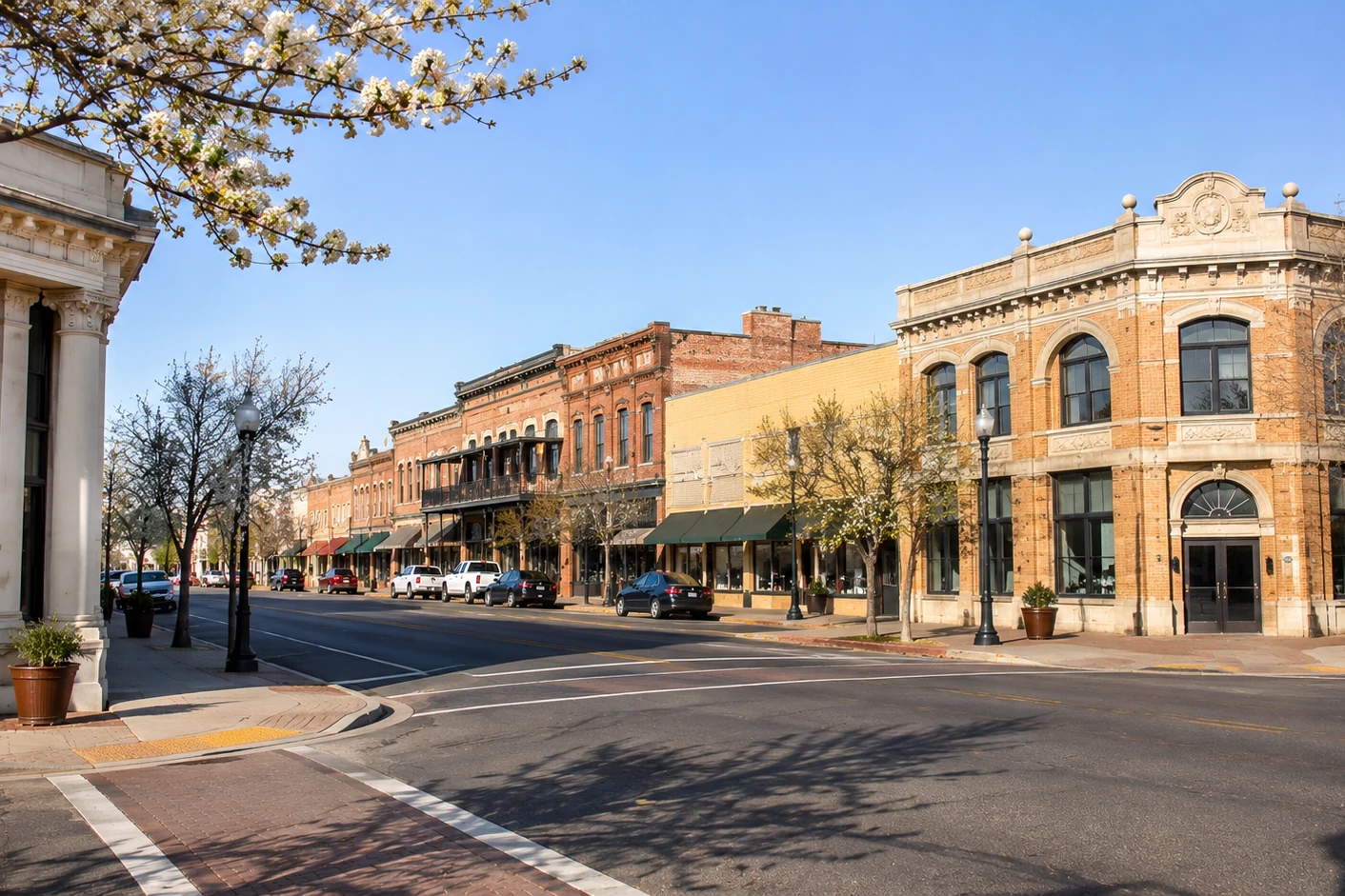
Ripon’s downtown along Main Street holds brick commercial buildings from the early twentieth century, some with upper floors, iron balconies, and original rear stairs. The residential streets around it carry pre-war and post-war houses with front porches and steps that predate current railing and connection standards. Work here means bringing load capacity and railing geometry up to code while keeping the character of the building, and expecting older connection methods behind the finish. On the iron balconies downtown, the anchors into masonry deserve as much attention as the balcony itself, because corrosion where steel meets brick damages the wall as well as the fixing.
Common building stock we work on
Ripon grew from a small farming town into a larger community mostly from the 1980s onward, so much of the housing is two-storey single-family construction from that period, often with balconies over garages and rooms as described above. That stock is now at the age where builder-grade flashing, door thresholds, and first-generation balcony membranes reach the end of their service life. Older homes and brick commercial buildings near Main Street make up a smaller share and carry the painted-finish and older-connection issues set out above. Apartment and HOA-managed townhome communities form the SB 721 and SB 326 inventory. Our certified construction crew scopes every project to the era, what is underneath the balcony, and the code in effect at installation.
Neighborhoods served
Our certified Ripon crew covers Downtown Ripon and Main Street, North Ripon, the river side of town, the Jack Tone Road corridor, the Colony Road area, the Milgeo Avenue area, the Fulton Avenue area, the Doak Boulevard area, the River Road area, the Second Street area, and the wider Ripon community. ZIP code 95366 covers the city.
What we typically see
Across our Ripon inspections, our company most often documents: (1) balconies over garages and rooms leaking at the door threshold, wall junction, or drain, with water travelling under the membrane and showing up as a ceiling stain below — a Ripon-specific concentration given how much two-storey housing here puts a balcony over living space; (2) surface patches applied to those balconies that did not reach the actual entry point; (3) porches, decks, and railings with decay under many layers of paint or solid stain; (4) heat-driven surface checking and sealant breakdown from summers past 95°F; (5) corroded anchors where iron balconies meet brick on the older downtown buildings; (6) railings on pre-2000 stock that fall short of the current CRC 42-inch height and 4-inch sphere rule. Every finding is captured in a written assessment with prioritized repair, replacement, or restoration scope.
Emergency response & remodeling
For Ripon properties with acute safety issues — sagging framing, loose railings, visible rot at load-bearing connections, an active leak into a room below a balcony, red-tagged structures, or storm damage — we offer expedited scheduling within 5–7 business days, ahead of our normal block scheduling for this part of the service area. Where water is coming into a ceiling, we stop the entry first and then open up enough to see how far the framing has been affected. We also handle full balcony and deck remodeling, with balconies over living space built and waterproofed as the roofs they are.