Climate considerations in Mill Valley
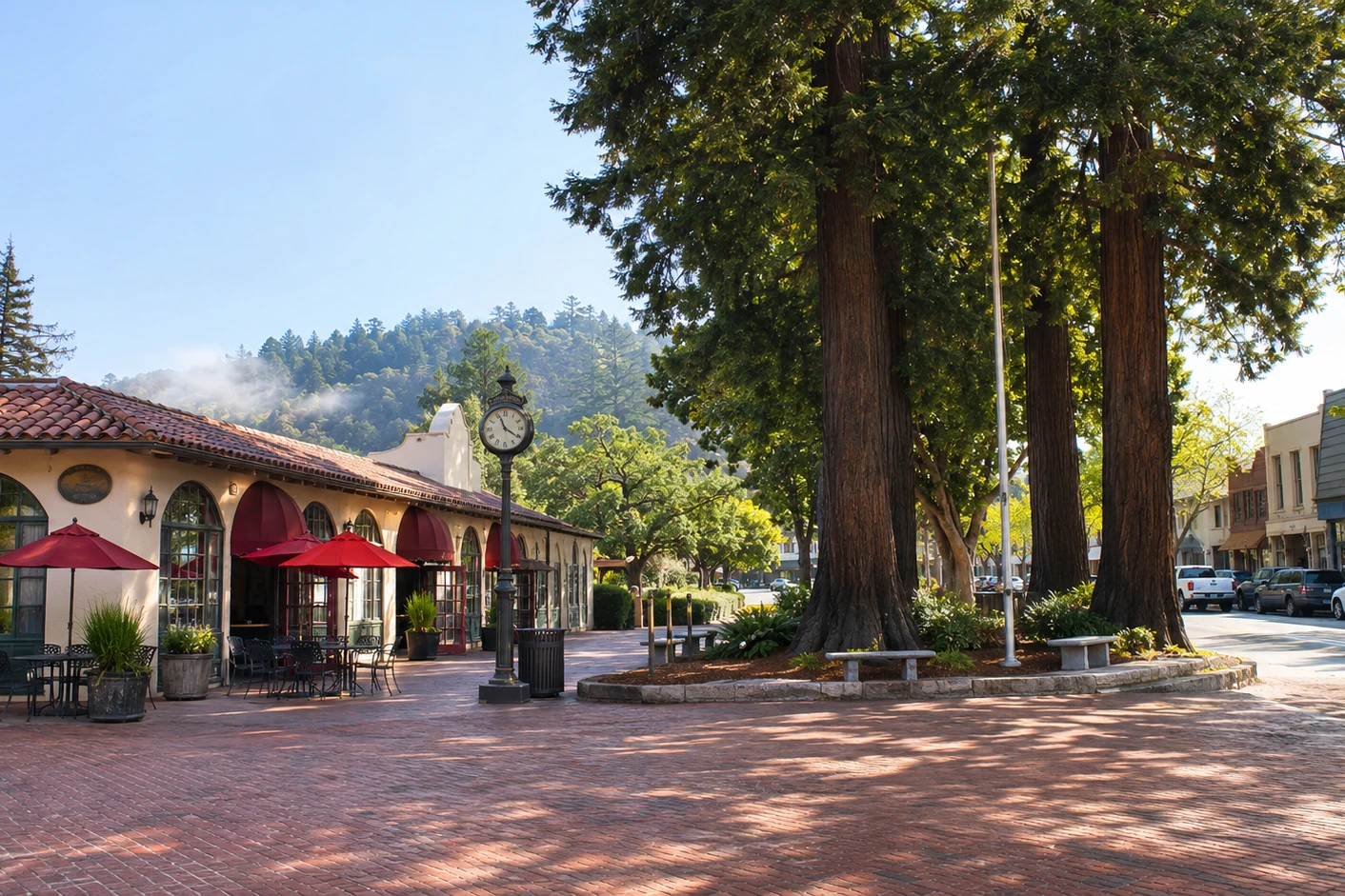
Mill Valley runs from the flats near the bay up into steep canyons on the slopes of the mountain. Temperatures are mild most of the year, and winters are wet, with roughly 38 inches of rain in a normal year downtown and more on the higher slopes, most of it between November and March. In summer, marine fog moves in from the ocean and settles into the canyons, often lasting through the morning. The canyons are also heavily wooded with redwoods and other tall trees, so many decks get little direct sun at any time of year. Those conditions together mean that on a lot of Mill Valley properties, wood never gets a real chance to dry out.
Wet in summer too
The rainfall figures say Mill Valley has a long dry season. Under redwoods, that is only partly true. Tall trees catch summer fog on their needles, the droplets collect and fall, and the ground and everything on it below the canopy gets wet, sometimes for hours on a foggy morning, in months that record little or no rain. A deck under that canopy can therefore stay damp from one winter to the next, with only short dry spells in between, and it gets little sun to help it dry. That is why decay here often looks more advanced than the age of the deck would suggest, and why it concentrates on the boards, joists, and ledger directly under the trees. Maintenance advice written for a dry summer does not fit. We probe wood under the canopy rather than judging it by eye, set re-seal and inspection intervals for a deck that is wet most of the year, and pay particular attention to the ledger and the tops of joists, where water from above has the most time to soak in.
Houses that began as cabins
Mill Valley grew in its early years as a retreat, and some of the older homes in the canyons started as seasonal cabins that were later enclosed, extended, and turned into year-round houses. Many of them are charming and well cared for. The relevant fact for deck work is simply that cabin-era framing was often lighter than a full-time house would be built to now: smaller members, wider spacing, and connections that were never meant to carry a large deck. When a new or bigger deck is attached to that framing through a ledger, the house side of the connection becomes the weak point. Before rebuilding or enlarging a deck on an older canyon home, we look behind the ledger at what it is actually fastened to. If the house framing can be reinforced, we do that; if not, the deck is designed to stand on its own posts and footings, so the house is not asked to carry it.
Steep lots and stairs
Many Mill Valley homes sit on steep canyon lots, some reached by long stairways or narrow lanes rather than a driveway. Decks on those lots are often tall at the downhill side, with long posts and a significant drop below the railing, so lateral bracing and guardrail strength rank high on any findings list. Getting materials in and debris out can mean carrying them by hand up or down a stairway, which we account for in the estimate rather than discovering on the first morning. Drainage matters too: water shed off a deck on a steep slope runs downhill fast and can carry soil away from footings, so we route it deliberately.
Common building stock we work on
Mill Valley’s housing spans more than a century. Early twentieth-century cabins and cottages in the canyons, many expanded over the years, carry the lighter framing described above. Mid-century homes on Middle Ridge, Scott Highlands, and the other hillside neighbourhoods typically have decks stepping down the slope, with connection details and railing geometry from the decade they were built or rebuilt. Downtown and the flats hold small apartment buildings, condominiums, and mixed-use buildings that form the SB 721 and SB 326 inventory, with original waterproofing and hardware at or past service life on the older ones. Our certified construction crew scopes every project to the era, the canopy, the slope, and the code in effect at installation.
Neighborhoods served
Our certified Mill Valley crew covers Downtown Mill Valley and Lytton Square, Blithedale Canyon, Cascade Canyon, the Old Mill area, Middle Ridge, Warner Canyon, Scott Highlands, Sycamore Park, Kite Hill, the Boyle Park area, the Miller Avenue corridor, the East Blithedale Avenue corridor, and the wider Mill Valley community. ZIP code 94941 covers the city.
What we typically see
Across our Mill Valley inspections, our company most often documents: (1) water damage on boards, joists, and ledgers directly under redwoods, more advanced than the deck’s age would suggest, because fog drip keeps the wood wet through the summer — a Mill Valley-specific pattern in its canyons; (2) maintenance intervals set for a dry summer that the deck never gets; (3) ledgers fastened to light cabin-era house framing that was not built to carry the deck; (4) tall downhill decks on steep lots with lateral bracing and guardrail strength that need attention; (5) soil loss around footings where deck runoff runs down the slope; (6) railings on pre-2000 structures that fall short of the current CRC 42-inch height and 4-inch sphere rule. Every finding is captured in a written assessment with prioritized repair, replacement, or restoration scope.
Emergency response & remodeling
For Mill Valley properties with acute safety issues — a deck pulling away from the house, sagging framing, loose railings over a steep drop, visible rot at load-bearing connections, red-tagged structures, or storm damage — our emergency repair crew responds within 24–48 hours with temporary shoring and code-compliant stabilization. Where a ledger is pulling from light house framing, we take the load off the house first. We also handle full deck remodeling on canyon lots, designed for year-round moisture and for what the house can actually carry.