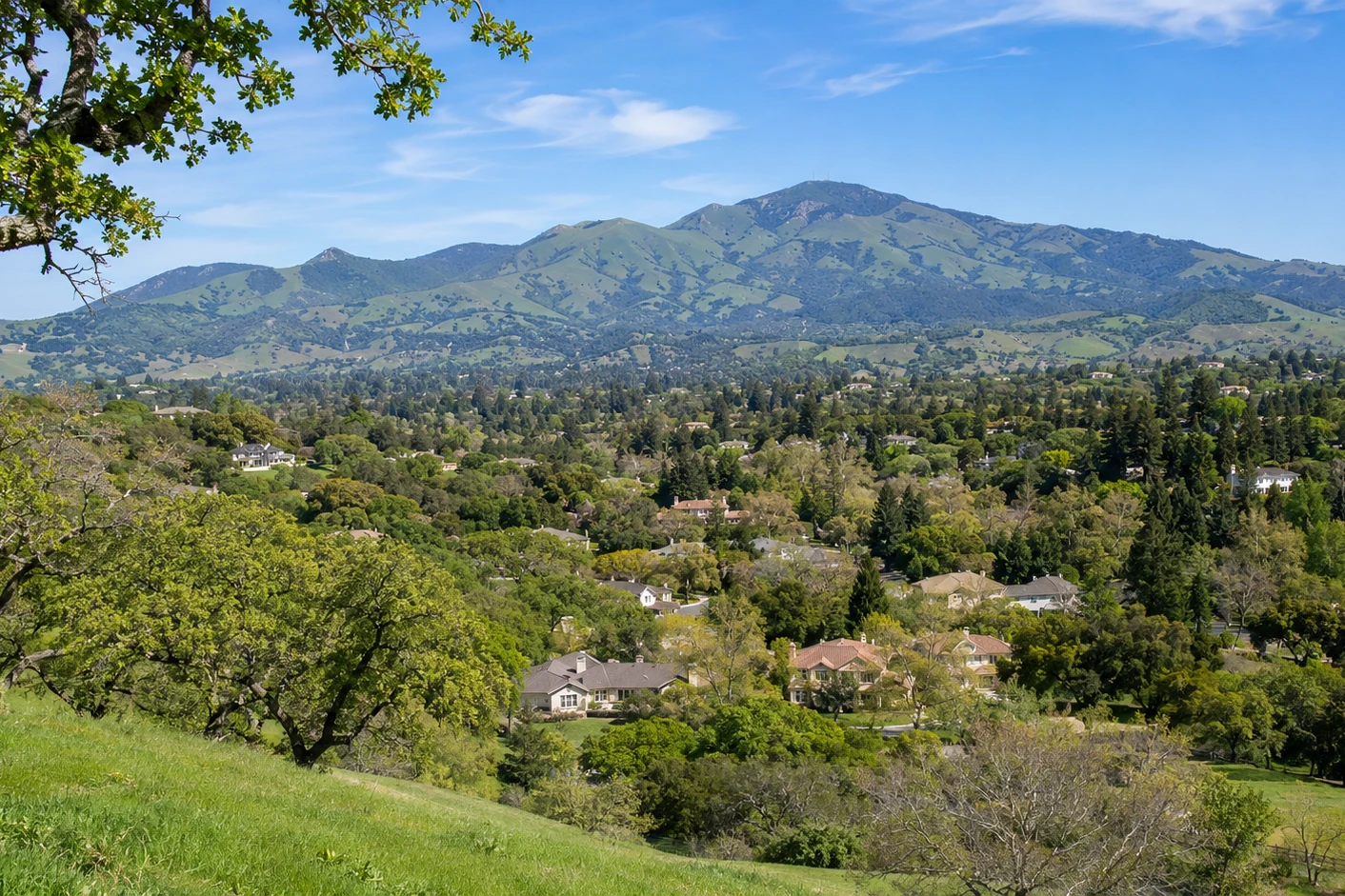
Climate considerations in Alamo
Alamo sits in a sheltered valley with warm dry summers, afternoons regularly in the nineties, and cool wet winters bringing roughly 20 inches of rain between November and March. Mature oaks and other large trees cover much of the residential land, so shaded sections of a deck stay damp after rain while sunny sections take UV and heat through the summer. That pattern is common across this part of the East Bay. What sets Alamo apart is less the weather than the way its large lots are used: much of outdoor life here happens on the deck, and a great deal has been built onto decks over the years.
What the deck is carrying
A deck is framed for people, furniture, and a reasonable margin. Over the life of a house, though, Alamo decks often acquire much more: a hot tub, an outdoor kitchen with stone or concrete counters, built-in planters full of wet soil, a fire feature, a pergola with heavy beams. Each was added in its own year, usually without anyone going back to check the framing underneath. A filled hot tub with people in it can weigh several thousand pounds, concentrated on a small area, which is far more than an ordinary deck is designed to carry. The effects show slowly: joists sagging under the load, a beam cracking, the ledger pulling slightly at that end, posts settling. The surface may look fine throughout. During the assessment we look underneath everything heavy and compare what the framing is doing with what it is carrying. The fix depends on the situation — added joists and beams, new posts and footings, or a separate support so the load bypasses the deck entirely — and where a deck needs to be checked or redesigned for a hot tub or similar load, that involves engineering, which we coordinate.
Pool splash and hardware
Many Alamo properties have a pool close to the house, and decks and stairs often sit within splash range. Pool water carries chlorine and, in salt-chlorinated pools, dissolved salt, and both leave chlorides on whatever they wet. On wood, the effect is modest. On metal, it is not: standard galvanized connectors, hangers, and fasteners within splash range corrode much faster than the same hardware a few yards away, and the corrosion often starts where it cannot be seen, inside a hanger or under a washer. We regularly find hardware badly rusted on the pool side of a deck and nearly new on the far side. Near pools we check connectors closely, replace corroded ones with hardware suited to chloride exposure, and look at how splash and pool-deck drainage reach the framing so less of it does.
Unincorporated: county jurisdiction
Alamo is a Census Designated Place, not a city, so there is no local building department. Building permits for structural deck and balcony work go through Contra Costa County Building Inspection, and SB 721 and SB 326 inspection reports are filed with County Code Enforcement. Work that adds or reinforces support for a hot tub or other heavy load typically needs a permit and, depending on the design, engineering. We handle the county process as part of the job.
Common building stock we work on
Alamo’s housing is mostly single-family on large lots. Ranch homes from the 1950s through the 1970s make up much of the older stock, many remodelled and extended with larger decks since. Custom and semi-custom homes from the 1980s onward, in areas such as Round Hill and Stone Valley, often have extensive multi-level decks with the added loads and pool exposure described above. Townhome and condominium communities near the commercial centre form most of the SB 326 inventory, with a small amount of multi-family rental housing under SB 721. Our certified construction crew scopes every project to the era, what the deck carries, and the code in effect at installation.
Neighborhoods served
Our certified Alamo crew covers Round Hill, Stone Valley, Westside Alamo, Alamo Oaks, the Livorna Road area, the Las Trampas area, the Alamo Plaza area, the Hemme Avenue area, the Miranda Avenue area, the Iron Horse Trail corridor, and the wider Alamo community. ZIP code 94507 covers the community.
What we typically see
Across our Alamo inspections, our company most often documents: (1) joists and beams sagging or cracked under hot tubs, outdoor kitchens, and heavy planters added after the deck was built — an Alamo-specific concentration given how much outdoor living has been built onto decks here; (2) ledgers pulling slightly at the end carrying the heaviest load; (3) connectors and fasteners within splash range of a pool corroded far worse than the same hardware elsewhere on the deck; (4) concealed water damage in shaded sections under mature trees, with UV and sealant failure on sunny sections of the same deck; (5) extensions joined to older ranch-era decks with connection details from different decades; (6) railings on pre-2000 structures that fall short of the current CRC 42-inch height and 4-inch sphere rule. Every finding is captured in a written assessment with prioritized repair, replacement, or restoration scope.
Emergency response & remodeling
For Alamo properties with acute safety issues — framing sagging or cracking under a heavy load, loose railings, visible rot or corrosion at load-bearing connections, red-tagged structures, or storm damage — our emergency repair crew responds within 24–48 hours with temporary shoring and code-compliant stabilization. Where a hot tub is involved, we advise draining it and keeping people off until the support is sorted. We also handle full deck remodeling, with framing sized from the start for the tub, kitchen, or planters the owner intends to put on it.