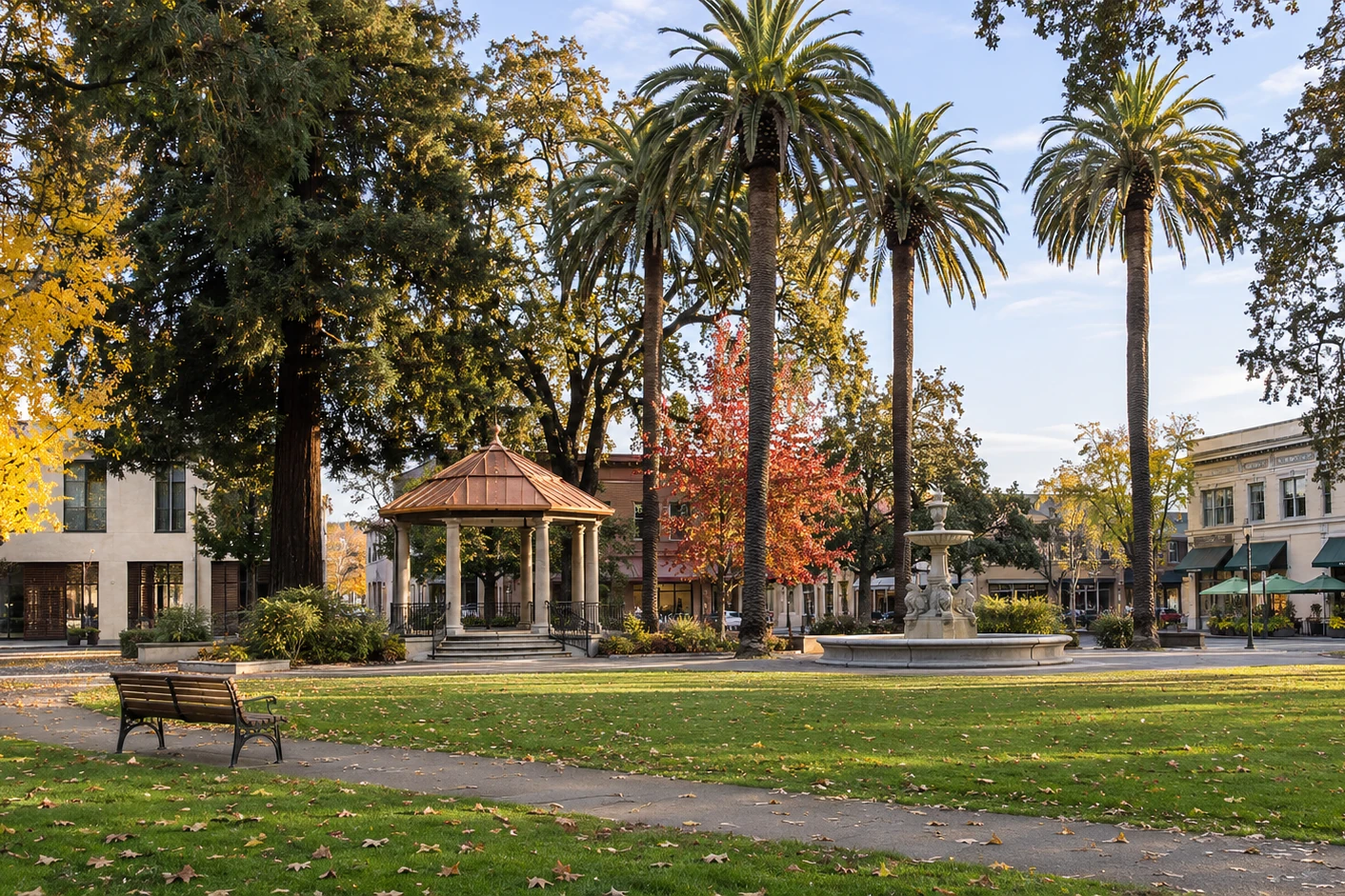
Climate considerations in Healdsburg
Healdsburg sits at about 105 feet beside the Russian River. July averages a high of nearly 89°F and a low of about 53°F, a wide daily swing, and usually brings no measurable rain. Winters are wet, with about 42 inches of rain a year on average, far more than the long dry summer suggests. For decks, that means boards dry, shrink, and check through months of sun, then soak up heavy winter rain through those openings. Wherever plants or debris keep wood from drying, the wet season does its damage faster.
When the vine becomes part of the structure
Wisteria, grapevines, and climbing roses are a familiar sight over Healdsburg decks and pergolas, and they do provide welcome summer shade. They also add load and trap moisture. Utah State University Extension describes wisteria as capable of destroying all but the strongest wooden or metal structures because of its weight and twining vines, calls for supports such as 6×6 or larger wood posts or steel, warns that it destroys lattice and prefabricated trellises, and advises keeping it out from under siding and out of gutters and downspouts. On decks we see the results: posts pushed out of plumb, beams sagging under a mature canopy, lattice and light rafters crushed, fasteners pulled, and rot where stems hold moisture against posts and railings. The fix is to size the structure for the plant, or give the plant a support of its own so the deck no longer carries it. Cutting back or training the vine is work for a gardener or arborist; we handle the structure.
Homes that sit empty
Some Healdsburg homes are lived in only part of the year. In 2020 the city had 5,051 housing units, and 264 of them were vacant for seasonal, recreational, or occasional use. Decks and balconies on those homes are easy to neglect. A leak at a ledger, a loose railing, or a stair that has started to rot can go unnoticed for a whole winter when nobody is there to see it, and the damage is larger by the time the owner returns. We inspect on a schedule that suits the owner, arrange access through a local contact, send a photo report, and can carry out repairs while the owner is away, with progress photos along the way.
The Plaza and the historic districts
Healdsburg was founded in 1857 and incorporated in 1867, and it still grows out from its nineteenth-century plaza. The Johnson Street and Matheson historic districts are locally designated, and their older houses have porches, steps, and railings built long before current standards. Some building permits in the city may also need design review, so we check with the City before planning exterior changes on these houses. The work usually means bringing railings and stairs up to code while keeping the character of the house, and replacing water-damaged wood under the paint.
Common building stock we work on
Healdsburg has about 11,300 residents, and roughly 58% of households own their homes. Older houses fill the historic districts and the streets around downtown. Newer homes toward the edges of town often have large decks and pergolas built for outdoor living, many now carrying mature vines. Part-time residences are spread through both. Small apartment and condominium buildings form the SB 721 and SB 326 inventory. Our certified construction crew scopes every project to the age of the house, what grows on it, how often it is occupied, and the code in effect at installation.
Neighborhoods served
Our certified Healdsburg crew covers Downtown Healdsburg and the Plaza, the Johnson Street Historic District, the Matheson Historic District, the North Area, the South Area, the University Street area, the Grove Street area, the Healdsburg Avenue corridor, the Dry Creek Road area, the streets toward the river, and the wider Healdsburg community. ZIP code 95448 covers the city.
What we typically see
Across our Healdsburg inspections, our company most often documents: (1) decks and pergolas overloaded or distorted by mature wisteria and other vines — a Healdsburg pattern given how many outdoor structures carry plantings here; (2) rot hidden behind stems and foliage on posts and railings; (3) problems on part-time homes that went unnoticed through a winter; (4) sun-checked boards letting heavy winter rain into the framing; (5) older porches and steps in the historic districts with decay under the paint; (6) railings on pre-2000 stock that fall short of the current CRC 42-inch height and 4-inch sphere rule. Every finding is captured in a written assessment with prioritized repair, replacement, or restoration scope.
Emergency response & remodeling
For Healdsburg properties with acute safety issues — sagging framing, loose railings, a pergola leaning under a vine, visible rot at load-bearing connections, red-tagged structures, or storm damage — our emergency repair crew responds within 24–48 hours with temporary shoring and code-compliant stabilization, including for owners who are away. We also handle full deck and pergola remodeling, sized from the start for the plants that will grow on them.