Climate considerations in Alum Rock
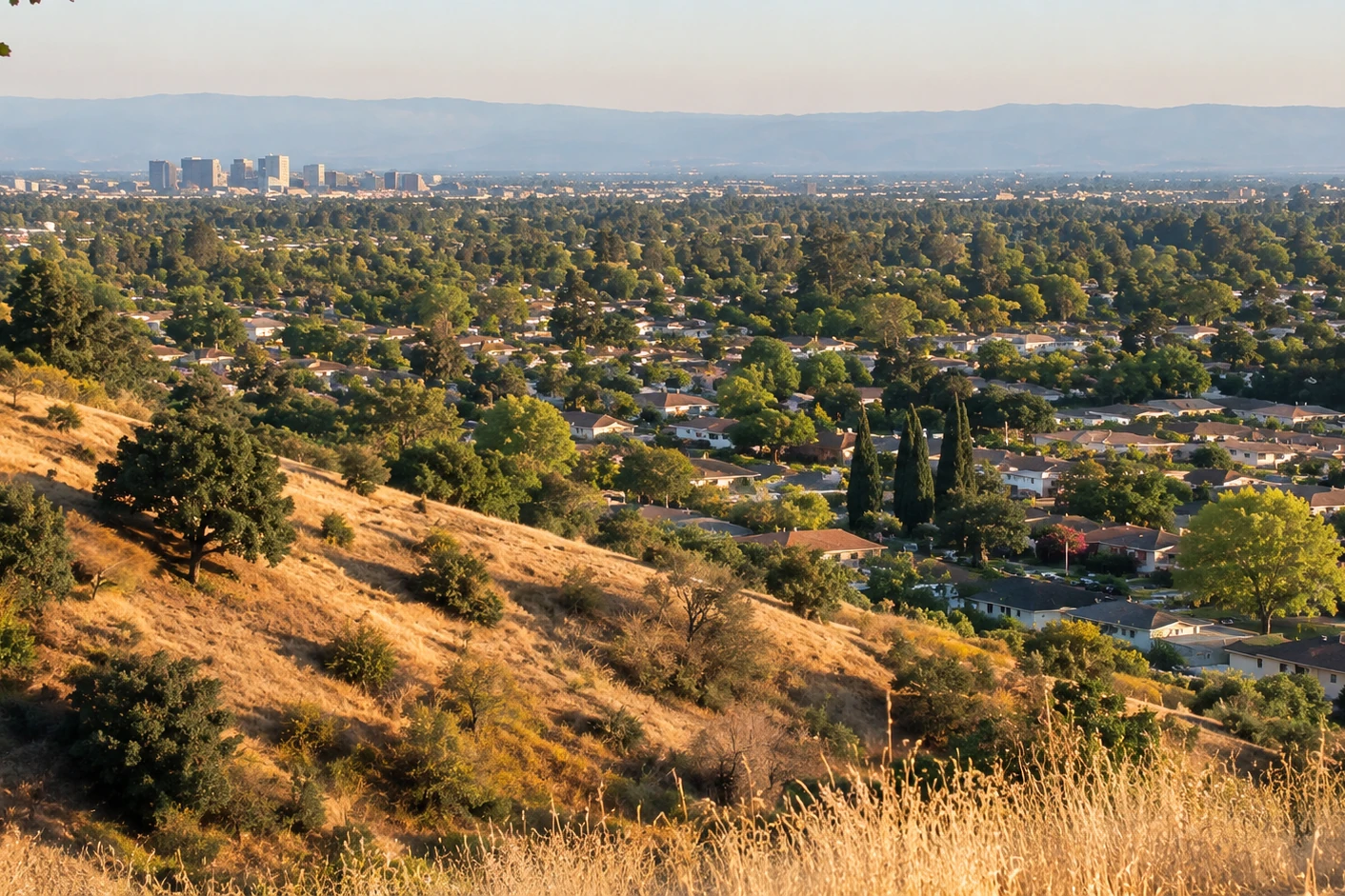
Alum Rock lies on the valley floor at the foot of the eastern hills, at about 150 feet. Summers are warm and dry, and the grass on the hills above turns brown by early summer. Winters are mild, with most of the year’s rain between November and March. For decks, the long dry season means strong sun, fast drying, and checking on exposed boards, followed by winter rain soaking into those checks. The ground is flat across most of the community and rises only at its eastern edge, so drainage around footings matters more than slope.
County or city: check before you apply
Alum Rock was once a separate town and became part of the wider urban area in the 1950s, but much of it was never annexed. Today much of the community is unincorporated land surrounded by an incorporated city, and some parcels have been annexed while their neighbours have not. Mailing addresses carry the city’s name either way, so the address alone does not tell you who issues the permit. For unincorporated parcels, building permits are issued by the County Department of Planning and Development, and SB 721 or SB 326 inspection reports go to the County where those laws apply. Planners have noted that residents of such areas can be confused about who provides services, and some only find out they are unincorporated when they need something. We confirm the jurisdiction for every parcel with the County’s property lookup before quoting a permit, so the application goes to the right counter the first time.
A deck that stays attached in an earthquake
On the evening of October 30, 2007, an earthquake of about magnitude 5.6 on the Calaveras Fault was centered in the hills just east of here. It caused only minor damage, but it was the largest earthquake in the region since 1989 at the time, and it is a reminder that faults run close to these homes. For decks, the part that matters most in shaking is the connection to the house. Many older decks rely only on a ledger bolted or nailed to the wall, which holds the deck up but does little to stop it pulling away sideways. The current California Residential Code requires lateral load connections for attached decks: hold-down tension devices in at least two places, within 24 inches of each end of the deck, each rated for at least 1,500 pounds, or four smaller devices rated at least 750 pounds. Adding them to an existing deck is usually straightforward when the framing is accessible, and we suggest it whenever a ledger is opened for repair.
Postwar houses on former orchards
Alum Rock was mostly orchard land until housing arrived in the 1940s and 1950s, and much of its housing dates from that period. These houses were usually built with small porches or concrete steps at the doors, and the backyard decks came later, often added by owners over the decades. As a result, decks here are often younger than the houses but built to whatever standard the builder chose at the time, with ledgers fastened into old framing, no flashing, and no lateral connection. We check what the deck is attached to as carefully as the deck itself.
Common building stock we work on
Alum Rock is densely built, with about 12,000 residents and households averaging about four people, and about six in ten homes owner-occupied. Much of the stock is single-family postwar housing with porches, back steps, and added decks. Homes on the foothill edge sit closer to the open grassland. Small apartment buildings along the main corridors and near the commercial strip at Alum Rock Avenue and White Road form the SB 721 inventory. Our certified construction crew scopes every project to the age of the house and deck, the agency that has jurisdiction, and the code in effect at installation.
Areas served
Our certified crew covers the Alum Rock Avenue corridor, the commercial strip at Alum Rock Avenue and White Road, the White Road area, the Capitol Avenue area, the neighborhoods between White Road and Capitol Avenue, the Fleming Avenue area, the Rose Avenue area, the Kirk Avenue area, the older postwar streets, the foothill-edge streets, and the wider Alum Rock community. ZIP code 95127 covers the community.
What we typically see
Across our inspections here, our company most often documents: (1) owners unsure whether their parcel is County or city, or permits started with the wrong agency — an Alum Rock pattern given how the unincorporated areas are laid out; (2) attached decks with no lateral connection to the house; (3) ledgers fastened into old framing without flashing; (4) added decks built to inconsistent standards on 1940s and 1950s houses; (5) sun-checked boards that let winter rain into the framing; (6) railings on pre-2000 stock that fall short of the current CRC 42-inch height and 4-inch sphere rule. Every finding is captured in a written assessment with prioritized repair, replacement, or restoration scope.
Emergency response & remodeling
For properties here with acute safety issues — sagging framing, loose railings, a deck pulling away from the house, visible rot at load-bearing connections, red-tagged structures, or damage after an earthquake or storm — our emergency repair crew responds within 24–48 hours with temporary shoring and code-compliant stabilization. We also handle full deck remodeling, with lateral connections built in from the start.