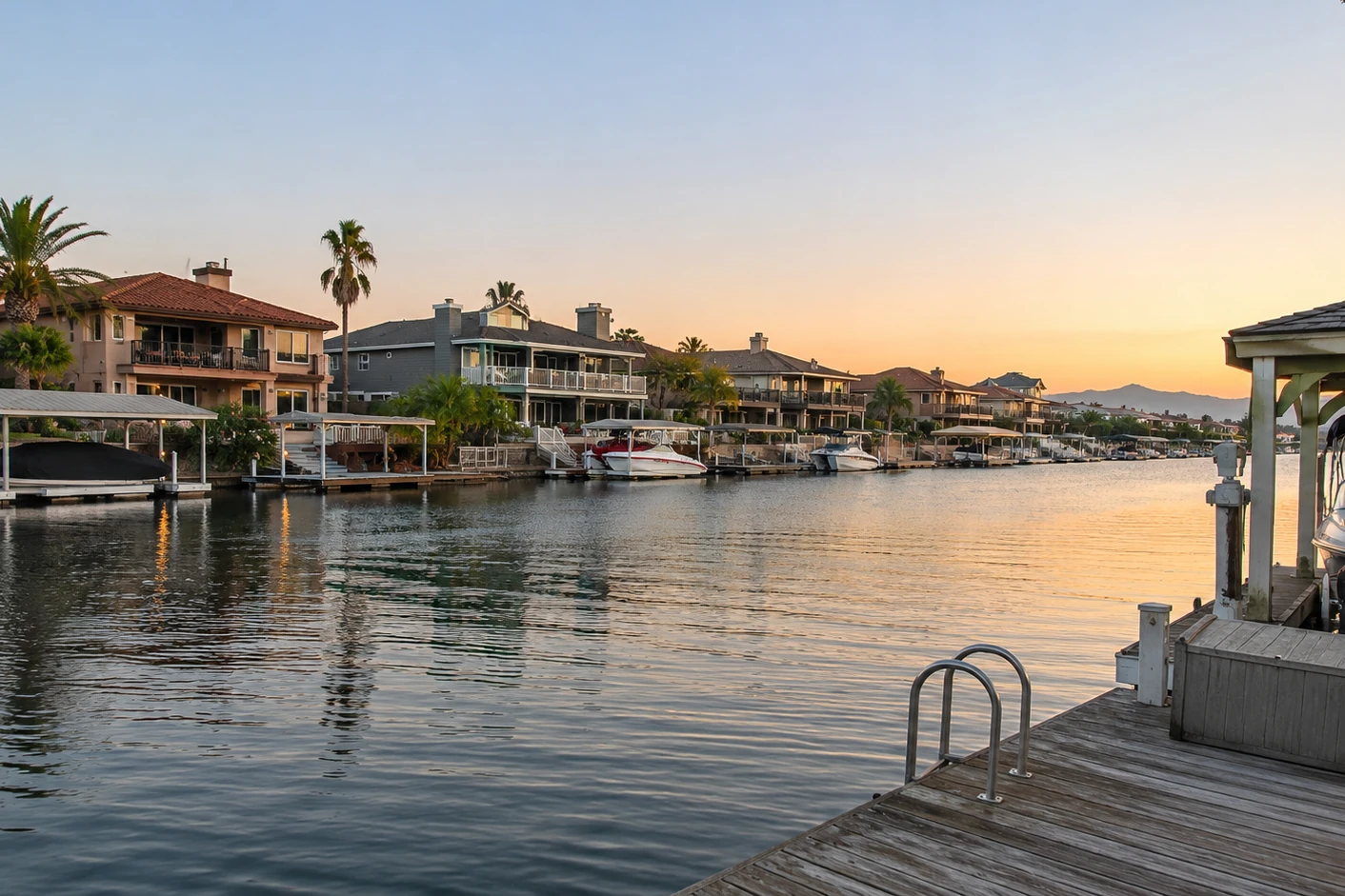
Climate considerations in Discovery Bay
Discovery Bay sits on the edge of the Delta, with long hot summers that regularly reach the high nineties and above, around 13 inches of rain falling between November and March, and wind off the water most afternoons. Humidity near the channels stays higher than a few miles inland, so ground-contact wood at the water’s edge dries more slowly than the climate figures suggest. On the water-facing side of a house, sun and wind arrive across open water with nothing to block them, so finishes and sealants on that side wear faster than on the street side. Those are the conditions. The features that make this community different are at the back of the lot.
The wall at the back of the yard
Waterfront lots along the channels end at a bulkhead or seawall that holds the yard back from the water. A deck built near that edge has its footings in the fill the bulkhead is retaining, so it is only as stable as that fill. Bulkheads age: joints open, boards or panels crack, and at the waterline, where the water level moves up and down against the wall, fine soil can wash out through gaps a little at a time. The loss happens behind the wall and below the surface, so the first sign is often a deck post or corner that has started to drop, a soft patch in the lawn near the edge, or a small sinkhole after a wet spell. Replacing or shimming the post in that situation does not hold, because the ground under it is still going. We check the area behind the bulkhead for settlement and voids before trusting any footing near it. The bulkhead itself is marine work, and we refer it to a marine contractor; once the wall is sound, the footings can be reset in ground that will stay.
Where the deck ends and the dock begins
A typical waterfront property here runs from the house to a deck or patio, then down a set of stairs to a landing at the top of the bulkhead, and from there by gangway to a dock or boat lift on the water. Owners often expect one contractor to handle all of it. In practice there are two trades involved. The deck, the land-side stairs, and the landing are structural carpentry, permitted through the County like any other deck work. The dock, gangway, floats, boat lift, and the bulkhead itself are marine work, and work in or over the water typically involves agencies beyond the County as well. We do the first part and not the second, and we would rather say that on the first visit than price work outside our trade. Where both are being done, we agree the handover point with the marine contractor so the stairs, landing, and gangway meet cleanly and the order of work makes sense, with the bulkhead dealt with first if it is part of the job.
Balconies facing the water
Many Discovery Bay homes are two storeys with balconies on the water side, and those balconies take more than most. They face open water, so afternoon sun and wind reach them directly, and in summer that sun is strong and long. Finishes and sealants break down faster on that side, and door thresholds and wall junctions get tested by wind-driven rain each winter. Where a balcony sits over a room below, a leak at the threshold goes into the ceiling rather than off the edge. We inspect water-facing balconies from above and below, re-flash thresholds and junctions where they have failed, and specify membranes and finishes for that exposure rather than for the shaded street side of the same house.
Common building stock we work on
Discovery Bay was developed mainly from the 1970s through the 2000s, with waterfront homes built along the dredged channels and inland homes behind them. Earlier waterfront homes are now at the age where original ledger flashing, deck framing near the water, and the bulkheads beside them have all been through several decades. Later two-storey homes carry water-facing balconies with the exposure described above. Townhome communities and a small amount of multi-family housing form the SB 326 and SB 721 inventory. Our certified construction crew scopes every project to the era, its position relative to the water, and the code in effect at installation.
Neighborhoods served
Our certified Discovery Bay crew covers Discovery Bay West, the Lakes, the marina area, the Discovery Bay Boulevard corridor, the Willow Lake Road area, the Clipper Drive area, the Newport Drive area, the Cabrillo Point area, the Bixler Road area, the original waterfront tracts, and the wider Discovery Bay community. ZIP code 94505 covers the community.
What we typically see
Across our Discovery Bay inspections, our company most often documents: (1) deck posts and corners near the water dropping because fill behind the bulkhead has washed out through gaps at the waterline — a Discovery Bay-specific pattern on its channel lots; (2) posts shimmed or replaced in earlier repairs without anyone looking behind the wall; (3) owners expecting a single contractor for deck, stairs, dock, and bulkhead, with the marine work unscoped; (4) water-facing balconies with finishes failing early and door thresholds leaking under wind-driven rain; (5) ground-contact decay at the water’s edge where humidity stays high; (6) railings on pre-2000 structures that fall short of the current CRC 42-inch height and 4-inch sphere rule. Every finding is captured in a written assessment with prioritized repair, replacement, or restoration scope.
Emergency response & remodeling
For Discovery Bay properties with acute safety issues — a deck dropping near the water’s edge, sagging framing, loose railings, a stair to the dock that has started to move, visible rot at load-bearing connections, red-tagged structures, or storm damage — our emergency repair crew responds within 24–48 hours with temporary shoring and code-compliant stabilization. Where the bulkhead is involved we stabilise the deck and tell you plainly that the wall needs a marine contractor first. We also handle full deck, stair, and balcony remodeling on waterfront lots, coordinated with any marine work on the same edge.