Climate considerations in Dixon
Dixon sits on flat farmland on the valley floor. Summers are long, hot, and dry, with afternoons regularly in the high nineties and above, driving UV degradation of finishes, surface checking, and thermal stress at connections. Annual rainfall is around 18 inches, nearly all of it between November and March, with tule fog in the winter months. The ground is level across the whole city, so there is no slope to carry water away from a structure, and soils are heavy enough to hold moisture once they are wet. On those numbers alone a deck here should spend half the year bone dry. Many do not, and the reason is not the weather.
Wet all summer from the sprinklers
In a town this hot and dry, lawns and garden beds are irrigated through most of the year, and on a great many properties the sprinklers reach the deck. Overspray wets the boards, the posts, and the ledger against the house, sometimes every morning from spring to autumn. Planting along the edge of a deck adds to it: shrubs grown against posts and skirting hold water against the wood and keep air from moving. The result is a pattern that surprises owners: decay concentrated along one edge or at a few posts, in a structure that has been through very few rainy days since it was last sealed. Summer heat then works on the wet surface, so finishes break down faster there too. The repair itself is ordinary carpentry. What makes it last is dealing with the cause, which usually means adjusting or moving a few sprinkler heads and keeping planting clear of the structure. We check which surfaces the irrigation reaches during the assessment and mark them in the report, so the fix covers both the damage and where it came from.
Decks that sit almost on the ground
Because Dixon lots are flat, many decks here are built low — often less than a foot above the soil, sometimes only a few inches. Low decks have one serious drawback that is easy to miss: there is no way to see the framing without lifting boards. The space underneath is too shallow to get into, air barely moves through it, and the soil below stays damp long after the surface has dried. Joists and beams in that space can take on water damage for years while the deck surface looks fine and feels solid underfoot, until a board gives way or a joist fails. A walk across the surface tells you very little about a structure like this. During the assessment we lift selected boards so the framing can actually be seen, and on a rebuild we add clearance and ventilation underneath wherever the site allows, so the next deck does not sit in the same conditions.
Downtown and the older streets
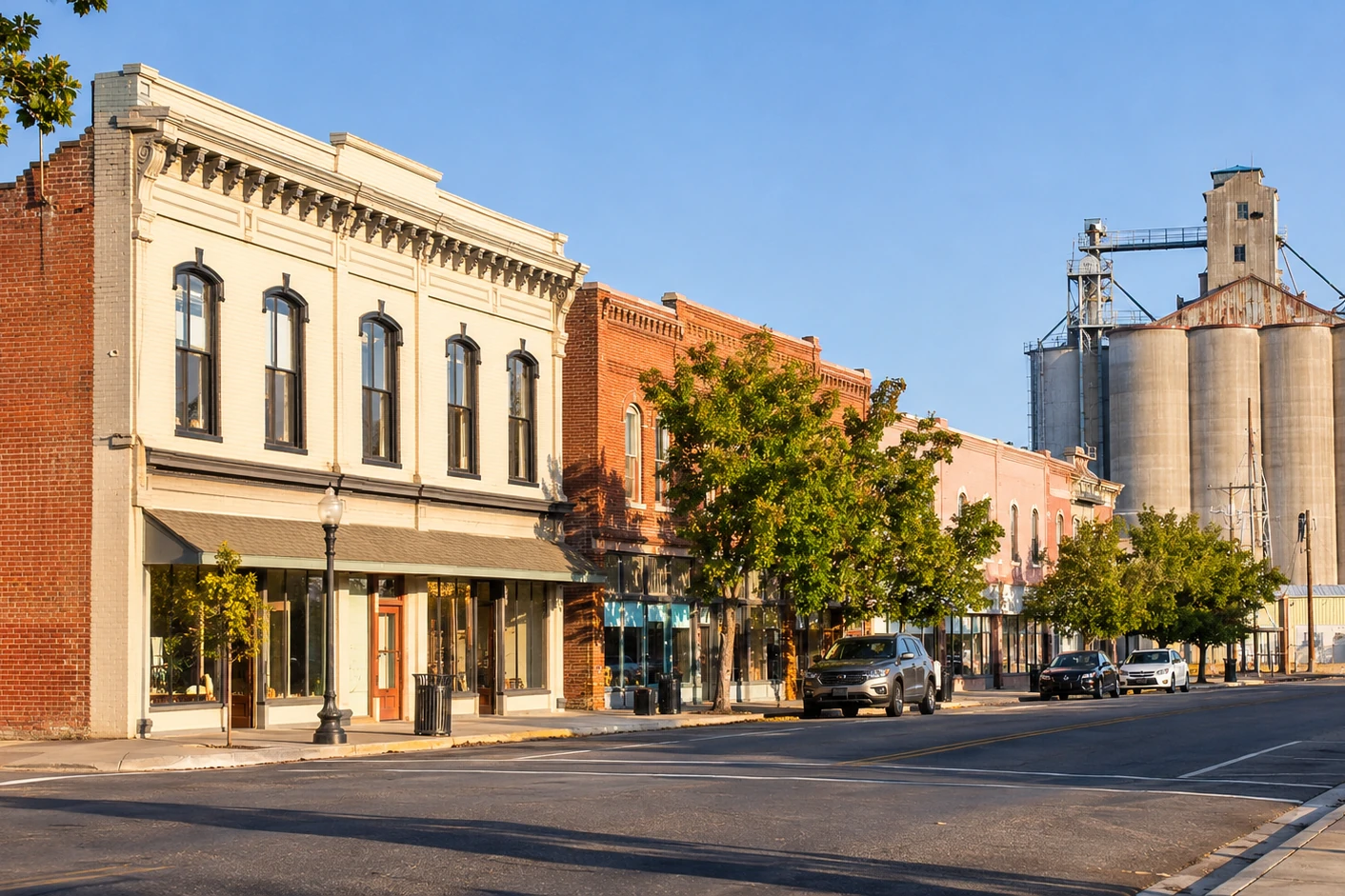
Dixon’s downtown along First Street holds brick commercial buildings from the late nineteenth and early twentieth centuries, some with upper floors and original stairs, set beside the rail line and the grain elevator that served the farms around the town. The residential streets near the centre carry pre-war and post-war houses with original porches, stairs, and connection details that predate current standards. Work on this stock means bringing load capacity and railing geometry up to code while keeping the character of the building, and it means expecting older connection methods behind the finish rather than assuming modern framing. These buildings are a small share of the city, but they are where the oldest details are found.
Common building stock we work on
Most of Dixon’s housing was built from the 1980s onward as the town grew, across Valley Glen, Southwest Dixon, North Dixon, and the surrounding subdivisions. That stock is now at the age where builder-grade ledger flashing, caulked joints, and first-generation waterproofing reach end of service life, and the low decks and irrigation exposure described above apply to much of it. Older houses near the centre and the brick commercial buildings downtown carry the details set out in the previous section. Apartment and HOA-managed townhome communities form the SB 721 and SB 326 inventory, with original waterproofing and hardware at or past service life on the older complexes. Our certified construction crew scopes every project to the era, the clearance under the deck, and the code in effect at installation.
Neighborhoods served
Our certified Dixon crew covers Downtown Dixon, the First Street district, Valley Glen, Southwest Dixon, North Dixon, the A Street corridor, the Pitt School Road area, the Stratford Avenue area, the Porter Road area, the Rehrmann Drive area, and the wider Dixon community. ZIP code 95620 covers the city.
What we typically see
Across our Dixon inspections, our company most often documents: (1) water damage concentrated along one edge, at a few posts, or at the ledger where sprinkler overspray reaches the structure through the dry season — a Dixon-specific pattern in a town where irrigation, not rain, is often the deck’s main source of water; (2) joists and beams water-damaged under low decks that look and feel sound from the surface; (3) shrubs and planting grown against posts and skirting, holding moisture and blocking airflow; (4) heat-driven surface checking and sealant breakdown from summers in the high nineties; (5) builder-grade ledger flashing failing on the 1980s and later subdivisions; (6) railings on pre-2000 stock that fall short of the current CRC 42-inch height and 4-inch sphere rule. Every finding is captured in a written assessment with prioritized repair, replacement, or restoration scope.
Emergency response & remodeling
For Dixon properties with acute safety issues — a board or joist that has given way, sagging framing, loose railings, visible rot at load-bearing connections, red-tagged structures, or storm damage — our emergency repair crew responds within 24–48 hours with temporary shoring and code-compliant stabilization. Where a low deck has failed, we check the rest of the framing underneath before deciding on a repair, because decay in that space rarely stops at one joist. We also handle full deck remodeling for owners replacing older low decks, with added clearance, ventilation, and posts kept clear of irrigation.