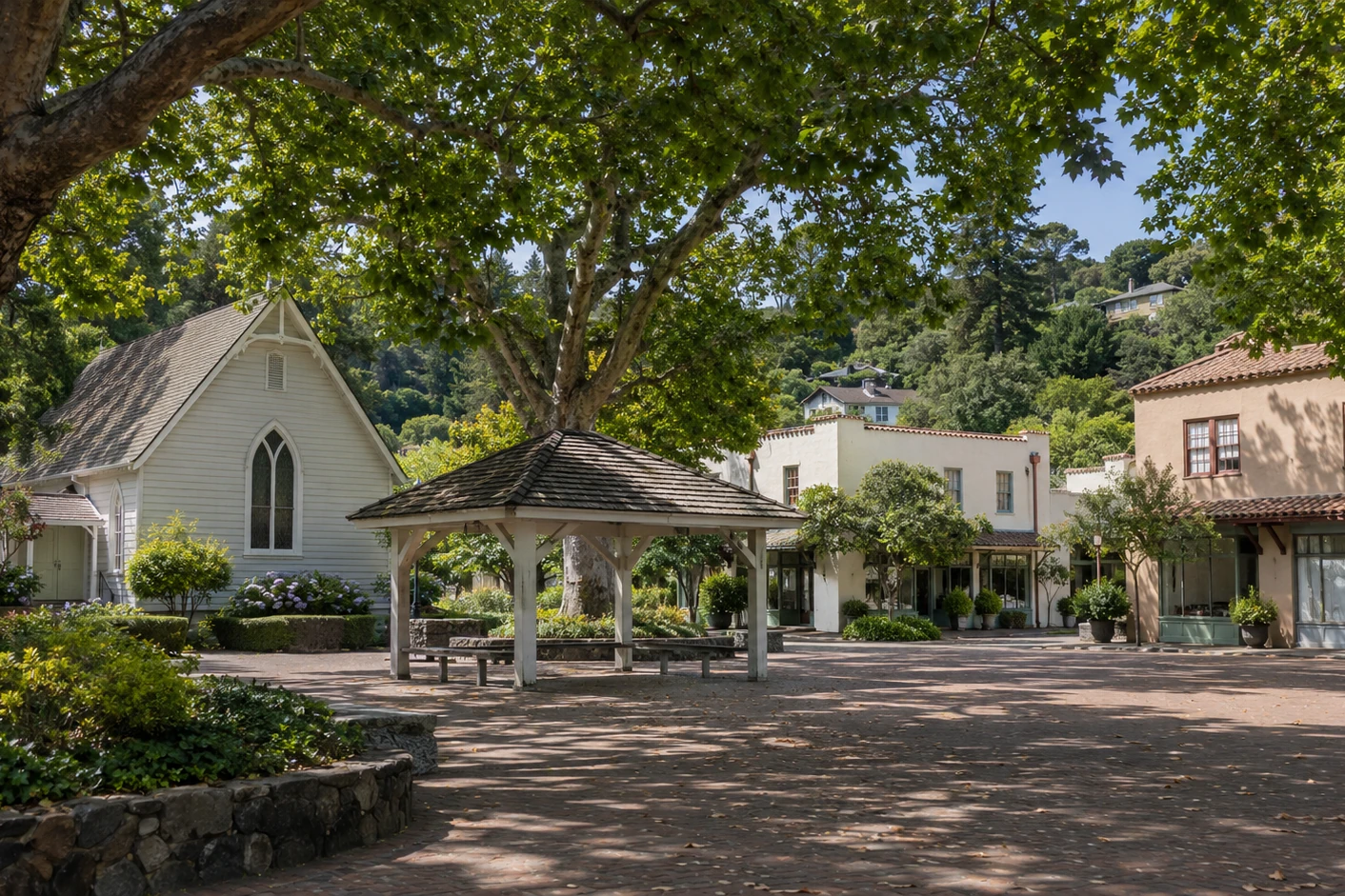
Climate considerations in Corte Madera
Corte Madera sits at an elevation of about 39 feet, running from wooded slopes below the mountain down to flat ground at the edge of the bay. Summers are mild and winters wet. The hillside neighborhoods are shaded and slow to dry after rain. On the low ground, the Town’s Climate Change Adaptation Assessment notes that king tides and storm events already flood streets and backyards, and the ground itself is slowly sinking. For decks, that means two very different settings in one small town: damp, shaded decks on the hill, and low decks near the bay that sit closer to standing water every year.
When the house goes up, the deck goes with it
Some Corte Madera homes in the flood zone are being raised so that their first floors sit above base flood elevation. A deck that used to be a step down from the back door can end up several feet in the air, which changes everything about it: it needs stairs and landings, guards wherever the drop is more than 30 inches, footings sized for the new height, and room on the lot for all of it. In 2025 the Town filed a zoning amendment that applies only to uncovered decks, landings, or stairs attached to homes raised above base flood elevation. It would allow additional flexibility on lot coverage and setbacks for uncovered rear-yard decks 3 to 5 feet high on bayside lots along Golden Hind Passage, and increase lot coverage by 2% for medium-density residential parcels in the flood zone. We plan the new deck at the same time as the raised house, so the layout, stairs, and guards fit the lot and the rules, and suggest confirming the current provisions with the Town.
Low decks on settling ground
Parts of Corte Madera are slowly sinking, mostly because the bay mud they were built on keeps compacting, and Marina Village is protected by a flood-protection berm that the Town has sought to strengthen and raise. For low decks and patio decks, that slow settlement shows up as lost clearance. A deck built a few inches above the yard can, over years, end up with joists and posts touching soil, or sitting in water after every storm. Wood in that position stays wet and decays from below, out of sight. We measure the clearance under low decks, look for water lines and soil against the framing, and fix the cause: lifting or rebuilding the deck, replacing framing with lumber rated for ground contact, and adding gravel or drainage underneath so water does not pond.
Christmas Tree Hill and the older town
Corte Madera incorporated in 1916, and Christmas Tree Hill is one of its oldest neighborhoods. Its first lots were tiny, many used for tents and cabins after 1906, and most later year-round homes were built on combinations of several of them. Its public paths and stairs are older than its roads, and the upper streets are narrow, steep, and winding. Decks on the hill are often on posts over sloping ground and stay shaded and damp. Before planning an extension there, we confirm where the lot actually ends and where any public path runs.
Common building stock we work on
Corte Madera has about 10,200 residents and roughly 4,000 homes, with around seven in ten owner-occupied. Older houses fill Christmas Tree Hill, Chapman Park, and the streets near the old town square. Homes on the low ground toward the bay, including Marina Village and the bayside lots, face settling ground and, for some, the choice to raise the house. Condominium and townhome communities form much of the SB 326 inventory, and apartment buildings fall under SB 721. Our certified construction crew scopes every project to the ground the deck stands on, the height it needs to reach, and the code in effect at installation.
Neighborhoods served
Our certified Corte Madera crew covers Christmas Tree Hill, Chapman Park, Marina Village, the Golden Hind Passage area, the old town square, the Corte Madera Avenue corridor, the shoreline neighborhoods, the central neighborhoods, the hillside streets, the flood-zone residential areas, and the wider Corte Madera community. ZIP code 94925 covers the town.
What we typically see
Across our Corte Madera inspections, our company most often documents: (1) low decks whose framing has settled into soil or standing water — a Corte Madera pattern given the compacting bay mud under much of the low ground; (2) homes raised above flood level with temporary or undersized stairs and landings; (3) decks rebuilt at a new height without guards or handrails sized for it; (4) shaded hillside decks slow to dry after rain; (5) older decks on the hill fastened to framing from several eras; (6) railings on pre-2000 stock that fall short of the current CRC 42-inch height and 4-inch sphere rule. Every finding is captured in a written assessment with prioritized repair, replacement, or restoration scope.
Emergency response & remodeling
For Corte Madera properties with acute safety issues — sagging framing, loose railings, a stair pulling away from a raised house, visible rot at load-bearing connections, red-tagged structures, or storm and flood damage — our emergency repair crew responds within 24–48 hours with temporary shoring and code-compliant stabilization. We also handle full deck remodeling for raised homes and low-ground lots.