Signs Your Apartment Balconies Need Waterproofing
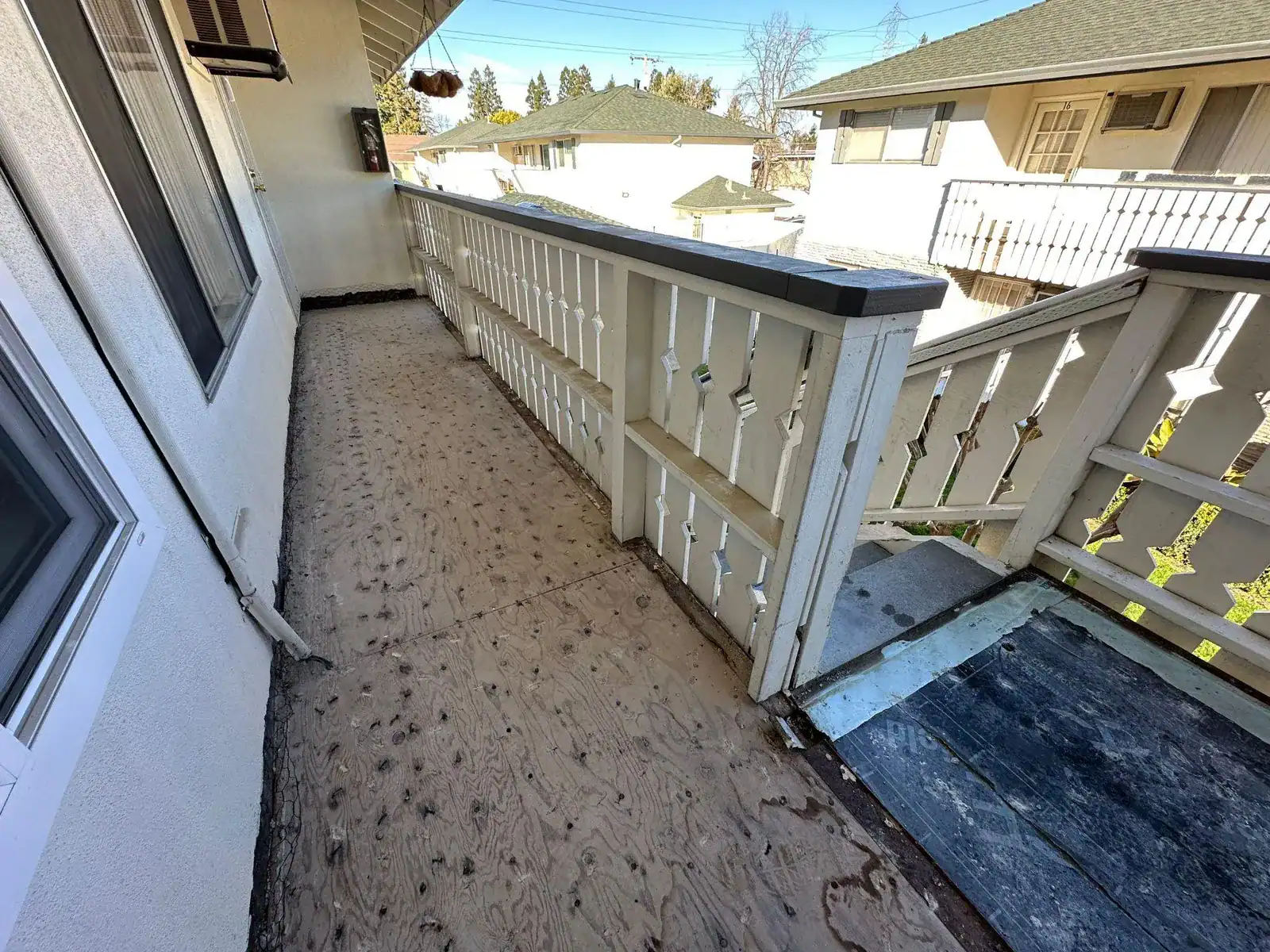
A balcony on a California building looks solid right up until the day it doesn’t. On the surface everything checks out: the paint holds, the deck feels firm underfoot, tenants set out a chair and a few potted plants without a second thought. Underneath, though — below the coating and behind the stucco — water has been doing its quiet work for several seasons. Wood loses strength long before the damage shows: by the time it surfaces, the load-bearing capacity is often seriously compromised.
This article is about the early signs — the ones a manager or owner spots on a routine walk-through and then puts off for later. We’ll go through them one at a time: what each one means, what to do about it, and how urgently to act. Along the way we’ll explain why, in California, these signs aren’t just cosmetic but a matter of law, insurance, and people’s safety.
Why Catching It Early Changes Everything
Water doesn’t punch through a balcony overnight. It works its way in gradually: through a hairline crack in the coating, through a worn-out membrane, through a wall joint that lost its seal long ago. From there the moisture gets trapped inside the structure. An elevated balcony has no real airflow underneath, so the water has nowhere to evaporate — and rot sets in, hidden from view for months, sometimes years.
That’s why an early sign is worth a lot, in the good sense. Catch a stain in time and you’re looking at a waterproofing refresh. Miss it, and you’re opening up the deck and replacing joists — a different conversation in both cost and timeline. In 2015 a balcony collapsed at an apartment building in Berkeley and six people died; the cause was traced to hidden dry rot in the wooden joists behind the membrane. It was after that tragedy that California introduced mandatory inspections. We keep that case in mind not to frighten anyone, but to remember the price of a missed signal.
Seven Warning Signs You Shouldn’t Ignore
California balconies have a seasonal trap of their own. A long dry summer bakes the coatings until they crack and lose their flex — and the first real rainy season hits those weakened spots hard. That’s why many of the signs below show up right after the rains: checking your balcony in the fall, before the wet season, and again in spring, after it, is a habit that pays for itself.
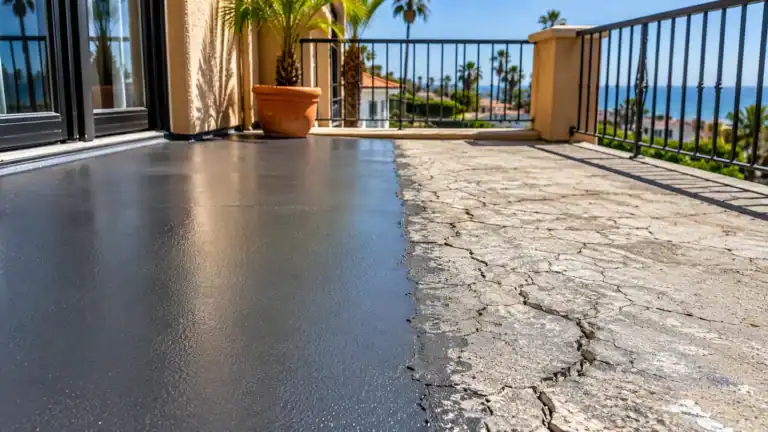
- Cracks and chips in the surface. A fine web on the coating is one thing, but a crack that keeps coming back after you patch it points to movement in the structure below. What to do: don’t seal it blind — bring in a specialist to look at the substrate. Urgency is moderate, but don’t drag your feet.
- Dark stains and discoloration. A change in color on the deck or on the ceiling beneath the balcony is a near-certain sign moisture is already inside. What to do: track down the source and inspect the underside. Urgency is high if the stain is spreading.
- Mold or that telltale musty smell. Mildew and a damp odor mean standing water where there shouldn’t be any. What to do: find where the moisture is coming in, rather than just scrubbing off the surface. Urgency is high.
- Puddles that won’t drain. Water sitting longer than half an hour after rain means the slope is off or the drainage is blocked. What to do: restore the drainage and a slope of roughly one to two percent. Urgency is moderate.
- Rust on fasteners and brackets. Reddish streaks on the metal mean corrosion of load-bearing hardware — especially aggressive near the coast because of the salt air. What to do: assess how far the corrosion has gone. Urgency is high if the supports are affected.
- Peeling or blistering paint. The coating bubbles and flakes off in patches where moisture is building underneath. What to do: open up the trouble spot and check what’s behind it. Urgency is moderate.
- A soft, spongy deck underfoot. A board that flexes, sinks, or sounds hollow is no longer a warning — it’s nearly a diagnosis: rot inside. What to do: limit the load and call a contractor right away. Urgency is critical.
Spot even one of these and it’s not a verdict — but it’s not a reason to wait, either. The sooner you understand what’s happening under the coating, the cheaper and calmer the repair will be.
When the Surface Is Clean but Trouble Hides Inside
The trickiest scenario is when there are no obvious signs at all. The surface is even, the paint intact, no stains in sight — and yet the wood under the membrane is already soft. It happens because water enters at a single point: one joint, one crack by the wall, one seam where the deck meets a door threshold. That trail of moisture barely reads from the outside, but inside it feeds rot for years, and by the time a board starts to sag, you’re repairing the structure, not the surface.
That’s exactly why a seasoned contractor doesn’t rely on a glance. Simple but honest tools come into play: a moisture meter reveals hidden dampness where the eye is useless, tapping uncovers voids and punky wood under a crust that looks solid, and in questionable spots a small section is carefully opened up to view the framing firsthand. For California balconies this matters most near the coast, where salt air eats hardware from within, and in stucco-faced buildings where dampness has an easy place to hide. A moisture reading once a year, especially after the rainy season, catches the problem while it still costs pennies.
What These Signs Mean Under California Law
In California, the condition of a balcony stopped being the owner’s private business a while ago. Senate Bill 721 requires owners of rental buildings with three or more units to have their exterior elevated elements — balconies, stairways, walkways — inspected by a licensed professional. The first inspection deadline landed on January 1, 2026 (extended by Assembly Bill 2579), and it has already passed. For condominiums run by an HOA, a separate law applies: SB 326, with its own schedule.
Here’s the connection worth understanding. The same seven signs you notice with your own eyes are exactly what an inspector looks for during an official check. Neglected defects turn into citations, and unresolved violations carry fines of one hundred to five hundred dollars a day, a lien on the property, and insurance trouble that can go as far as a refusal to renew the policy.
It sounds severe, but the intent of the law is simple: don’t let a balcony reach a state where it’s dangerous to people. Regular inspection and timely waterproofing are how you pass a check without surprises and sleep easy. If your property is a condominium run by an HOA, it falls under SB 326 rather than SB 721, with its own requirements for who signs the report. You’ll find more on the inspection itself for rental buildings on our SB 721 page.
Not sure how this applies to your building?
A licensed contractor answers — free, same-day callback.
What to Do Once You’ve Found a Sign
The first instinct — patch it, paint over it, forget it — is exactly what leads to the expensive outcomes. The right order is different, and it isn’t complicated. Here’s what to do, step by step.
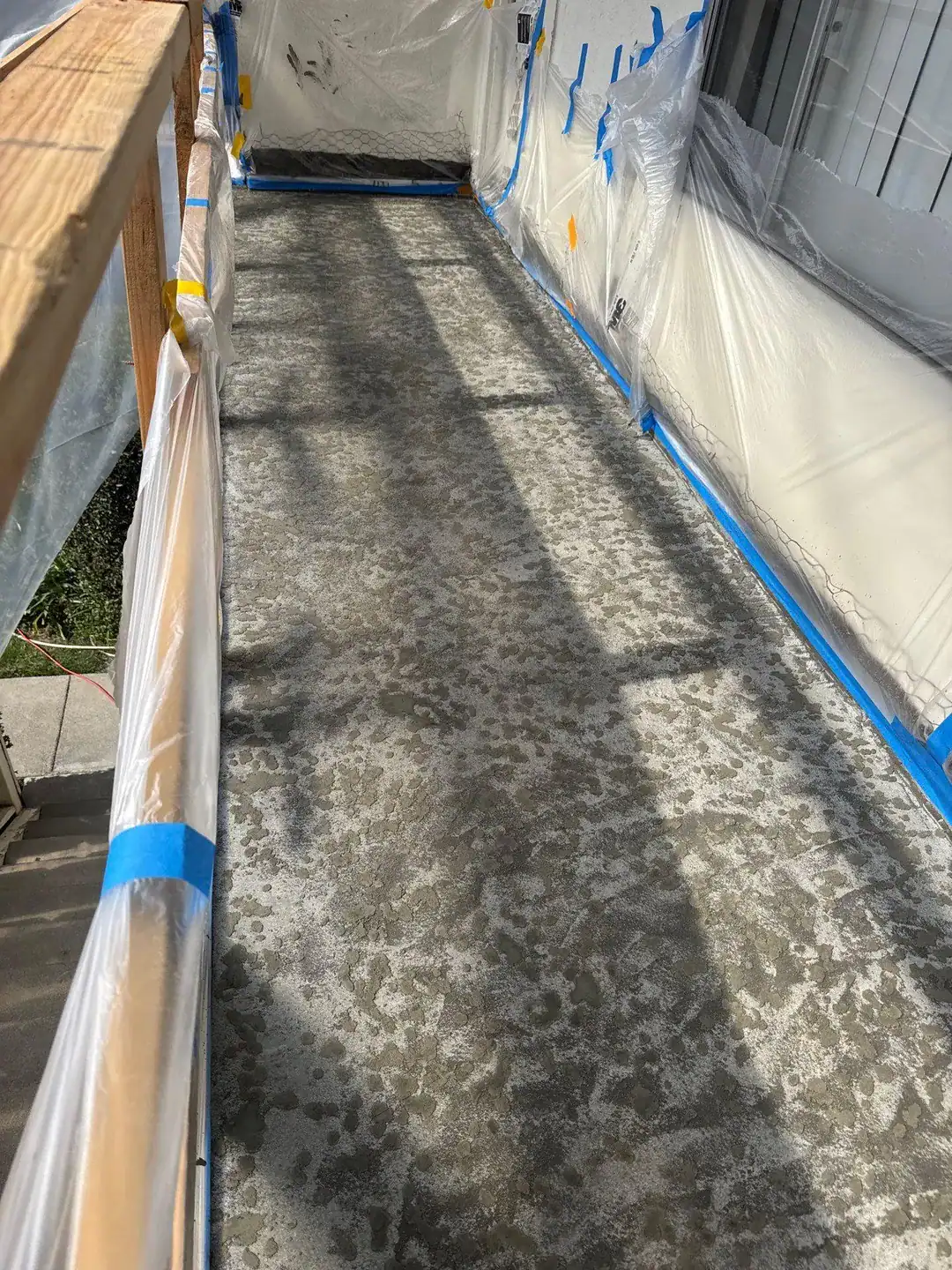
- Document it. Photograph the spot close up and from a distance, and note the date. This helps the contractor, the insurer, and the inspection too.
- Gauge the urgency. A soft deck, corroded supports, a growing stain — these are reasons to act within days, not weeks.
- Restrict access if there’s a hazard. A shaky balcony is better closed off to tenants for now than left to chance.
- Call a specialist. A licensed contractor will open up the problem area and tell you for certain whether a waterproofing refresh is enough or the structure needs repair.
- Keep the paperwork. Save the reports and repair records — they show the property is being maintained and help at the next inspection.
This approach saves both nerves and budget. You’re not guessing — you’re acting on facts, and the call is made by someone who has seen hundreds of balconies like yours.
Waterproofing or a Full Repair: Where the Line Is
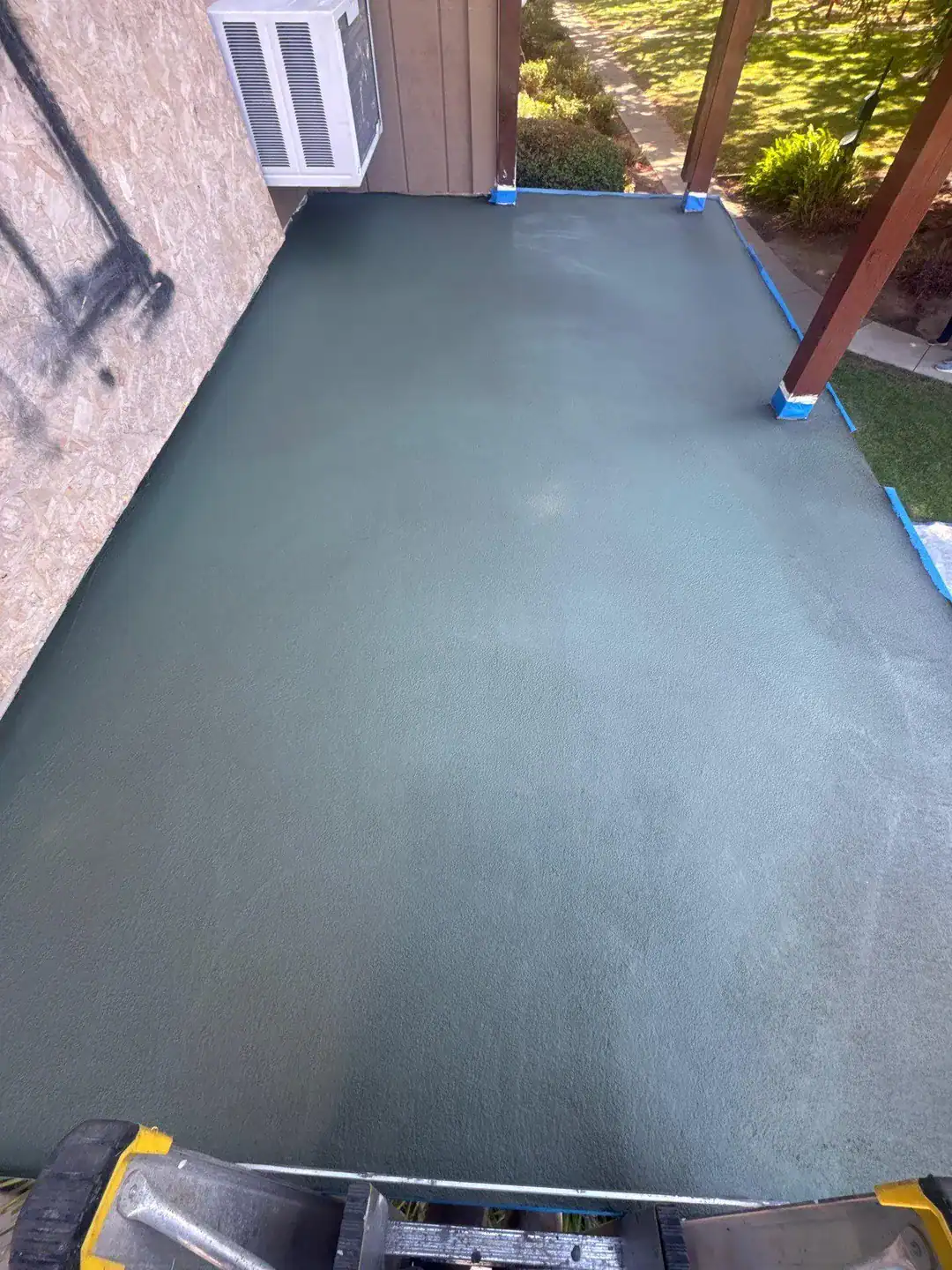
Not every warning sign means major construction. If water is only beginning to find its way in and the framing is sound, the fix is often a waterproofing refresh: the old coating comes off, the slope and the seals are restored, and a new membrane goes on. It’s planned, predictable work, and it costs noticeably less than replacing joists.
It’s another matter when the deck is soft and there’s punky wood underneath. Then the surface alone won’t do — you have to open it up, replace the damaged elements, restore the load-bearing part, and only then lay the waterproofing again. No one will honestly quote you an exact figure over the phone: the price depends on the number of balconies, how accessible the structure is, and how much hidden damage turns up along the way. The one reliable rule of thumb: the earlier you call someone in, the closer your case is to the simple version.
There’s another convenience, too — with us, the assessment, the official inspection, and the repair stay in one set of hands. We carry out the legally required inspection ourselves, including with a licensed engineer on staff, and the same crew handles the repair that follows — no handing the property off to outside contractors and no passing the buck. For what’s involved in each type of work, take a look at our Waterproofing section and the Balconies 101 guide.
Acting Early Costs Less Than Fixing It Late
A balcony rarely fails out of nowhere — it sends signals for a long time, and nearly all of them are visible with ordinary attention. A crack that returns, a dark stain, a musty smell, a standing puddle, rust, blistered paint, a sagging board — each of these speaks its own language, and now you understand it.
It’s worth keeping the law’s calendar in mind, too: inspections under SB 721 and SB 326 repeat on a cycle, which means a well-kept, properly waterproofed balcony isn’t only about tenant safety — it’s also about clearing the next inspection without a scramble or a fine.
Acting in order — document, assess, call a specialist — beats waiting for the problem to decide everything for you. And if you’d like the balcony looked at, and repaired where needed, by someone who does this every day across Sacramento and the Bay Area, we’re here.
Related service
Waterproofing
Licensed, insured and SB 721/326-fluent — from assessment to sign-off, one accountable team.
About the author
Tom Marsden
Retired Property Inspector · Reviewed under CSLB #1060736
Tom Marsden is a retired property inspector with 20 years of experience. Starting as a general contractor, he transitioned to inspections, specializing in multi-family dwellings. Known for his straightforward approach and ability to simplify complex regulations, Tom became a respected figure in the local property management community. Now retired, he mentors new inspectors and writes about building safety, focusing on balcony inspections and maintenance. In his free time, Tom enjoys restoring vintage sailboats and volunteering at the local community center.
More from Tom Marsden