Cable Deck Building · CSLB #1060736
Commercial Cable Deck Building in California
We build decks with cable railing for apartment communities, condominiums and HOA properties across the Bay Area, Central Valley, and Sacramento. A deck cable railing keeps the view open, but its cables are pulled tight and stay that way, and that pull goes into the end and corner posts and the deck frame under them. We build the deck and the railing together, so the frame is ready for that load before the cables go in.
- CSLB #1060736 Licensed California contractor
- 9+ yrs Building decks on occupied buildings
- Framed for tension End and corner posts built for cable pull
- Commercial & HOA Apartments, condominiums & HOA communities
01 Why it matters
A deck cable railing pulls on the frame all the time
A picket railing only carries load when someone leans on it. A cable railing carries load from the day it is installed. Feeney, one of the main cable railing manufacturers, states that each properly installed cable carries a tension of at least 300 pounds. A 42-inch railing with cables about 3 inches apart has more than ten cables, so the end post of a single run is pulled by several thousand pounds, all the time.
That load lands on the end and corner posts and on the framing they are fastened to. If the post is attached to a single rim joist, the rim can roll, the post leans in, the cables lose tension and start to sag. A sagging cable is a code problem, not only a looks problem: the guard has to keep a 4-inch sphere from passing through, and cables that deflect under a push can open past that.
So the framing under the posts is part of the railing design. On a deck we build for cable railing systems, the end and corner posts sit on blocking or doubled framing and are through-bolted, posts are spaced so the cables cannot deflect too far, and the guard as a whole is designed for the 200-pound load the code applies to its top. That work is simple while the deck is open and difficult once the boards are on.
Every cable is pulling on the end post from the day it is tightened. The frame under that post decides whether the railing stays tight.

02 The D&B difference
How we frame a deck for cable tension
Posts are planned with the framing
End posts, corner posts and stair posts are located on the framing plan before the joists go in, with blocking and through-bolts drawn at each one.
Spacing set for deflection, not just looks
Cable spacing, post spacing and intermediate spacers follow the manufacturer’s instructions, so the railing passes the 4-inch sphere rule after tensioning, not only on paper.
Hardware matched to the site
Stainless cable and fittings, and posts and rails in finishes chosen for the exposure. Where salt air or pool water is nearby, we match the stainless grade to it.
03 · Service Areas
Where We Work in California
Every city links to a dedicated local page — crews, recent projects and compliance details for that area.
Sacramento Metro
22 cities
East Bay
31 cities
North Bay
17 cities
Central Valley
15 cities
South Bay & Peninsula
29 cities
Don’t see your city? We likely still cover it — call (916) 848-2728.
04 How a project runs
How a cable deck project runs
-
01
Assessment
A free property assessment, scheduled within a week. We record the deck outline, its height above grade and every run where railing will go.
-
02
Design
Deck layout, railing runs, post locations, cable direction and finishes.
-
03
Drawings
Framing plan with blocking at every end and corner post, guard details and calculations from a licensed structural engineer we work with.
-
04
Permit
Plans filed with the building department and followed through plan check.
-
05
Framing and decking
Footings, framing, blocking at the posts, decking.
-
06
Railing
Posts, top rail, cables threaded, tensioned evenly and checked against the 4-inch sphere.
05 Scope
What our cable railing deck work covers
Deck Railing Stairs
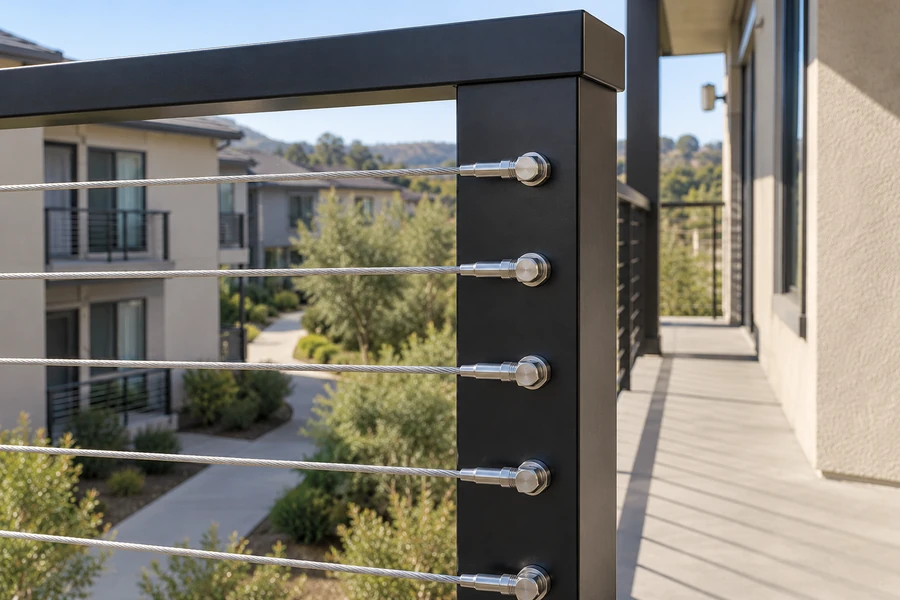
- Footings, beams, joists and decking in wood or composite
- Blocking and doubled framing at every end, corner and stair post
- Ledger attachment per CBC 1604.8.3 where the deck is attached to the building
- Horizontal or vertical cable infill
- Posts and top rails in aluminium, steel or wood, with stainless cable and fittings
- Post and cable spacing per the manufacturer’s instructions
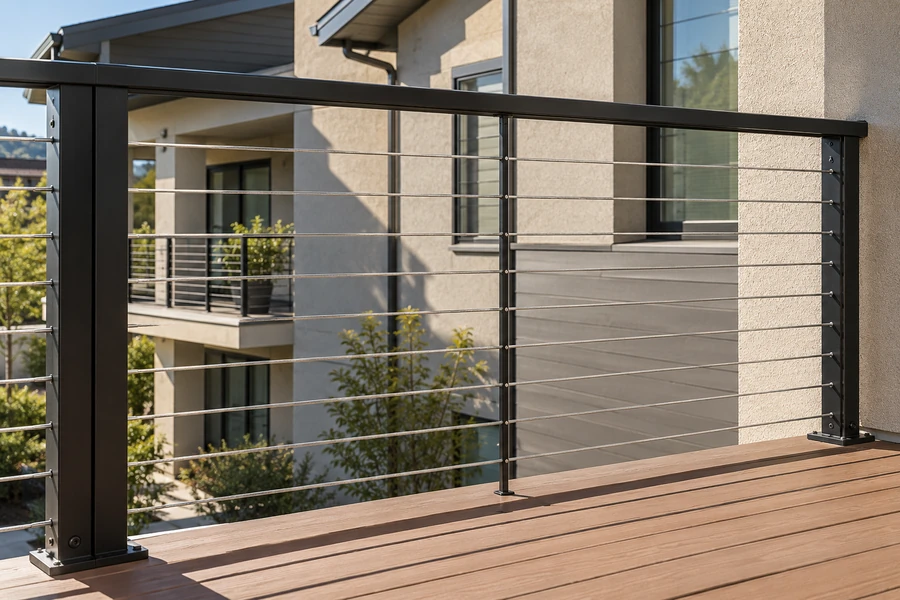
- Intermediate spacers on longer runs
- Guards at least 42″ high where the drop is more than 30 inches
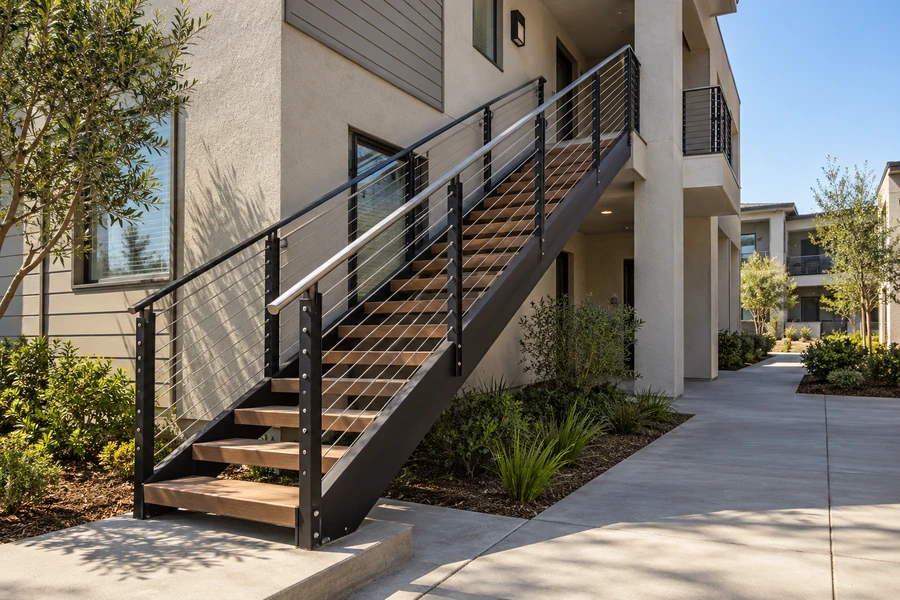
- Cable infill following the stair slope
- Graspable handrails on stairs
Built to current code: CBC 1015 guards · 42″ guard height · 4″ sphere rule · 200 lb concentrated load on the top of the guard · CBC 1011 stair handrails · CBC 1604.8.3 deck attachment · SB 721 and SB 326 requirements for exterior elevated elements
06 Investment
What the deck and cable railing cost
We price after a free assessment, and you receive an itemized quote within five business days.
What sets the number
- How large and how high each deck is
- Linear feet of railing
- Number of end and corner posts, each with its own tension hardware and framing
- Horizontal or vertical cables
- Post and rail material and finish
- Stairs with cable infill
- Design and permit requirements of the city or county
Why corners cost more than straight runs: the cable and posts in a straight run are a large part of the price per linear foot, but every end and corner adds a heavier post, tension fittings and blocking in the frame. A railing with many short runs costs more per foot than one long run.
Final pricing follows an on-site assessment. Request a free estimate — no obligation.
In the field
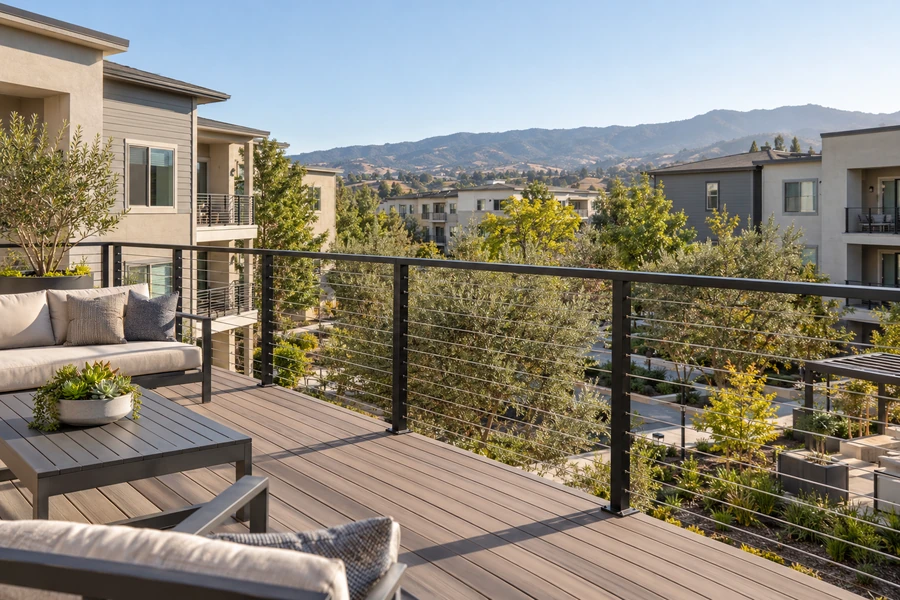
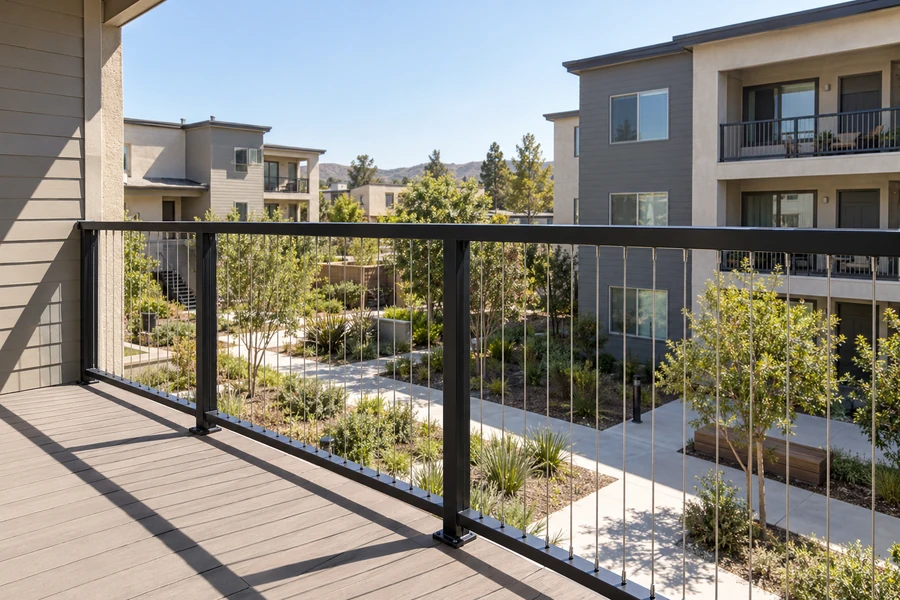
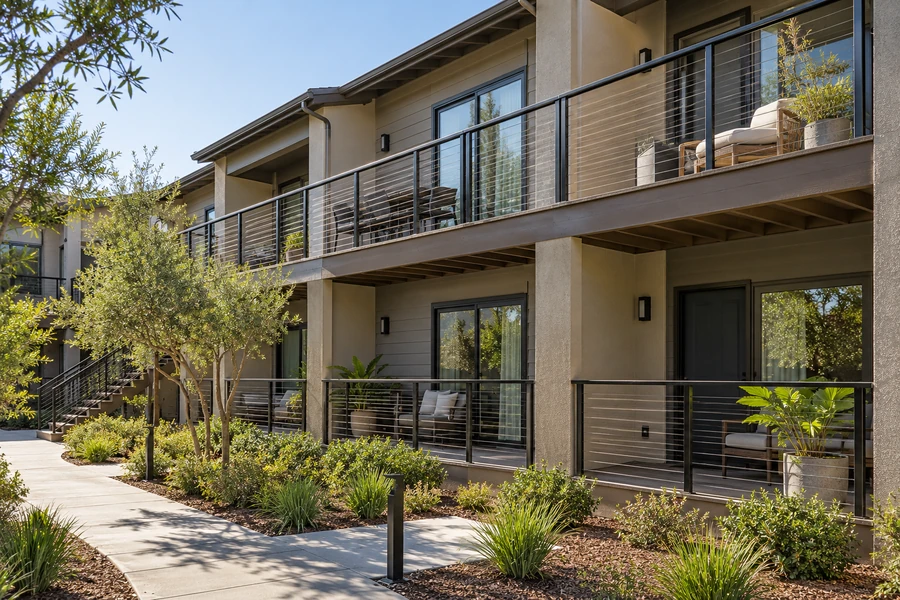
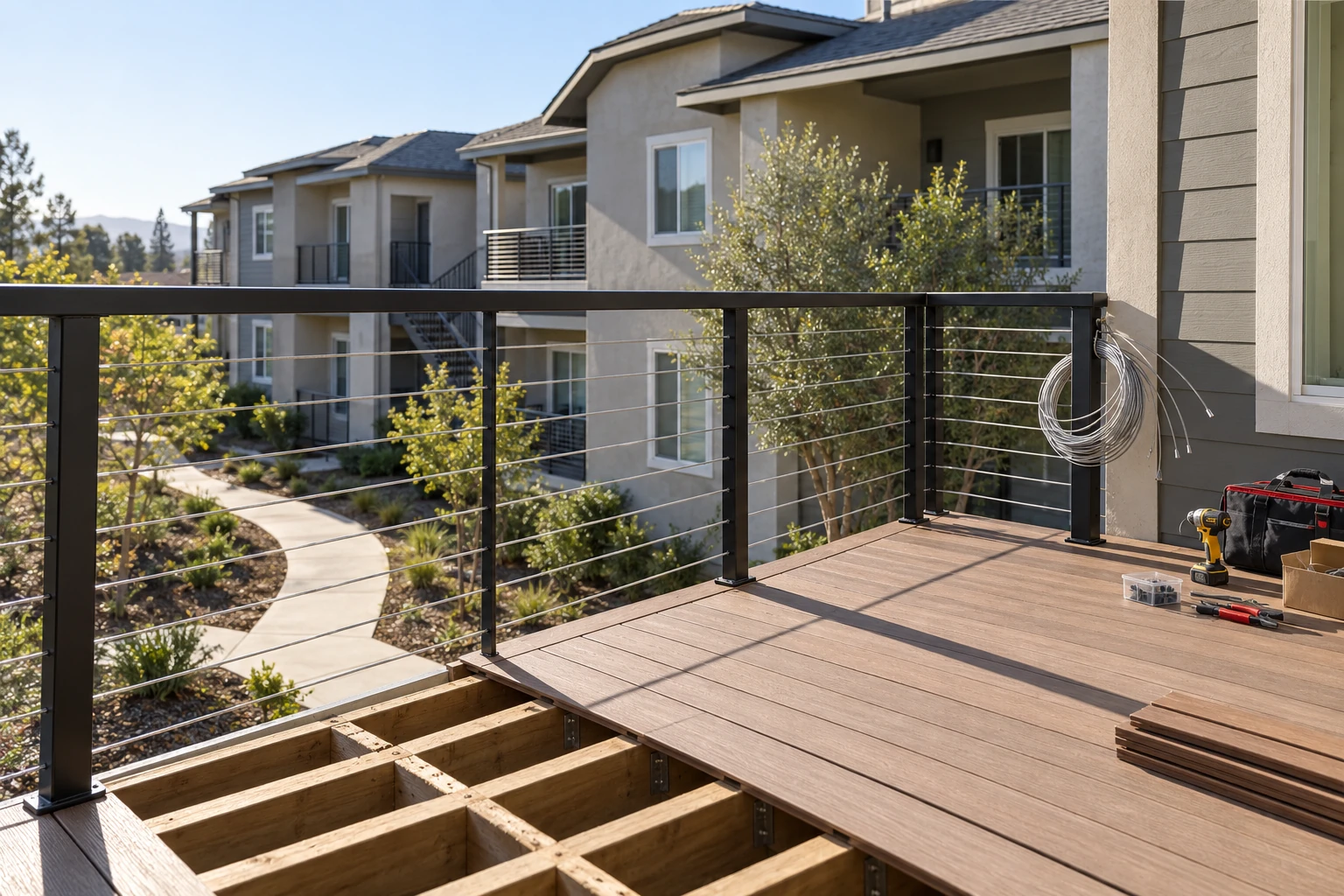
Deck cable railing ideas on apartment properties
Open views, intermediate spacers, vertical cables, stairs and one railing repeated along a building.
07 Project example
A recent amenity deck with cable railing
The property wanted an open railing so residents could see the courtyard and the hills from the deck. We set the end and corner posts on the framing plan before the joists went in, added blocking and through-bolts at each one, and kept the posts close enough together that the cables could not deflect past the sphere limit. The cables were tensioned evenly from the middle run outward, and each run was checked with a 4-inch sphere before the deck was handed over.
We wanted the view without the railing getting in the way. They showed us what the cables would pull on and framed the deck for it from the start. Property Manager · California apartment community
08 Case studies
Recent Projects, Documented
Real commercial properties — what the building needed, what we did, and what it delivered.
 Deck ConstructionCommunity-Wide Elevated Deck Replacement — San RamonEvery elevated deck across a hillside townhome community rebuilt to a single spec in one managed program —…View case study
 Deck RepairTrex Stair & Balcony Installation — Apartment Building, OaklandFrom the patio the stair looked like one well-kept assembly. From underneath it was an open wood frame…View case study
 Balcony RepairBalcony Replacement with Trex Composite Decking — 18 Balconies, AntelopeThe rot had already reached the beams and posts. We rebuilt the framing under every balcony and re-decked…View case study
09 Client feedback
What property managers say
We wanted the view without the railing getting in the way. They showed us what the cables would pull on and framed the deck for it from the start.
Our old cable railing had gone slack at every corner. The new posts are bolted into blocking, and the cables have stayed tight.
They walked the deck with a 4-inch ball before handing it over. That told us more than any brochure.
10 FAQ
Cable railing deck questions
What do cable systems for deck railings need from the deck?
Strong end and corner posts and framing that can hold them. Each cable is tensioned to hundreds of pounds, and all of that pull goes into the end posts. Those posts need blocking or doubled framing and through-bolts, which is easiest to build in when the deck itself is built.
How far apart are the cables and posts?
On a deck cable railing, manufacturers set the spacing so the railing passes the 4-inch sphere rule after the cables are tensioned. Feeney specifies cables no more than 3 inches apart and a post or intermediate spacer at least every 3 feet; other manufacturers give similar figures. We follow the instructions of the system installed.
What does the building code require for cable deck rails?
The same as any guard: at least 42 inches high where the drop is more than 30 inches, no opening a 4-inch sphere can pass through, and a design that carries a 200-pound load on the top. With cable, the sphere rule has to hold with the cables pushed, which is why spacing and tension matter more than with pickets.
Is a vertical cable deck railing better than horizontal?
Vertical cables are set between a top rail and a bottom rail and do not pull on the end posts the way long horizontal runs do. Horizontal cables keep the view most open and are the more common choice. Some properties choose vertical cables near play areas so the railing offers no footholds.
Can cable railing go on a deck stair?
Yes. The cables follow the slope of the stair between the posts, and a graspable handrail is added where the stair requires one. The top rail of a cable guard is often too wide to grip, so the handrail is usually a separate round rail.
How much does a cable deck railing cost?
It depends on the linear feet of railing, the number of end and corner posts, cable direction, post material and stairs. Ends and corners cost more than straight runs because each one has heavier posts, tension fittings and framing. We price per project after a free assessment and send an itemized quote within five business days.
Does a deck cable railing need maintenance?
Cables can lose a little tension over time, especially in the first months. Manufacturers call for checking tension periodically and retightening when needed. Stainless fittings and cables should be rinsed where they are exposed to salt air or pool water.
Can cable railing be added to an existing deck?
Often, but the existing frame has to be opened or checked at each end and corner post to confirm it can take the cable tension. Where it cannot, blocking is added before the posts go on. Building the railing with a new deck avoids that step.
Do you build decks and cable railings near me?
We work across the Bay Area, Central Valley and Sacramento, with free property assessments scheduled within a week. Decks, railings, stairs and permits come from one CSLB-licensed contractor (#1060736). Call (916) 848-2728 with the city and roughly how many feet of railing the job needs.
11 Start here
Build a deck with cable railing for your property — book a free assessment in California
Tell us whether the deck is new or existing, the length of railing, and whether you prefer horizontal or vertical cables. We schedule the assessment within a week and send an itemized quote within five business days.
CSLB #1060736 · 9+ years · Insured & Bonded · Commercial, multifamily & HOA properties across the Bay Area, Central Valley & Sacramento