Deck Board Repair · CSLB #1060736
Commercial Deck Board Repair in California
We repair deck boards and replace the ones that cannot be kept on apartment, condominium and HOA properties across the Bay Area, Central Valley, and Sacramento. Deck boards can be repaired one at a time, and each one can fail in its own way: a splintered surface, a crack, a break, a cupped or soft board, a nail working loose. To fix deck boards so the repair holds, we look at three things on every board: what failed, how it was fastened, and what the new board is cut from.
- CSLB #1060736 Licensed California contractor
- 9+ yrs Repairing decks on occupied buildings
- Board by board Repaired or replaced one at a time
- Commercial & HOA Apartments, condominiums & HOA communities
01 Why it matters
A deck board repair is decided by the fastener and the cut end, not only the board
The USDA Forest Products Laboratory’s Wood Handbook says horizontal surfaces such as decks are often the worst affected when sun dries the wood and rain wets it again, and that wooden decks are most commonly replaced because of checking and splitting, not decay. Left to weather, wood fibres gradually fray off the surface, a process the Handbook calls erosion. Wetting and drying make the wood swell and shrink, and the Handbook links those changes to checking, splitting, warping and cupping.
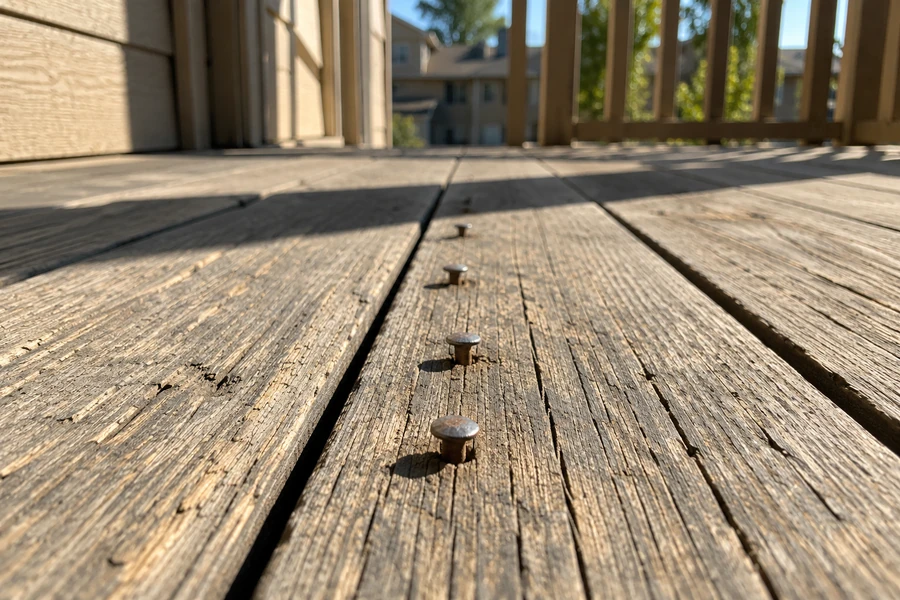
Fasteners are part of the board repair. The Handbook says common smooth-shank nails driven into green wood that then dries lose a major part of their hold, down to as little as 25% of the value right after driving, while threaded nails of the same diameter hold about four times better under changing moisture. On older decks fastened with smooth nails, we check every nail head that stands above the surface and refasten with threaded fasteners.
A replacement board has its own weak points. AWPA Standard M4 sets requirements for field cuts and holes in pressure-treated wood that reach past the preservative zone, and the American Wood Protection Association’s Colin McCown names copper naphthenate for cut ends and drilled holes. He also notes that the sapwood of redwood or cedar has little or no decay resistance. So every field cut we make is sealed, and redwood replacement boards are chosen without sapwood.
A new board needs a sound joist under it, a threaded fastener in it and a sealed cut end. We check all three on every board we replace.

02 The D&B difference
What we do differently on every board we touch
Each board gets a named failure
We mark boards as splintered, cracked, split, broken, cupped, soft or loosely fastened. The quote lists them the same way, so the property sees why each board is on it.
Cut ends and holes are sealed on site
Pressure-treated boards cut to length on the deck get copper naphthenate on the cut ends and drilled holes, the field finish AWPA Standard M4 requires for cuts in pressure-treated wood.
Loose boards are refastened, not nailed again
Raised nails are pulled or set and the board is refastened with threaded fasteners rated for pressure-treated lumber, into the joist, not into the old hole.
03 · Service Areas
Where We Work in California
Every city links to a dedicated local page — crews, recent projects and compliance details for that area.
Sacramento Metro
20 cities
East Bay
28 cities
North Bay
14 cities
Central Valley
13 cities
South Bay & Peninsula
27 cities
Don’t see your city? We likely still cover it — call (916) 848-2728.
04 How a project runs
Fixing decking boards on a property, step by step
-
01
Assessment
We visit for free within a week, walk and probe every board, and mark each one by type of failure.
-
02
Quote
Sent within five business days, item by item: boards to replace, boards to refasten, joist work.
-
03
Removal
Damaged boards cut out between joists or pulled whole, without splitting the boards beside them.
-
04
Joist check
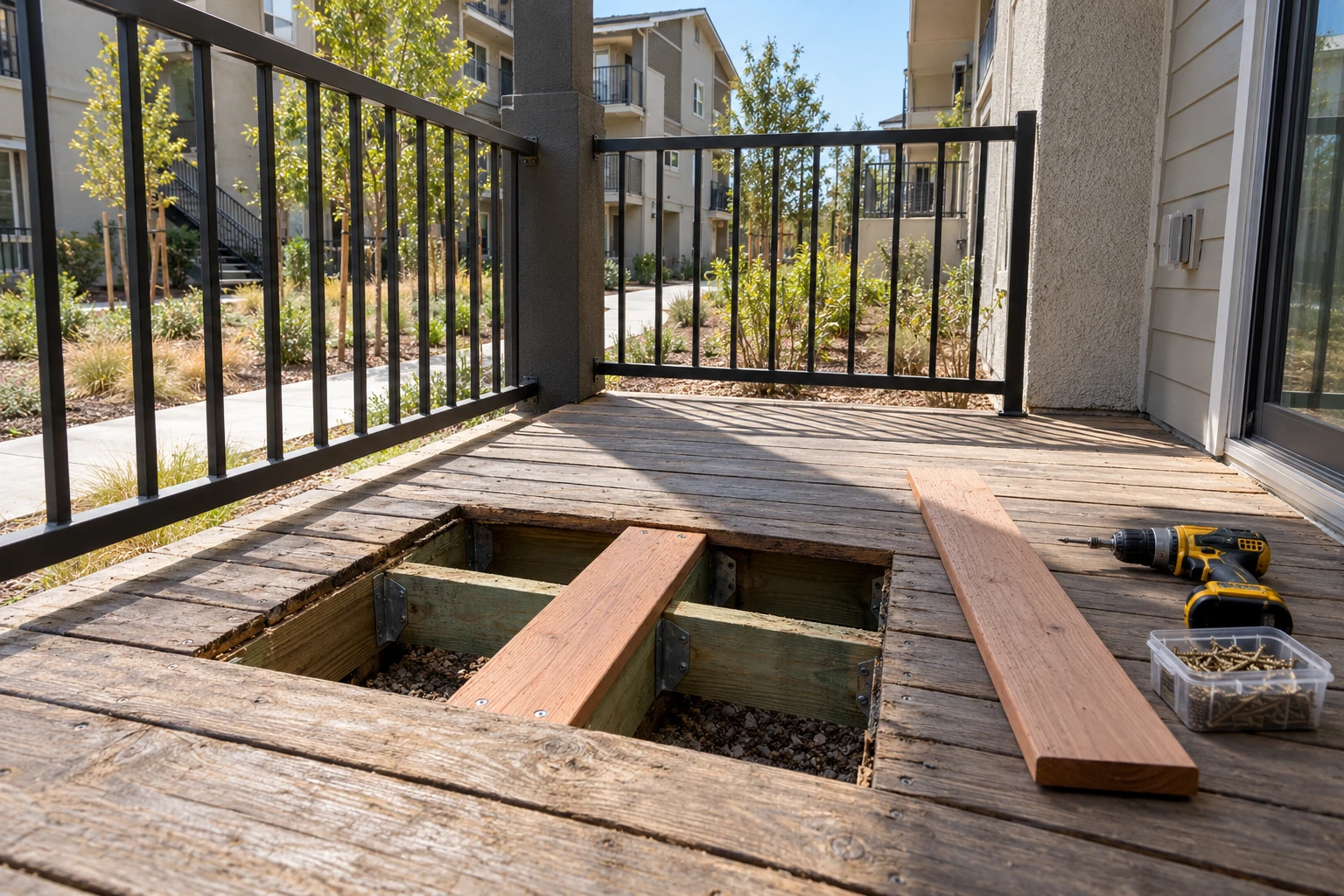
With the board out, the joist top below is probed; soft or split framing is repaired before a new board goes on.
-
05
New boards
Boards matched in species and size, cut ends sealed, fastened with threaded fasteners and gapped to the boards around them.
-
06
Finish
A penetrating finish on the repaired area or the whole deck, if the property chooses.
05 Scope
What our deck board repair covers
Boards Fastening and cut ends Under and on the boards
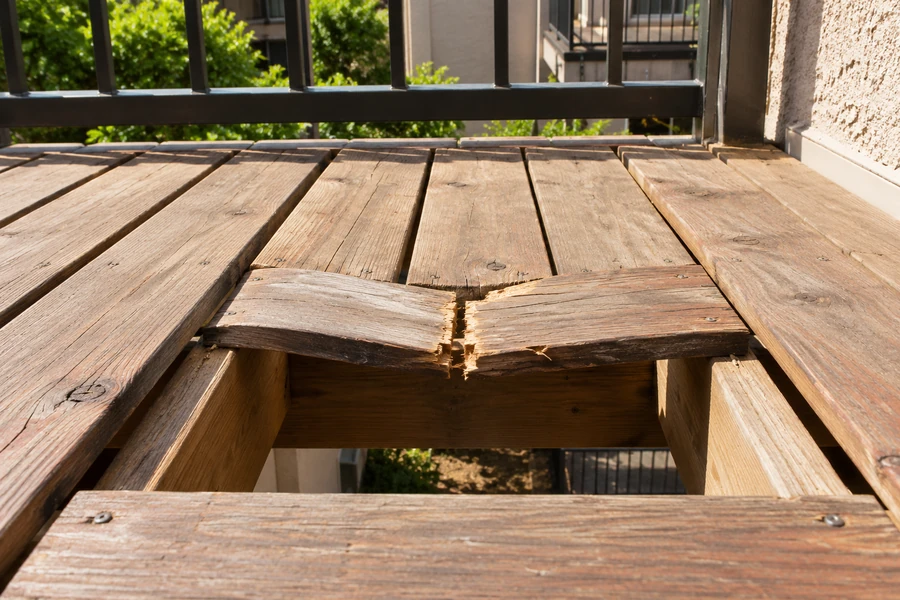
- Replacement of splintered, split, broken and cupped boards
- Removal of rotted boards and the wood around them
- Composite boards replaced with the deck’s own fastening system
- Stair treads replaced to match the deck
- Raised nails pulled or set, boards refastened with threaded fasteners
- Copper naphthenate on cut ends and drilled holes of pressure-treated boards
- Redwood replacements chosen without sapwood
- Joist tops probed under every removed board
- Joist and blocking repair where the framing is damaged
- Penetrating finish after repair
Built to current code: Field cuts in pressure-treated wood finished per AWPA M4, referenced in CBC 2303.1.9 · CRC R507.2.3 deck fasteners and connectors where the Residential Code applies · CBC 1604.8.3 deck attachment where the ledger is repaired · CBC 1015 guards · SB 721 and SB 326 requirements for exterior elevated elements
06 Investment
What decides the cost to repair deck boards
Pricing follows a free site visit, with every board and every fastener job listed.
What sets the number
- Count of boards to replace and boards to refasten
- Species and size of board needed to match
- Joist repair found under removed boards
- Stairs and railings next to the repaired area
- Finish on the repaired area or the whole deck
- Number of decks and access to them
Why refastening is priced separately: a board that is sound but loose needs new fasteners, not new wood. Listing those boards apart keeps new lumber on the boards that need it.
Final pricing follows an on-site assessment. Request a free estimate — no obligation.
In the field
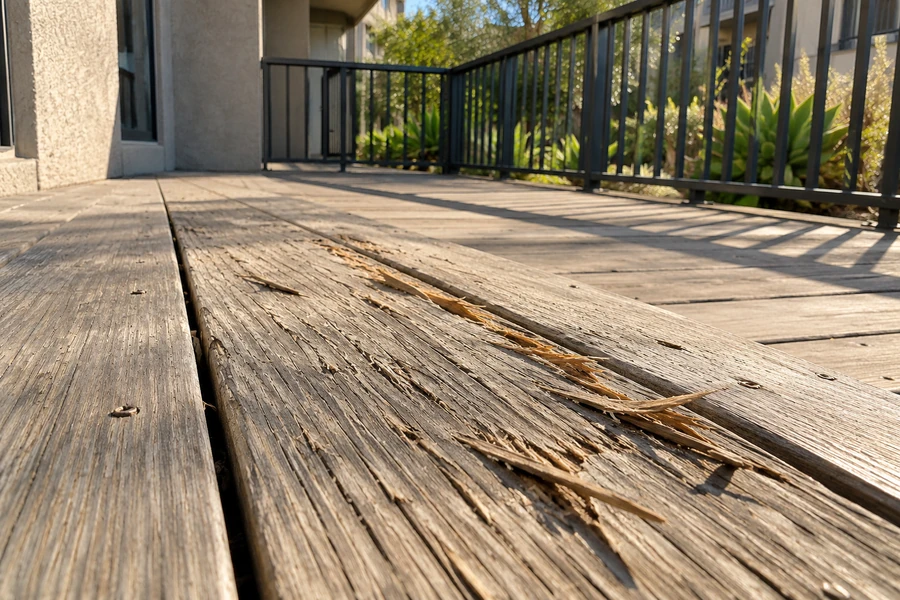
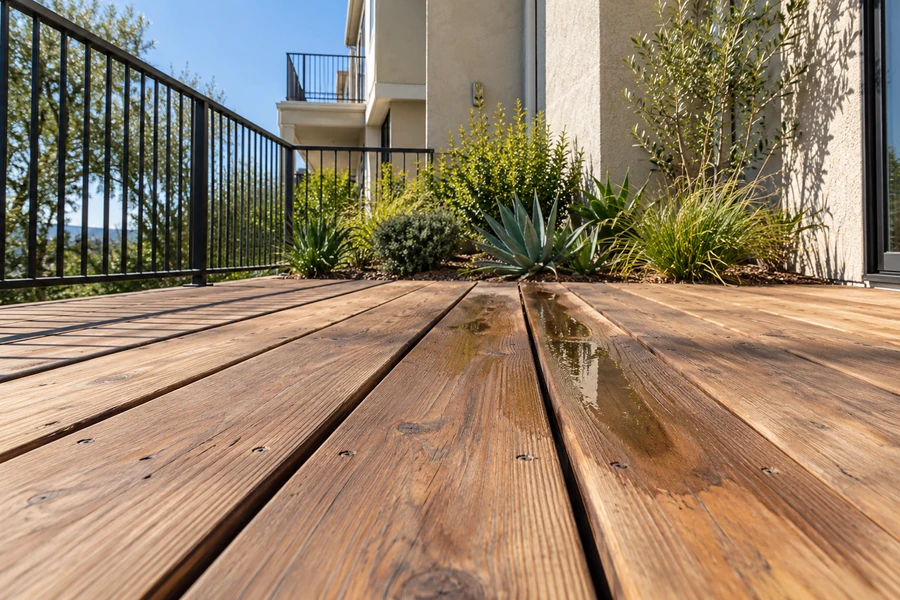
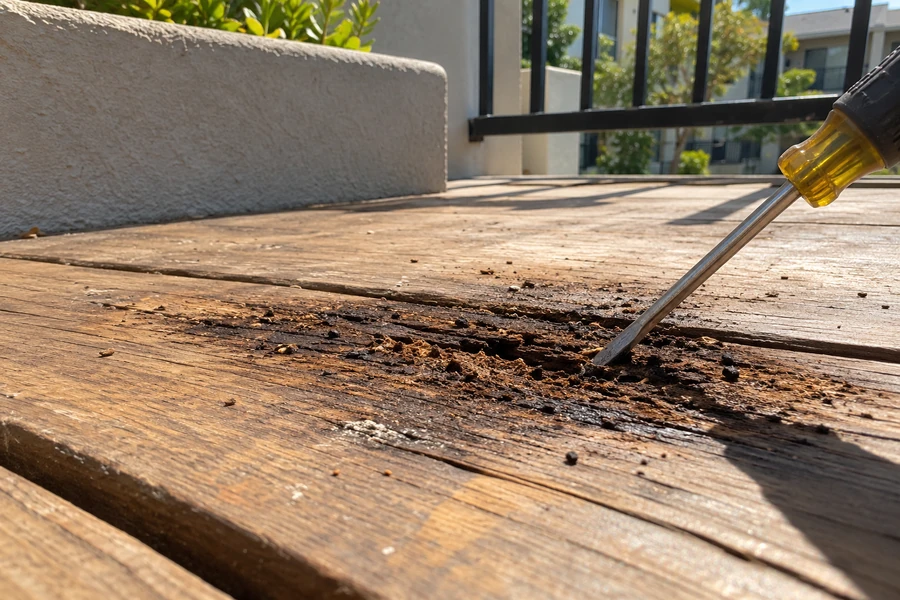
Splinters, standing water, rot, raised nails and a repaired balcony
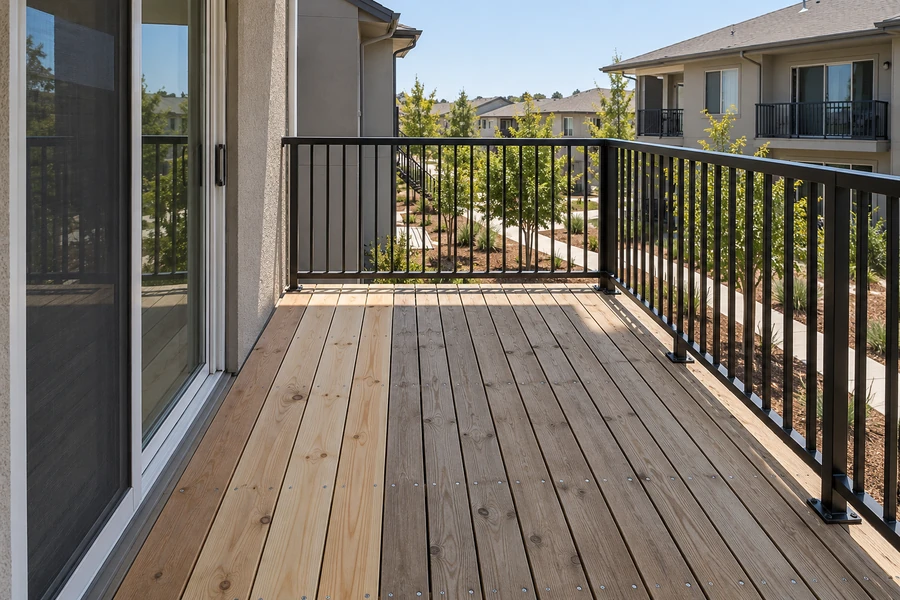
What we find board by board on apartment and HOA decks, and what a balcony looks like once the bad boards are replaced.
07 Project example
A recent board repair on apartment patio decks
Residents had been catching shoes on raised nail heads, and a board by one door had broken. We walked each deck and marked every board. The splintered, broken and soft boards came out, the joist tops under them were probed, and the soft blocking by the planter was replaced. New redwood boards went in with sealed cut ends and threaded screws, and the sound boards that had lifted were refastened instead of replaced.
They told us which boards needed new wood and which just needed new screws. The quote was smaller than we expected, and the nails are gone. Property Manager · California apartment community
08 Case studies
Recent Projects, Documented
Real commercial properties — what the building needed, what we did, and what it delivered.
 Deck RepairElevated Deck Reconstruction & Waterproofing — 24 Balconies, SacramentoOpen board decks sitting directly over enclosed garages. Every gap between the boards was a route for water…View case study
 Deck RepairElevated Restaurant Dining Deck Restoration — SaratogaA multi-level hillside dining deck taken from failing boards and moisture-damaged connections back to a sound, sealed structure…View case study
 Deck ConstructionPatio Deck & Post Base Replacement Across a Bungalow Community — San RafaelDeck-by-deck replacement across a courtyard community, driven by the one detail that failed first — posts set straight…View case study
09 Client feedback
What property managers say
They told us which boards needed new wood and which just needed new screws. The quote was smaller than we expected, and the nails are gone.
A board broke by a resident’s door on a Monday. They had it replaced that week and checked the joist under it while it was open.
The new boards had their ends painted with preservative before they went down. Nobody had done that on our decks before.
10 FAQ
Questions about cracked, broken, warped and loose deck boards
How do you fix deck boards with raised nails?
We pull or set the nail and refasten the board with threaded fasteners into the joist. The Forest Products Laboratory’s Wood Handbook says smooth-shank nails driven into green wood that later dries can lose much of their hold, and threaded nails hold about four times better under changing moisture.
What does repairing cracks in deck boards involve?
First we tell a check from a split. A check is a surface crack along the board; a split goes through the full thickness, and a bad split can leave a board unusable. Boards with checks stay and get a penetrating finish. Split boards are replaced.
Can you repair splintered boards?
The Wood Handbook explains that weathered wood loses fibres from the surface, and that badly weathered wood with loose fibres cannot hold paint. On our projects, a board that is splintering in a walking path is replaced, and the boards around it are checked for the same wear.
What does repairing rotted deck boards include?
The rotted board comes out, the joist under it is probed, and soft framing found there is repaired. AWPA’s Colin McCown notes that wood at 20 to 30 percent moisture is wet enough to deteriorate, so the source of the water, such as a planter, a wall or standing water, is part of the repair.
Is repairing warped deck boards possible?
A cupped or bowed board is replaced rather than forced flat. The Wood Handbook links warping and cupping to the wood swelling and shrinking with moisture, and notes that a finish that keeps the wood drier makes those effects less likely.
How do you repair a broken deck board?
We replace it, and we check why it broke. Once the board is up, the joist below and the distance between supports are checked before the new board goes in.
What is the cost to repair a broken deck board?
It depends on the board size and species, how it was fastened and what we find under it. We look at the rest of the deck on the same visit, and the quote follows that free site visit.
Do you work on decks in my area?
We do. Our crews cover apartment, condominium and HOA decks in the Bay Area, Central Valley and Sacramento; call (916) 848-2728 to book a walk-through.
11 Start here
Fix deck boards across your property — schedule a free board-by-board walk-through in California
Photos of the boards you are worried about and a count of the decks are enough to start. We book the walk-through within a week, and the written price, board by board, arrives within five business days.
CSLB #1060736 · 9+ years · Insured & Bonded · Commercial, multifamily & HOA properties across the Bay Area, Central Valley & Sacramento