Commercial Composite Deck Repair · CSLB #1060736
Composite Deck Repair for California Commercial & Multifamily Properties
Composite decking repair for apartment communities, condominiums, HOAs, and hotels across California — cracked, burned, scratched, and delaminating boards replaced, hidden fastener systems reworked, and the wood frame underneath repaired where water has reached it. Composite can’t be sanded and refinished the way wood can, so repairing composite decking is a precision job: the right board, the right fastener, and a colour match that doesn’t announce itself.
- CSLB #1060736 Licensed California contractor
- 9+ yrs Repairing commercial decks & balconies
- SB 721 / 326 Structural findings repaired & documented
- Commercial Multifamily, HOA & hotel only
01 Why it matters
Composite can’t be refinished — it has to be replaced correctly
Wood forgives repair. Sand it, fill it, stain it, and the damage disappears. Composite doesn’t work that way. Nearly all modern composite decking is capped — a durable polymer shell bonded over a wood-flour-and-plastic core. That shell is the entire weather defence. Sand it, grind it, or aggressively scrub a scratch out of it, and you’ve opened the core to moisture, which is what leads to swelling, staining, and surface breakdown down the line.
So composite deck repair is really about replacement done properly, and that’s harder than it sounds. Most composite decks use hidden fastener clips that lock boards to each other along their edges, meaning a single damaged board in the middle of a run can’t simply be lifted out. And because composite fades measurably in its first year or two before stabilising, a brand-new board dropped into an eight-year-old deck reads as a patch from across the courtyard.
Then there’s what’s underneath. Composite boards don’t rot — the frame carrying them does. On a multifamily or HOA property, that wood frame is what SB 721 and SB 326 inspect, so a composite surface changes nothing about your compliance obligations. Damage on top is often the first visible sign that water has been reaching the joists below.
With composite, the skill isn’t in repairing the board. It’s in replacing it so nobody can tell you did.

02 The D&B difference
What proper composite deck repair involves
We repair composite decks the way the material requires — replacement over refinishing, correct fastener systems, colour matched deliberately, and the frame beneath checked before anything goes back down.
We don’t sand the capstock
Damage that’s through the cap gets a new board. We won’t grind a scratch out of a capped composite and hand you a deck with its weather layer breached — that’s a repair that looks fine for a season and fails after it.
Colour matched, not just replaced
Composite fades before it stabilises, so we match by pulling boards from low-visibility areas — under grills, along walls, beneath furniture zones — and placing the new boards there instead. The result is a repair that reads as part of the deck, not a patch in the middle of it.
The frame gets checked, every time
Composite hides what’s happening below it. We check joists, ledger, and fasteners while boards are up — because on wood-framed decks that’s what SB 721 and SB 326 inspect, and it’s the only moment you’ll have easy access.
03 · Service Areas
Where We Work in California
Every city links to a dedicated local page — crews, recent projects and compliance details for that area.
Sacramento Metro
11 cities
East Bay
18 cities
Don’t see your city? We likely still cover it — call (916) 848-2728.
04 How a project runs
How repairing composite decking runs, start to finish
-
01
Assessment
We identify the damage type — surface, structural, or through-cap — check the frame and fasteners beneath, and confirm the board profile, brand, and colour where records or spare stock exist.
-
02
Scope & estimate
You get a written scope and firm price, including how we plan to handle colour matching and how many boards need to move to reach the damage.
-
03
Board removal
Boards are released from hidden fastener clips without damaging their neighbours, working from the nearest edge where a run is locked together.
-
04
Frame check & repair
With boards up, we inspect and repair joists, ledger connections, and flashing, and add joist protection while access is open.
-
05
Reinstallation & matching
New boards are installed with correct spacing, expansion gaps, and fasteners; matched boards are relocated so new material lands in low-visibility areas.
-
06
Cleaning & handoff
The repaired area is cleaned to blend with the surrounding deck, and any structural work is documented for the compliance file.
05 Scope
What we repair on composite decks
Every common composite failure — boards, fasteners, and the wood frame beneath — handled in-house by one licensed crew, so the decking and the structure carrying it are never split between contractors.
- Cracked and split boards — replaced, with the cause identified (impact, joist spacing, or insufficient expansion gap)
- Burn damage — melted and scorched boards from grills, coals, and fireworks replaced
- Deep scratches and gouges — through-cap damage replaced rather than sanded
- Delamination and swelling — boards whose core has taken on moisture replaced, and the water source corrected
- Hidden fastener systems — failed, loose, or corroded clips replaced; boards released and reset without damage
- Sagging or bouncy sections — joist spacing corrected where the frame was never rated for composite spans
- Expansion gap problems — buckling from insufficient end gaps corrected on reinstallation
- Mould and surface staining — cleaned and treated where the cap is intact
- Frame repair beneath — rotted joists, ledger connections, and flashing repaired while access is open
- Colour matching and board relocation so repairs blend
- SB 721 / 326 remediation — structural findings repaired and documented
A note on warranties: most composite decking carries a long limited warranty on the material. We repair in a way that respects those terms — correct fasteners, correct spans, correct expansion gaps — so your coverage stays intact.
06 Investment
What composite deck repair costs
Composite repairs are quoted after an on-site look, because the cost depends less on how many boards are damaged than on where they sit and what’s underneath.
What drives the number
- Number of boards damaged, and where in the run they sit — a board mid-deck can require releasing several to reach it
- Board availability — whether the original brand, profile, and colour are still produced
- Colour matching approach and how many boards get relocated
- Hidden fastener system type and condition
- Frame condition once boards are lifted — joist, ledger, or flashing repair adds scope
- Whether joist spacing needs correcting for composite span requirements
- Deck size, height, and access
- Whether the work is tied to an SB 721 / 326 finding on a deadline
Why discontinued boards matter: composite profiles change every few years. If your boards are no longer made, the repair becomes a design decision — matching as closely as possible, or replacing a defined section for a clean visual break. We’ll show you both options with pricing before you choose. Final pricing follows an on-site assessment — request a free estimate, no obligation.
In the field
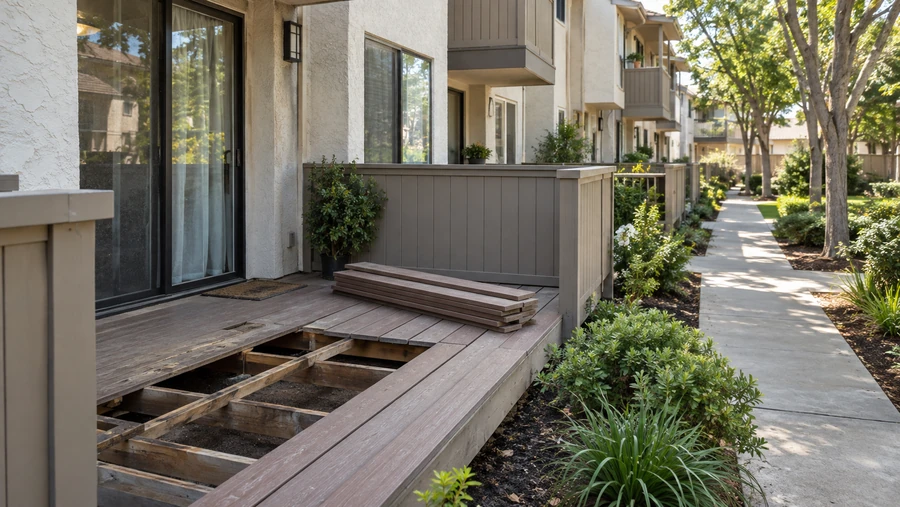
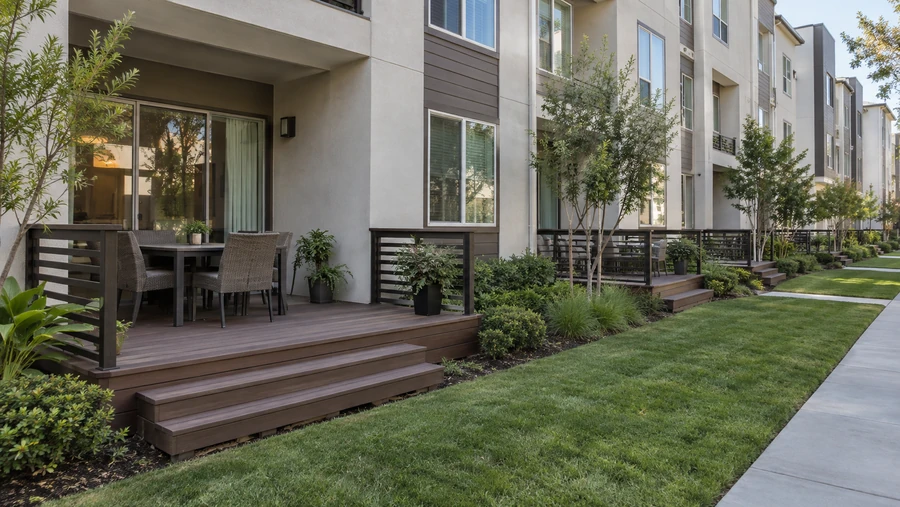
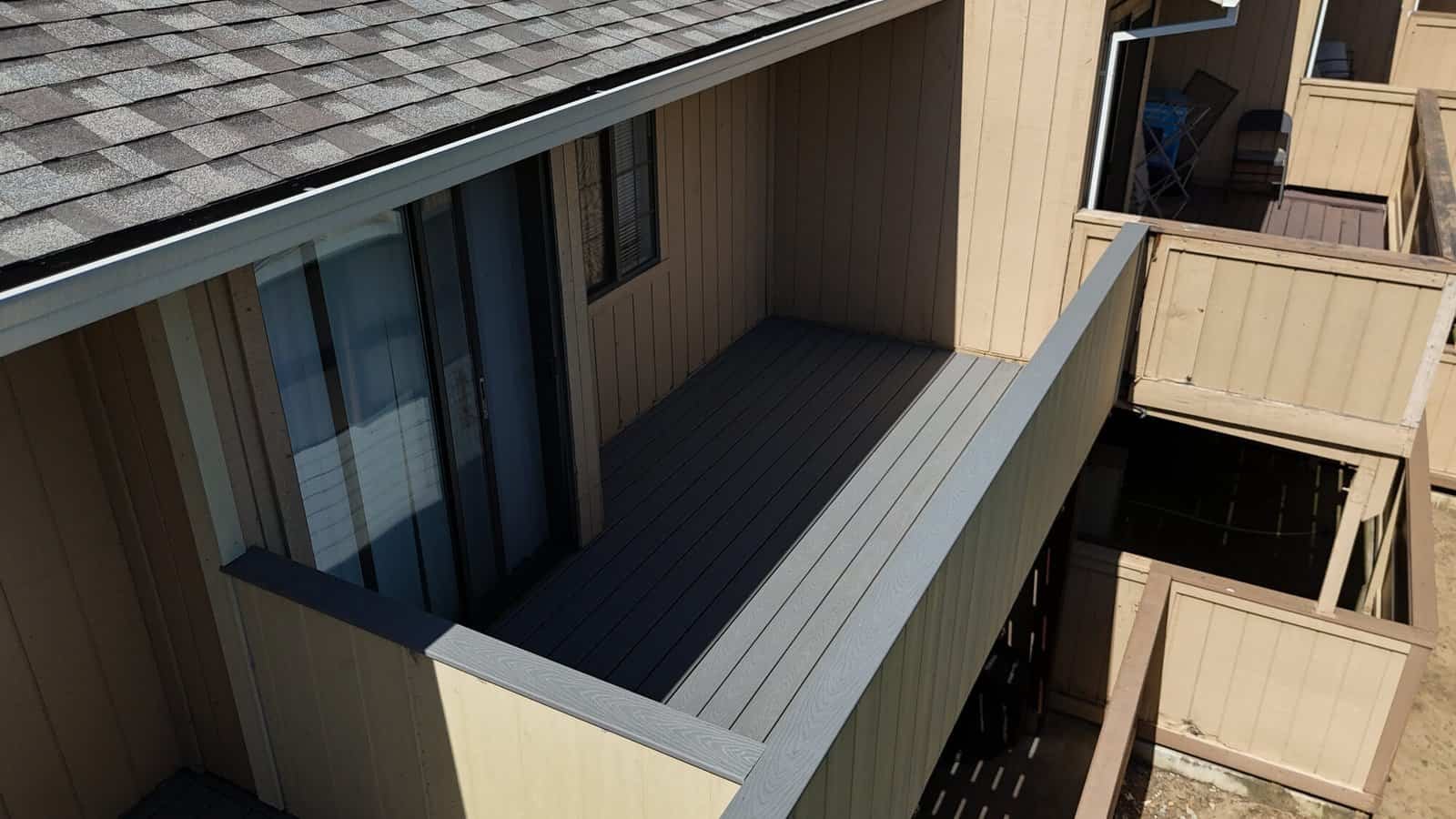
Composite board replacement
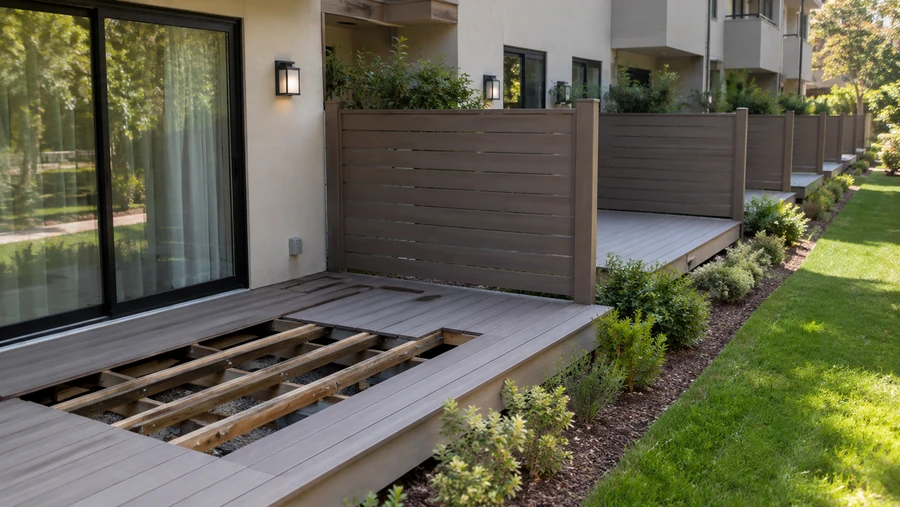
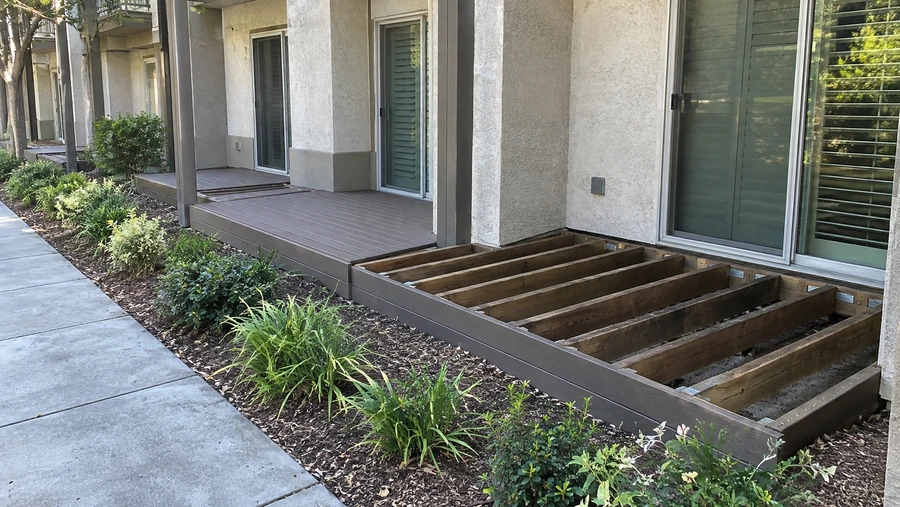
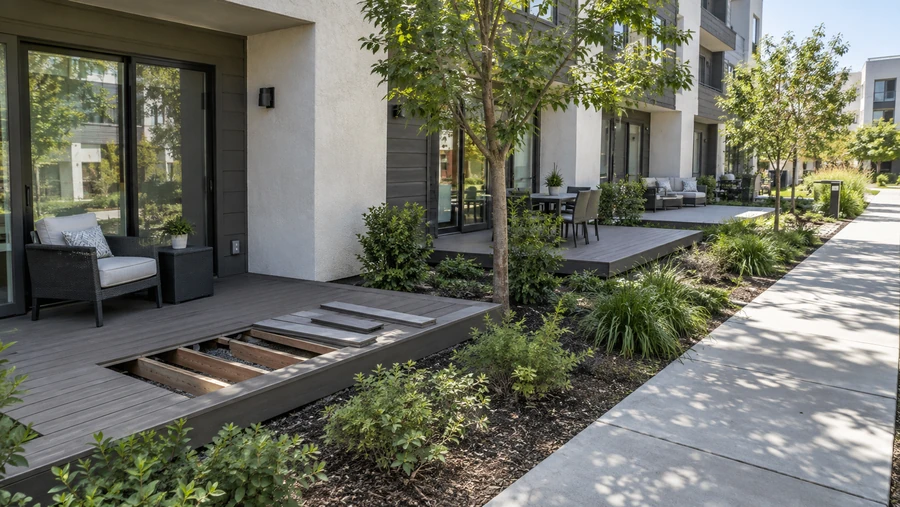
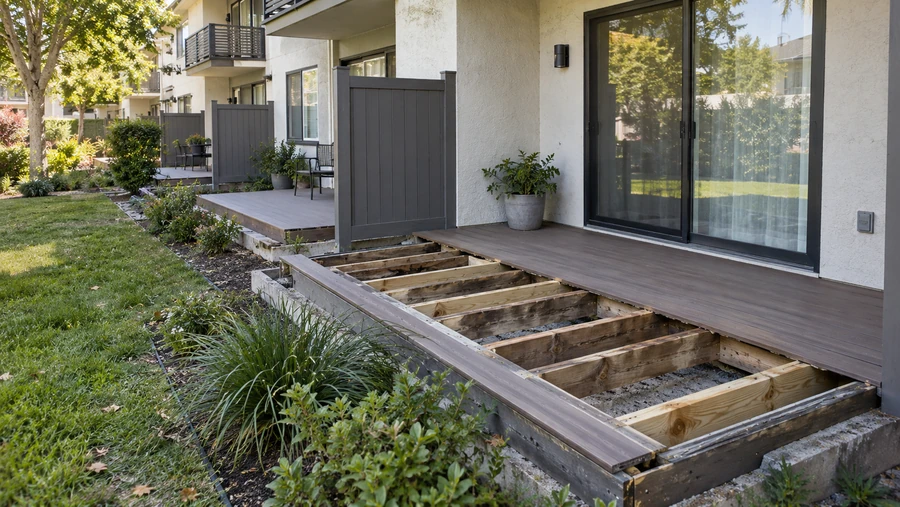
Deck sections at multi-unit buildings opened to the joists, framing exposed, finished composite alongside.
07 Project example
A recent composite deck repair
A residential community in the Central Valley had burn damage across its clubhouse deck — a grill had scorched several boards, and two more had cracked where the original joist spacing was too wide for the composite’s span rating. The boards were seven years old and the colour had long since faded from new stock. D&B pulled matching boards from the screened area behind the grill station, installed the new material there where nobody looks, and relocated the aged boards into the visible repair. With the deck open, the crew found moisture at two joists beneath the damaged section, repaired them, added joist protection, and corrected the spacing before reinstalling.
You genuinely can’t tell where the repair is. And they found joist damage we’d have paid much more to fix in two years. Community Manager · Central Valley community
08 Case studies
Recent Projects, Documented
Real commercial properties — what the building needed, what we did, and what it delivered.
 Deck RepairMulti-Level Ocean-View Deck & Stair Replacement — San MateoStepped decks cascading down a bluff, replaced surface and stairs first — because on a multi-level deck the…View case study
  Deck RepairElevated Restaurant Dining Deck Restoration — SaratogaA multi-level hillside dining deck taken from failing boards and moisture-damaged connections back to a sound, sealed structure…View case study
  Deck RepairTrex Deck, Walkway & Stair Replacement — 12-Unit Apartment Community, Menlo ParkResidents walked the same tired wood the whole way from the parking lot to their front door —…View case study
 09 Client feedback
What property managers say
Another company offered to sand the scratches out. D&B explained why that would wreck the boards’ outer layer — and replaced them instead. Wish we’d called them first.
Our boards were discontinued. They showed us two options with pricing instead of just telling us it couldn’t be matched.
They checked the framing while the boards were up and caught rot at the ledger. The composite was fine — the wood holding it wasn’t.
10 FAQ
Composite deck repair questions
Can composite decking be repaired, or does it have to be replaced?
It depends on whether the damage went through the cap. Surface marks, stains, and light scuffs on the protective shell can often be cleaned or treated. Anything through it — deep gouges, cracks, burns, delamination — means board replacement, because the cap is the board’s entire weather defence and sanding it away exposes the core to moisture.
How do you repair a cracked composite deck board?
Cracked boards are replaced, not filled — but the more important step is identifying why it cracked. Common causes are impact damage, joist spacing too wide for the board’s span rating, and fasteners set too close to a board end. If the cause isn’t corrected, the replacement board eventually cracks too, so we check spans and fastening as part of the repair.
Can burn marks on composite decking be repaired?
Composite is thermoplastic — it melts and scorches rather than charring the way wood does, and the damage can’t be sanded out. Composite deck burn repair means replacing the affected boards. Where the burn is from a grill, we’ll also talk through placement and mats, because it’s a repeat problem otherwise. Small surface scorching sometimes cleans up, and we’ll test that first before recommending replacement.
Will the new boards match our existing deck?
Not straight from the box — composite fades over its first year or two before the colour stabilises, so new stock will read brighter than aged boards. Our approach is to relocate: we pull boards from low-visibility areas like behind grills, along walls, and under furniture zones, and put the new material there instead. The visible repair gets aged boards that match, and the new boards go where nobody looks.
What if our composite boards have been discontinued?
It’s common — profiles change every few years. When an exact match isn’t available, you have two realistic options: match as closely as current stock allows and accept a slight variation, or replace a defined section so the transition reads as intentional rather than as a patch. We price both and let you decide.
Do composite decks still need inspection under SB 721 or SB 326?
Yes, if the frame is wood — which it almost always is. Those laws govern wood-framed exterior elevated elements, and composite decking sits on wood joists, beams, and a ledger connection. The surface doesn’t rot, but the structure carrying it does, which is exactly what gets inspected.
Will repairs void our manufacturer warranty?
Not when the repair is done to specification. Composite warranties depend on correct span, fastening, and expansion gaps, so repairs that ignore those can create problems. We work within manufacturer requirements and document what was done, so your coverage stays intact.
Are you composite deck repair contractors near me in California?
We’re a CSLB-licensed contractor (#1060736) handling composite deck repairs across the Bay Area, Central Valley, and Sacramento — boards, fasteners, and the wood frame beneath, from one crew.
11 Start here
Get your composite deck assessed — free estimate
Send photos or tell us what you’re seeing — cracked or burned boards, a soft or bouncy section, boards buckling at the ends — and we’ll assess the damage and the frame beneath it, then give you a free estimate covering scope, matching approach, timeline, and cost.
CSLB #1060736 · 9+ years · Insured & Bonded · Serving the Bay Area, Central Valley & Sacramento