Composite Deck Board Installation · CSLB #1060736
Commercial Composite Deck Board Installation in California
We install composite deck boards for apartment communities, condominiums, HOAs, and hotels across the Bay Area, Central Valley, and Sacramento. Composite is a less forgiving material to work than timber, and not in the way people expect: it’s harder wearing and easier to live with, but every cut is permanent. Nothing on a composite board can be sanded out, filled, or painted over afterwards.
- CSLB #1060736 Licensed California contractor
- 9+ yrs Installing commercial composite decking
- Bundles mixed Boards pulled from several bundles, no banding
- Commercial & HOA Apartments, condominiums, HOAs & hotels
01 Why it matters
Composite can’t be sanded, filled or touched up. Every cut is final.
A timber deck is forgiving. A chipped edge gets sanded, a rough cut gets planed, a scratch disappears under the next coat of stain, a gouge takes filler. None of that is available on composite. A capped board is a polymer shell over a core, and the shell is what you see — sand it and you cut through to a different colour and texture that never blends back. Fillers don’t bond. Paint doesn’t stay. What the crew does with the saw is what the deck looks like in twenty years.
That changes how the work has to be approached rather than making it difficult. Cuts are made with a fine-tooth blade at the right speed, because tearing out the capstock at a cut edge leaves a visible flaw that can’t be cleaned up. Cut ends expose the core, which is a different colour from the surface — on any end that will be seen, that gets a finished cap, a plug, or a border board over it rather than being left as-is. And measuring matters more than on timber, because a cut half an inch short is a wasted board rather than a board to be packed out.
The second thing decides how the finished deck looks, and almost nobody mentions it at the estimate. Composite is manufactured in batches, and colour varies slightly between them. Boards should come from a single production run where possible — and regardless, the crew should be pulling from several bundles at once and mixing them across the deck rather than laying one bundle then the next. Work through the bundles in order and any batch variation lands as a visible band down the surface. Mix them and it disappears into the grain. It costs nothing and it is entirely invisible when done right.
There’s no sanding a composite deck flat afterwards. The cut you make is the cut that stays.

02 The D&B difference
What proper composite deck boards installation involves
Boards mixed across bundles as they go down
Several bundles open at once, boards pulled from all of them, tone variation distributed through the deck rather than left to arrive as a band. It’s free, and it’s the difference between a surface that reads as one deck and one that reads as two deliveries.
Cuts made for a material that can’t be corrected
Fine-tooth blade, right speed, ends capped or bordered where they’ll be seen. Composite doesn’t accept filler or sanding, so the standard for a cut is higher than on timber, not lower.
Frame checked against the board before anything is ordered
Composite needs closer joist support than timber decking and flexes over a frame that’s too wide. On re-decking, the spacing gets measured first, because boards laid on a non-compliant frame lose their warranty and crack regardless.
03 · Service Areas
Where We Work in California
Every city links to a dedicated local page — crews, recent projects and compliance details for that area.
Sacramento Metro
17 cities
East Bay
25 cities
North Bay
12 cities
Don’t see your city? We likely still cover it — call (916) 848-2728.
04 How a project runs
How we install composite deck boards
-
01
Assessment
On re-decking, joist spacing measured against the board being considered and framing probed. On new frames, the structure checked before boards are ordered.
-
02
Ordering
Quantity confirmed with allowance for cuts, and boards sourced from a single production run where the supply allows.
-
03
Preparation
Framing repaired where needed, joist tops taped and flashed, blocking added under planned joints and borders.
-
04
Layout
Several bundles opened, boards dry-laid, tone and grain distributed, joints planned to stagger and land on joists.
-
05
Installation
Boards fixed with gaps set against the manufacturer’s temperature table, hidden clips or face fixing as specified.
-
06
Cuts and edges
Fine-tooth cutting, exposed ends capped or covered by borders, fascia and stair treads fitted.
-
07
Handover
Warranty documentation, maintenance notes, and compliance file material where the deck qualifies.
05 Scope
What’s included
Complete composite deck boards installation on new and existing frames, from one CSLB-licensed crew.
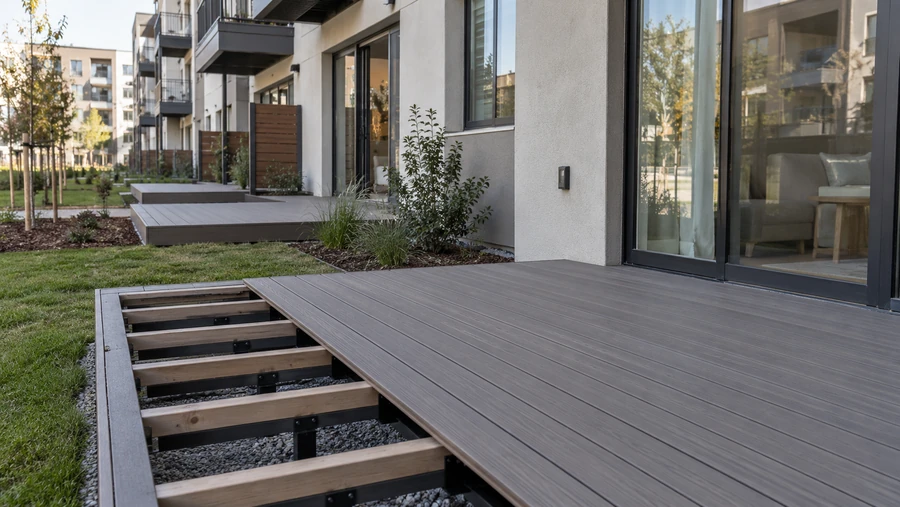
- Frame assessment with joist spacing measured against the chosen board
- Framing repair where probing finds it
- Joist tape and flashing over joist tops and beams
- Blocking under planned joints, borders and inlays
- Boards sourced from a single production run where supply allows
- Installing composite deck boards mixed across bundles as they’re laid
- Boards dry-laid and grain distributed before anything is fixed
- Butt joints planned to stagger and land on joists
- Gaps set against the manufacturer’s temperature table
- Hidden fasteners on grooved boards, or face fixing, specified deliberately
- Fine-tooth cutting to avoid capstock tear-out
- Exposed cut ends capped, plugged or covered by border boards
- Picture-frame borders, mitred corners and inlays
- Fascia, riser boards and matching stair treads
- Warranty documentation handed over with the project
- SB 721 / SB 326 documentation where the deck qualifies
06 Investment
What composite board installation costs
Quoted after the deck is measured, and on composite the material is only part of the answer.
What drives it
- Board line and colour, the widest single variable
- New frame or re-decking, and whether an existing frame needs re-joisting
- Perimeter length relative to area — borders, mitres and fascia are linear work
- Fixing method, since hidden clips go in one at a time at every joist
- Stairs, which cost more per foot than any other part of a deck
- Waste allowance, because off-cuts on composite can’t be reused the way timber off-cuts can
- Number of decks, since a programme prices better per element
- Access and phasing around residents
The waste line, which is real: composite off-cuts have limited second uses. A short piece of timber gets used as blocking; a short piece of composite mostly doesn’t. A properly planned board layout reduces that, and a crew cutting without a plan turns it into a line item you pay for twice — once in material and once in the boards that have to be ordered to replace it.
Where ordering matters: confirming quantity properly at the start is worth more than it sounds. A second order weeks later may come from a different production run, and matching colour across batches on a deck that’s already half laid is a problem with no good solution.
Final pricing follows an on-site assessment. Request a free estimate — no obligation.
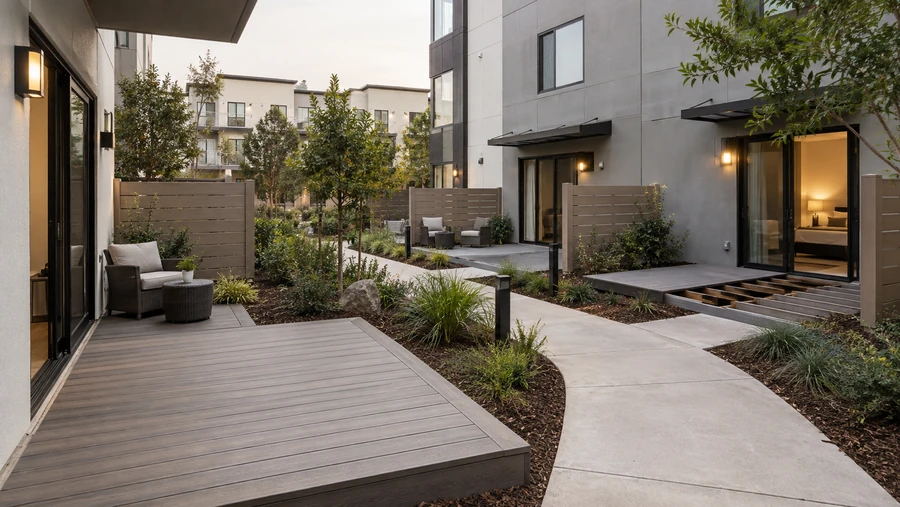
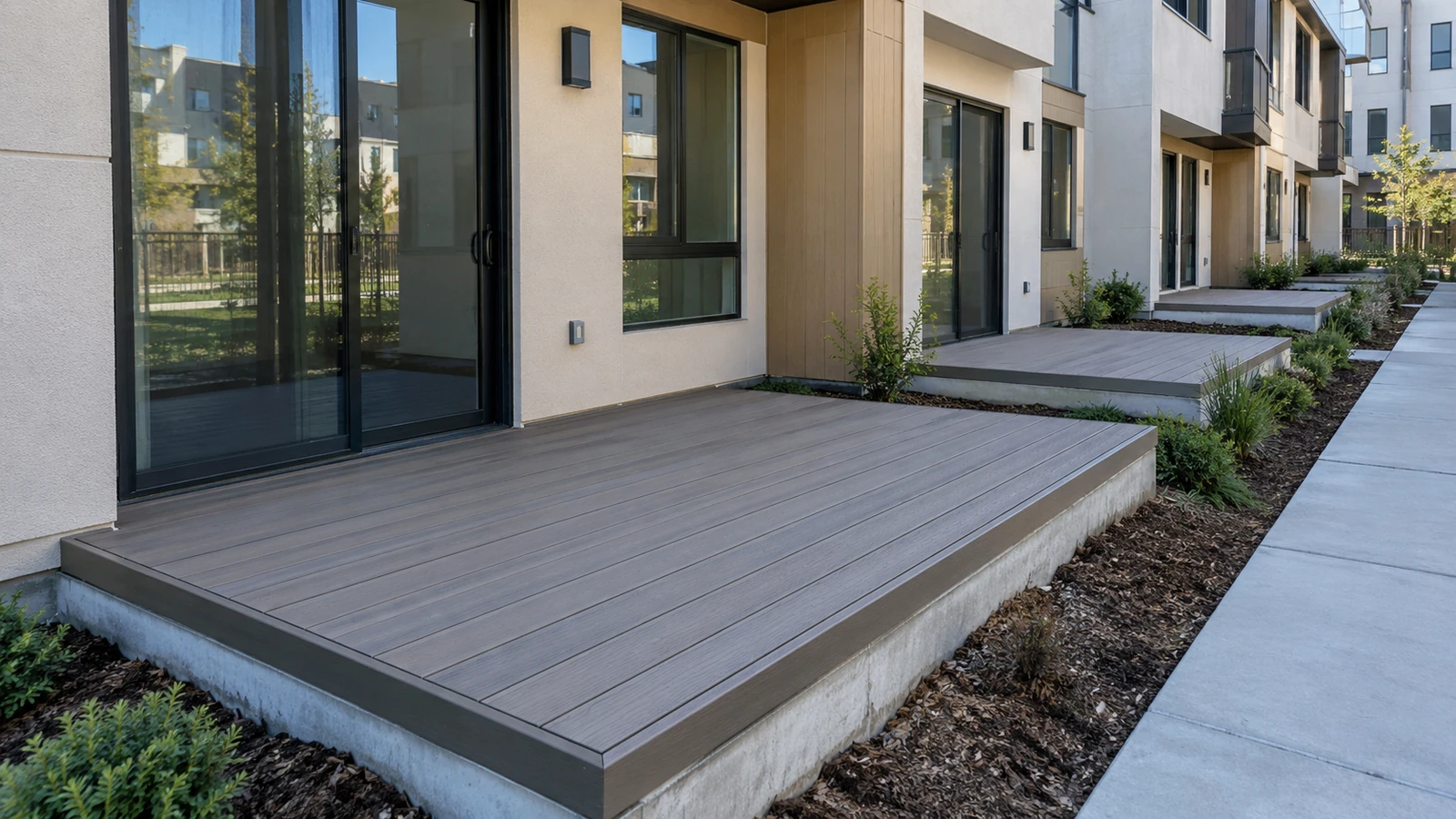
In the field
Composite board detail
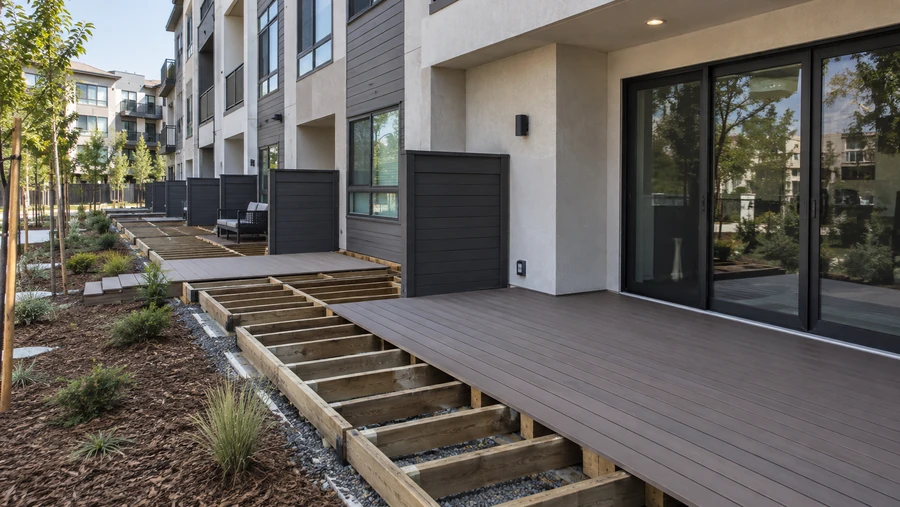
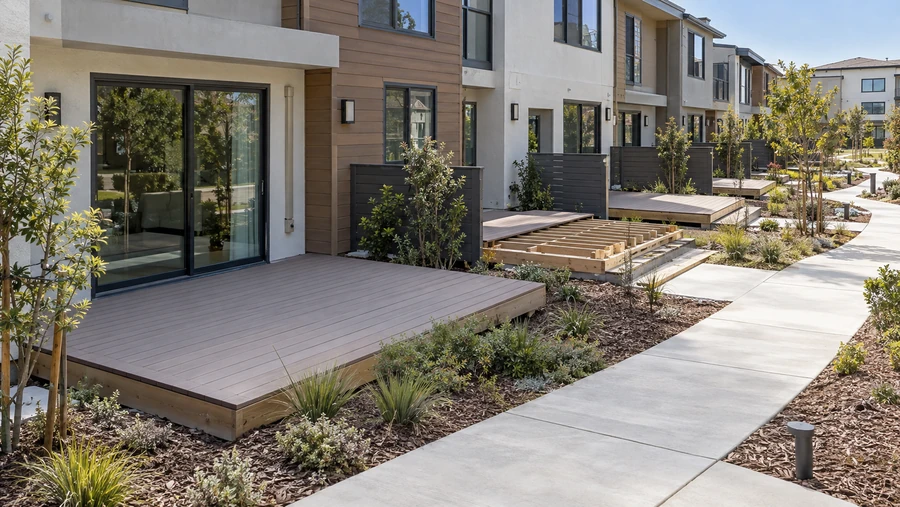
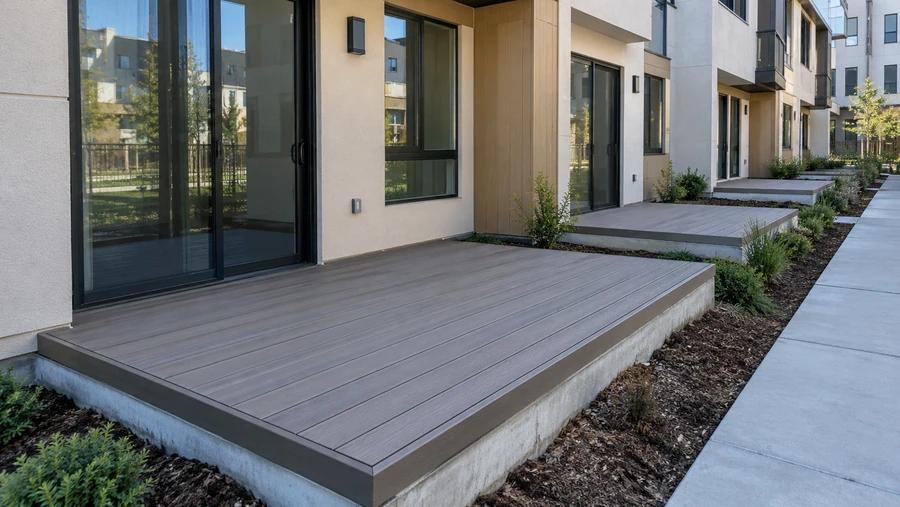
Bundles mixed, cuts finished, colour consistent across the deck.
07 Project example
A recent installation
A community was laying composite across forty ground-floor decks. The detail that shaped the job was ordering: we confirmed the full quantity including waste allowance up front and sourced it from a single production run rather than ordering in tranches as the phases progressed. It cost a delivery and some storage, and it removed the risk that decks finished in month four wouldn’t match decks finished in month one. On site the crew worked from several bundles at a time, distributing tone across each deck rather than laying bundle by bundle. Nobody mentioned the colour afterwards, which is the outcome you want from that decision.
They ordered the whole property’s worth at once and explained why. The last contractor ordered per phase and you can still see where the phases met. Community Manager · California townhome community
08 Case studies
Recent Projects, Documented
Real commercial properties — what the building needed, what we did, and what it delivered.
 Deck RepairTrex Deck, Walkway & Stair Replacement — 12-Unit Apartment Community, Menlo ParkResidents walked the same tired wood the whole way from the parking lot to their front door —…View case study
 Balcony RepairBalcony Replacement with Trex Composite Decking — 18 Balconies, AntelopeThe rot had already reached the beams and posts. We rebuilt the framing under every balcony and re-decked…View case study
 Deck ConstructionCommunity-Wide Elevated Deck Replacement — San RamonEvery elevated deck across a hillside townhome community rebuilt to a single spec in one managed program —…View case study
09 Client feedback
What property managers say
They ordered the whole property’s worth at once and explained why. The last contractor ordered per phase and you can still see where the phases met.
The crew had four bundles open and was pulling boards from all of them. I asked why and got a straight answer about batch colour.
Every cut end is either capped or hidden under a border. On our old deck you could see the core on every step.
10 FAQ
Questions we get asked
Can composite boards be sanded or touched up after installation?
No, and it’s the main practical difference from timber. A capped composite board is a polymer shell over a core; sanding cuts through the shell to a different colour and texture that won’t blend back. Filler doesn’t bond and paint doesn’t stay. Every cut and every mark is permanent, which is why the standard for cutting composite is higher than for timber rather than lower.
Why do you open several bundles at once?
Because composite is manufactured in batches and colour varies slightly between them. Laying bundle after bundle puts any variation down as a band across the deck. Pulling boards from several bundles and mixing them as they go down distributes it into the grain where nobody sees it. It costs nothing and it’s the single clearest sign of a crew that has laid composite before.
What happens at cut ends?
The cut exposes the core, which is a different colour and texture from the capped surface. On ends that will be seen — stair treads, the outer edge, anywhere without a border — that gets a finished cap, a plug, or a border board over it. Left bare, a cut end is the detail people notice first and complain about longest.
Does the blade matter when cutting composite?
Yes. A fine-tooth blade at the right speed gives a clean edge; a coarse blade or too much feed tears the capstock at the cut, and that tear-out can’t be sanded away. It’s a small equipment decision with a permanent consequence, which is a fair summary of working with this material generally.
Can we lay composite over our existing frame?
Only if the joist spacing meets what the board requires — composite needs closer support than timber decking, and frames built for timber are frequently too wide. Boards over a wide frame flex underfoot, crack in time, and lose warranty coverage because the installation was outside specification. We measure before quoting a re-deck rather than after.
How much waste should we expect?
More than on timber, in the sense that matters. Timber off-cuts get used as blocking and packers; composite off-cuts mostly don’t have a second life. A planned board layout keeps that down, and a properly calculated order at the start avoids the worse problem — a top-up order weeks later from a different production run that doesn’t quite match.
Should the boards run a particular direction?
Usually toward the view or away from the house, but the practical constraint is joist direction: boards run perpendicular to joists, so changing board direction means changing the frame beneath. Diagonal layouts need closer joist spacing again. It’s worth settling at design stage rather than after the frame is built.
Are you composite decking board installation contractors in California?
We’re a CSLB-licensed contractor (#1060736) laying composite deck boards across the Bay Area, Central Valley, and Sacramento on commercial, multifamily, and HOA property. Frame assessment, joist protection, boards, borders, stairs and warranty paperwork come from one crew.
11 Start here
Get the frame and the order right — free estimate
New boards on an existing frame, or a surface on a deck being built. Either way we measure the joist spacing against the board you’re choosing and work out the full quantity up front, so what arrives matches and what’s laid stays right.
CSLB #1060736 · 9+ years · Insured & Bonded · Commercial, multifamily & HOA properties across the Bay Area, Central Valley & Sacramento