Composite Deck Waterproofing · CSLB #1060736
Commercial Composite Deck Waterproofing in California
Waterproofing composite decking means working beneath the boards, and we do that for apartment communities, condominiums, HOAs, and hotels across the Bay Area, Central Valley, and Sacramento. The distinction matters: composite boards don’t absorb water and don’t need protecting from it. What needs protecting is the framing underneath them and whatever sits below — and no product applied to the boards achieves that.
- CSLB #1060736 Licensed California contractor
- 9+ yrs Waterproofing commercial composite decks
- Below the boards Joists taped, water collected and drained
- Commercial & HOA Apartments, condominiums, HOAs & hotels
01 Why it matters
Composite boards are already waterproof. The deck isn’t.
Searches for waterproof composite decking usually come from a reasonable assumption that turns out to be wrong in an interesting way. The boards themselves don’t need waterproofing — a capped composite board has a polymer shell specifically engineered to shed water and resist staining, and it doesn’t absorb, swell, or rot the way timber does. Applying a sealer or coating to it achieves nothing useful, and often doesn’t even adhere: the capstock is designed so that things don’t stick to it, and a coating is just another thing.
What people are actually experiencing is different. Water reaches the framing below, or drips onto a patio underneath, and the boards get blamed because they’re what’s visible. But water isn’t going through the boards — it’s going between them, and it has to. Composite expands and contracts along its length with temperature, so gaps at the ends and sides aren’t optional: close them up and the deck buckles in the first hot summer. The gap is a design requirement, which means a composite deck surface is not and cannot be watertight, regardless of what’s been applied to it.
So the useful version of this work is entirely below the boards. If the goal is protecting the joists, the answer is tape or flashing across the joist tops so water running through never sits on timber. If the goal is a dry space underneath, the answer is a collection layer and gutters — a system that catches what comes through and carries it away. And if a genuinely watertight walking surface is required, then the honest answer is that a gapped board deck of any material isn’t it: that needs a continuous membrane over a solid substrate, and it won’t look like decking.
The gap between composite boards isn’t a flaw to be sealed. It’s a requirement, and it’s why the surface can never be watertight.

02 The D&B difference
What waterproofing composite decking actually involves
We don’t sell surface treatments to composite
Coatings on capped boards don’t adhere well and don’t solve the problem people are paying to solve. We’ll say that rather than quote a product that looks like an answer.
Joist tops protected during installation or re-decking
The moment the boards are off is the only cheap opportunity to tape the joists. Water will keep coming through the gaps for the life of the deck; whether it sits on timber is decided then.
Collection and drainage where the space below matters
Where a dry patio or walkway is the requirement, we install a system that catches water beneath the boards and discharges it clear of the structure — because that is the only thing that works.
03 · Service Areas
Where We Work in California
Every city links to a dedicated local page — crews, recent projects and compliance details for that area.
Sacramento Metro
14 cities
East Bay
21 cities
Don’t see your city? We likely still cover it — call (916) 848-2728.
04 How a project runs
How the work runs
-
01
Assessment
What’s below the deck, what’s actually happening, and the condition of joists, ledger and post bases established by probing.
-
02
Goal clarified
Protecting the framing, keeping the space below dry, or achieving a watertight surface. Each has a different answer and only two of them involve the deck staying as it is.
-
03
Scope & estimate
Priced against the goal, with framing repair separated as its own line.
-
04
Framing repair
Corrected before anything is covered or closed in.
-
05
Joist protection
Tape and flashing across joists and beams wherever boards are lifted or newly laid.
-
06
Collection system, where specified
Above-joist or below-joist drainage with gutters and downspouts discharging clear of the structure.
-
07
Handover
Documentation, photographs before covering, and a maintenance note covering gutter clearing.
05 Scope
What we install
Everything that actually keeps water out of a composite deck assembly, from one CSLB-licensed crew.
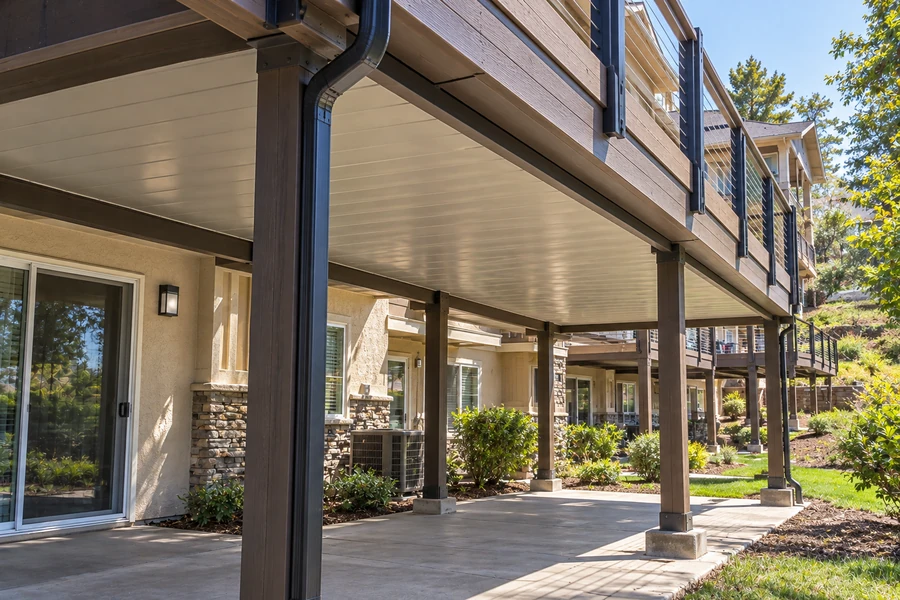
- Assessment of the framing and the space below before anything is quoted
- Probing of joists, ledger and post bases
- Framing repair corrected before covering
- Joist tape and flashing across joist tops and beams
- Ledger connections flashed per CBC 1604.8.1
- Above-joist collection systems keeping water off the framing entirely
- Below-joist drainage where the space underneath is the priority
- Gutters and downspouts discharging clear of the structure and foundation
- Under-deck ceilings finished below the drainage layer
- Composite decking installed with gaps set to the manufacturer’s temperature table
- Continuous membrane over a solid substrate where a watertight surface is genuinely required
- Threshold and edge detailing so water leaves rather than tracks toward the building
- Honest advice on what composite does and doesn’t need
- Maintenance schedule covering gutter and drainage clearing
- SB 721 / SB 326 documentation where the deck qualifies
06 Investment
What waterproofing composite decking costs
Quoted after the deck is assessed, because the price depends entirely on which of three goals you have.
What drives the number
- Protecting the framing is the cheapest by a wide margin and only possible when the boards are off — during installation, re-decking, or repair. Joist tape and flashing cost very little as part of work already happening and are disproportionately expensive as a standalone reason to lift a deck.
- Keeping the space below dry means a collection system, gutters and downspouts, priced by area plus the runs and discharge routing. Where a finished ceiling is wanted below, that’s an additional layer.
- A watertight walking surface means removing the boards, laying a continuous substrate, and installing a membrane over it. It works, and you no longer have a composite deck surface — you’re walking on the coating.
What we won’t quote: a composite waterproof decking sealer applied to capped boards. It doesn’t adhere reliably, it doesn’t bridge the gaps water actually passes through, and it doesn’t address the framing or the space below. If someone has offered you that, ask what it’s meant to stop.
Final pricing follows an on-site assessment. Request a free estimate — no obligation.
In the field
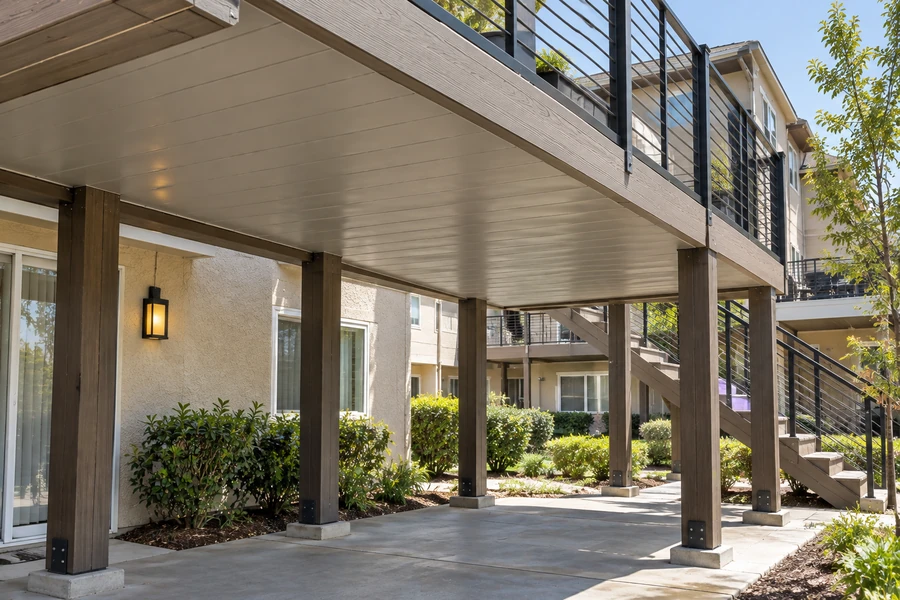
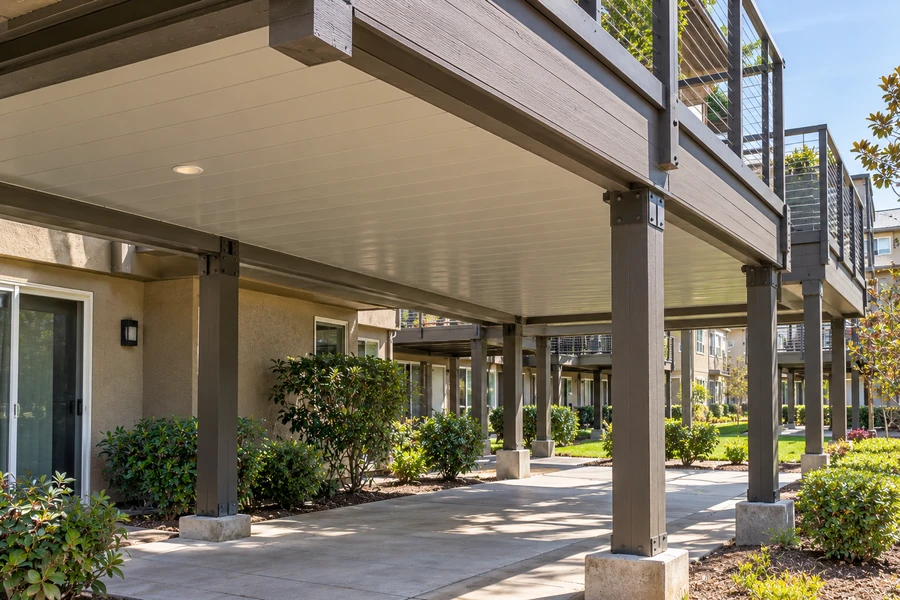
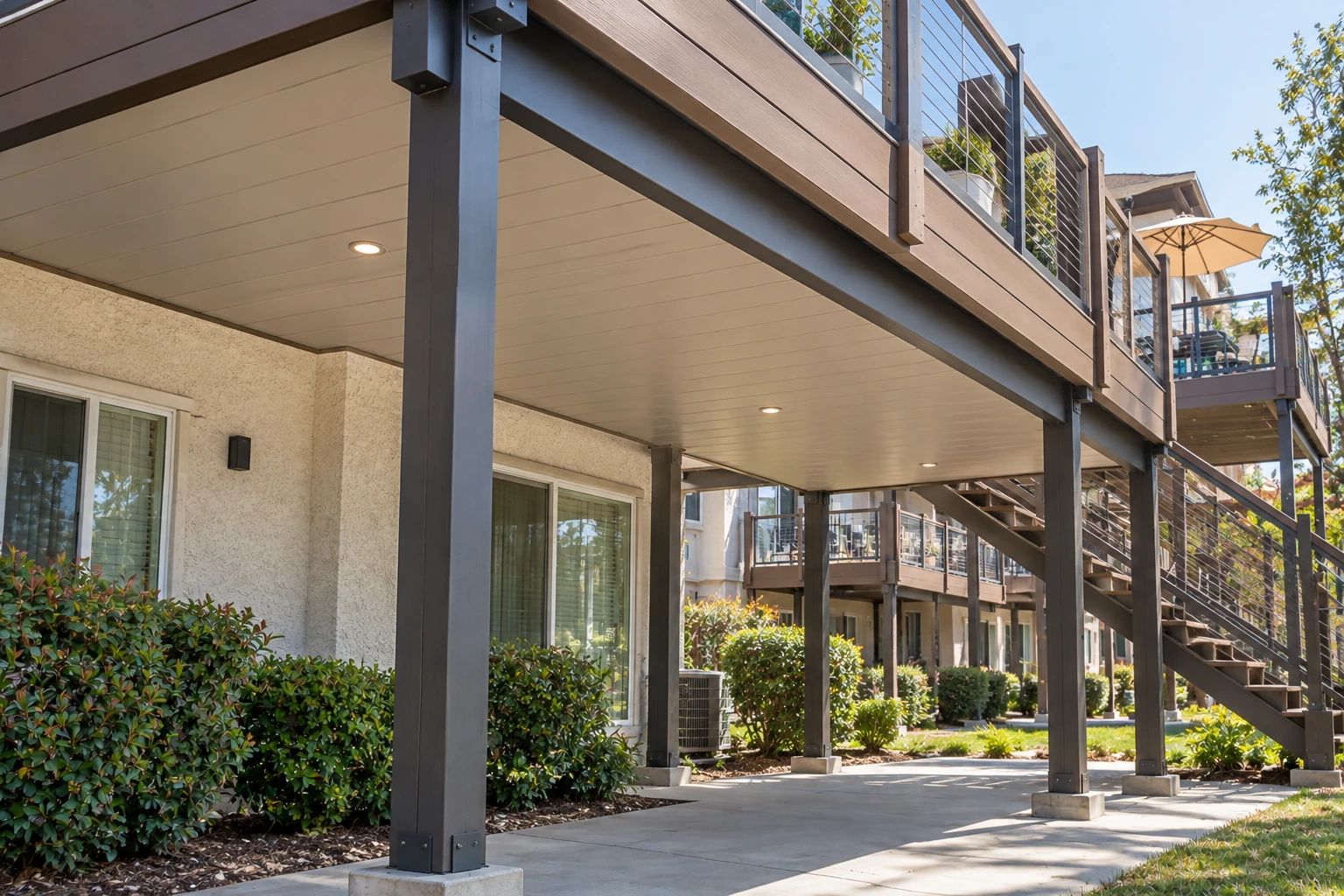
Composite deck detail
Water collected and carried away, which is the part that works.
07 Project example
A recent project
A community had replaced timber decks with composite a few years earlier and was still getting water onto the ground-floor patios below. Two contractors had proposed sealing the composite surface. The boards were doing exactly what composite does — shedding water perfectly well and letting it through the gaps, because the gaps have to be there. D&B installed an above-joist collection layer and gutters on the affected runs, which put the patios dry for the first time and took water off the joists at the same time. On two decks the boards had to come up anyway for framing repair, and the joist tops were taped while they were open — five minutes of work that only exists as an opportunity when a deck is apart.
Two people had quoted us to seal the surface. The surface was never the problem — the gaps are supposed to be there. Community Manager · California apartment community
08 Case studies
Recent Projects, Documented
Real commercial properties — what the building needed, what we did, and what it delivered.
 Deck RepairElevated Deck Reconstruction & Waterproofing — 24 Balconies, SacramentoOpen board decks sitting directly over enclosed garages. Every gap between the boards was a route for water…View case study
  Deck RepairTrex Deck, Walkway & Stair Replacement — 12-Unit Apartment Community, Menlo ParkResidents walked the same tired wood the whole way from the parking lot to their front door —…View case study
  Deck RepairTrex Stair & Balcony Installation — Apartment Building, OaklandFrom the patio the stair looked like one well-kept assembly. From underneath it was an open wood frame…View case study
 09 Client feedback
What property managers say
Two people had quoted us to seal the surface. The surface was never the problem — the gaps are supposed to be there.
They told us composite doesn’t need a coating and then explained what does need doing. That conversation cost them a product sale.
The joists got taped while the boards were up for a repair. Nobody would have paid to lift a deck just for that, and now it’s done.
10 FAQ
Questions we get asked
Is composite decking waterproof?
The boards are, in the sense that matters: capped composite has a polymer shell that sheds water, resists staining, and doesn’t absorb, swell or rot. The deck as a whole isn’t, because water passes between the boards. Those gaps are a manufacturer requirement — composite moves with temperature, and a deck laid tight buckles in its first hot summer. So composite decking waterproof as a material, and the surface as a whole not watertight, are both true at the same time.
Are composite deck boards waterproof enough without sealing?
Yes — that’s the point. Capped composite is engineered so that things don’t adhere to it — that’s how it resists stains — and a sealer is another thing that won’t stick reliably. Even where it does, it can’t bridge the gaps that water actually goes through, and those gaps can’t be closed. A coating sold as waterproof composite decking treatment is a product aimed at a problem it doesn’t touch.
Then why is water getting through our composite deck?
Because it’s supposed to. Every board deck sheds water down through the gaps by design, and the question is only what happens to it next. On a deck with nothing below, nothing. On a deck over a patio, walkway or occupied space, that water needs collecting and carrying away — which is what a composite decking waterproofing system actually is.
How do we keep the framing dry under composite?
Tape or flashing across the joist tops, installed while the boards are off. Water running through the gaps otherwise lands on the joists and sits there, which is where composite decks quietly rot underneath a surface that looks perfect. The cost is negligible during installation or re-decking and disproportionate as a reason to lift a deck on its own — so it’s worth doing whenever the boards are up for any reason.
Can we make the space below a composite deck dry?
Yes, with a collection system rather than anything applied to the boards. An above-joist layer catches water between the boards and the joists and protects the framing too; a below-joist system catches it underneath and keeps the patio dry while the joists still get wet. Both run to gutters and downspouts discharging clear of the structure.
What if we need a genuinely watertight surface?
Then a gapped board deck isn’t it, in composite or in timber. A watertight walking surface requires a continuous membrane over a solid substrate — the boards come off, sheathing goes down, and the membrane goes over it. It works and it’s what we install over occupied space. You’re then walking on the coating rather than on decking, and that’s worth knowing before the decision rather than after.
Does composite rot underneath?
The boards don’t. The timber framing beneath them absolutely does, and it’s a common finding on composite decks precisely because the surface stays looking new for years while the joists take everything that comes through the gaps. A composite deck that photographs perfectly can have soft joists, and the boards give no warning at all.
Are you deck waterproofing contractors in California?
We’re a CSLB-licensed contractor (#1060736) working across the Bay Area, Central Valley, and Sacramento on commercial, multifamily, and HOA property. Assessment, framing repair, joist protection, drainage and membrane systems come from one crew — and we’ll tell you when the answer costs less than you expected.
11 Start here
Tell us what’s actually happening — free assessment
Water onto a patio below, a deck you want protected properly, or a quote to seal composite boards that you’d like a second opinion on. We’ll assess the framing, establish what the goal is, and price the thing that solves it.
CSLB #1060736 · 9+ years · Insured & Bonded · Commercial, multifamily & HOA properties across the Bay Area, Central Valley & Sacramento