Wood Deck Waterproofing · CSLB #1060736
Commercial Wood Deck Waterproofing in California
We waterproof timber decks for apartment communities, condominiums, HOAs, and hotels across the Bay Area, Central Valley, and Sacramento. Before anything else, one thing worth settling: a wood deck with gaps between the boards cannot be waterproofed as it stands. Water goes through those gaps by design, and no coating spans them. What a wood deck can have is either a solid substrate with a waterproof system over it, or a finish that protects the timber itself — and those are different projects with different outcomes.
- CSLB #1060736 Licensed California contractor
- 9+ yrs Waterproofing commercial timber decks
- Two different jobs Dry space below, or timber that lasts
- Commercial & HOA Apartments, condominiums, HOAs & hotels
01 Why it matters
“Waterproofing a wood deck” means one of two different jobs
People asking about waterproofing wooden deck surfaces usually want one of two things, and the words don’t distinguish them. Some want the space underneath to stay dry — no drips onto a patio, no water reaching a walkway or a unit below. Others want the timber itself to last: no greying, no splitting, no rot in the boards. Those goals need opposite approaches, and buying the wrong one is the most common wasted spend on this subject.
Keeping water out requires a continuous surface, and a gapped timber deck isn’t one. To achieve it the boards come off and a solid substrate goes down — typically exterior-grade plywood, fastened and seamed — with a waterproof membrane or traffic coating over the top. That works, and it’s what we install on decks over occupied space. The trade is that you no longer have a timber surface: you’re walking on the coating. Owners who pictured waterproofed wood boards are often surprised by that, and it’s better said at the estimate than at handover.
Protecting the timber is the other job and it isn’t waterproofing at all. Penetrating finishes soak into the wood rather than forming a film, slow moisture movement in and out, and block the ultraviolet light that greys the surface. They keep boards looking and performing well, and they are renewed on a cycle — every couple of years in the Valley heat, longer in milder microclimates. What they don’t do is stop water passing between the boards, because nothing applied to the top of a gapped deck can.
A film-forming coating on a gapped timber deck fails twice over: it can’t bridge the gaps, and the boards move underneath it until it splits.

02 The D&B difference
What proper wood deck waterproofing involves
The goal is established before anything is quoted
Dry space below, or timber that lasts. We ask which one matters and price that, rather than selling a coating against a problem it doesn’t solve.
Solid substrate where a waterproof system is the answer
Boards off, exterior-grade sheathing down, seams treated, and the membrane or traffic coating installed as a continuous layer. No coating applied over gaps and hoped for.
The framing checked before it’s covered
Whatever goes on top hides the joists for years. We probe and correct first, because sealing a wet frame under a new surface is the most expensive version of this work.
03 · Service Areas
Where We Work in California
Every city links to a dedicated local page — crews, recent projects and compliance details for that area.
Sacramento Metro
14 cities
East Bay
21 cities
Don’t see your city? We likely still cover it — call (916) 848-2728.
04 How a project runs
How the work runs
-
01
Assessment
What’s below the deck, what the goal is, and the condition of boards, joists, ledger and post bases established by probing.
-
02
Approach agreed
Waterproof system over a solid substrate, a penetrating finish on the existing boards, or an under-deck drainage system where the surface should stay timber.
-
03
Scope & estimate
Each approach priced separately, including any framing repair the probing found.
-
04
Framing repair
Corrected before anything is laid over it.
-
05
Substrate or preparation
Boards removed and sheathing installed and seamed where a waterproof system is specified; stripping, cleaning and drying where a finish is.
-
06
System or finish applied
Membrane or traffic coating turned up at walls and dressed over edges; or penetrating finish applied at the right moisture content and temperature.
-
07
Handover
Documentation, photographs before covering, and a maintenance schedule matched to what was installed.
05 Scope
What we install
Both approaches to wood deck waterproofing, from one CSLB-licensed crew.
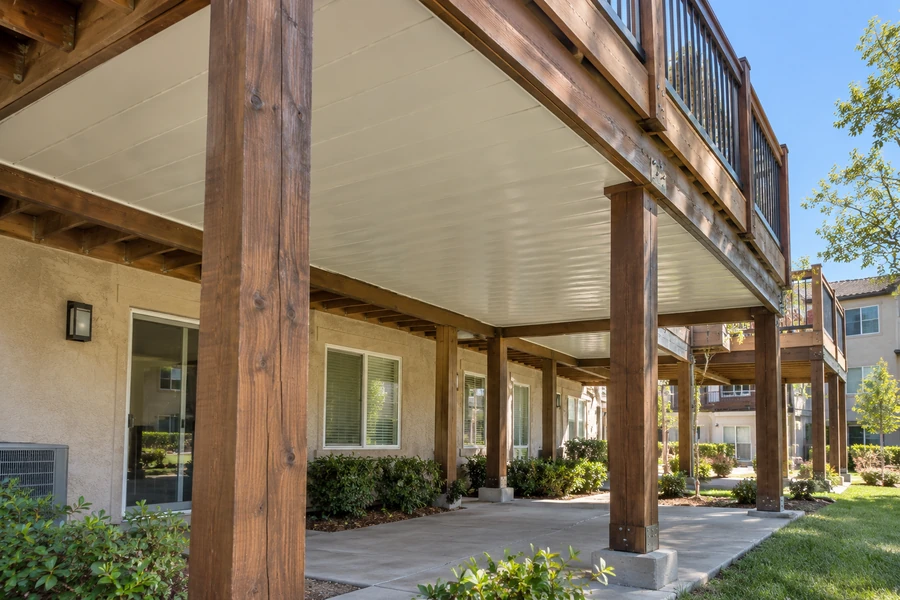
- Assessment of goal, structure and what sits below the deck
- Probing of joists, ledger and post bases before anything is covered
- Framing repair corrected before new surfaces go on
- Boards removed and exterior-grade substrate installed and seamed
- Wood deck waterproofing membrane over a continuous substrate
- Traffic-bearing coatings rated for pedestrian use
- Wood deck waterproofing systems turned up at walls and dressed over edges
- Thresholds detailed so water leaves rather than drains toward the building
- Coatings for wood decks — penetrating finishes where the timber surface stays
- Stripping, cleaning and sanding before any finish is applied
- Moisture content and temperature verified before application
- Under-deck drainage as an alternative where the boards should remain visible
- Joist tape and flashing over joist tops during reconstruction
- Maintenance schedule matched to the system or finish installed
- SB 721 / SB 326 documentation where the deck qualifies
06 Investment
What wood deck waterproofing costs
Quoted after the deck is assessed, and the two approaches sit at very different price points because they’re different amounts of work.
What moves either number
- Area, and how many separate decks or balconies
- Condition of the boards and how much preparation they need
- Framing repair found during probing
- Access and phasing around residents
- Number of elements, since programmes price better per deck
A penetrating finish is prepared and applied to the existing boards — stripping, cleaning, sanding, drying, then the finish. It’s the cheaper route by a wide margin, it keeps the timber surface, and it’s renewed on a cycle rather than lasting indefinitely.
A waterproof system requires the boards to come off, a solid substrate to go down, and a membrane or traffic coating over it. That’s materially more work and it produces a genuinely dry space below. It also changes what you walk on.
One detail that decides whether either lasts: the moisture content of the timber when work starts. Boards that look dry after a week of sun can still be well above the limit a finish needs to penetrate or a substrate needs to sit on, and applying anything over them traps what’s inside. We measure rather than judge by appearance, which occasionally costs a day and regularly saves a redo.
The comparison worth running: a finish costs less each time and recurs forever; a waterproof system costs more once and largely stops recurring. Over a long holding period on a multifamily property the ranking often reverses — but only if what you actually needed was a dry space below. If you only wanted the timber to last, the system is money spent on a problem you didn’t have.
Final pricing follows an on-site assessment. Request a free estimate — no obligation.
In the field
Timber deck detail
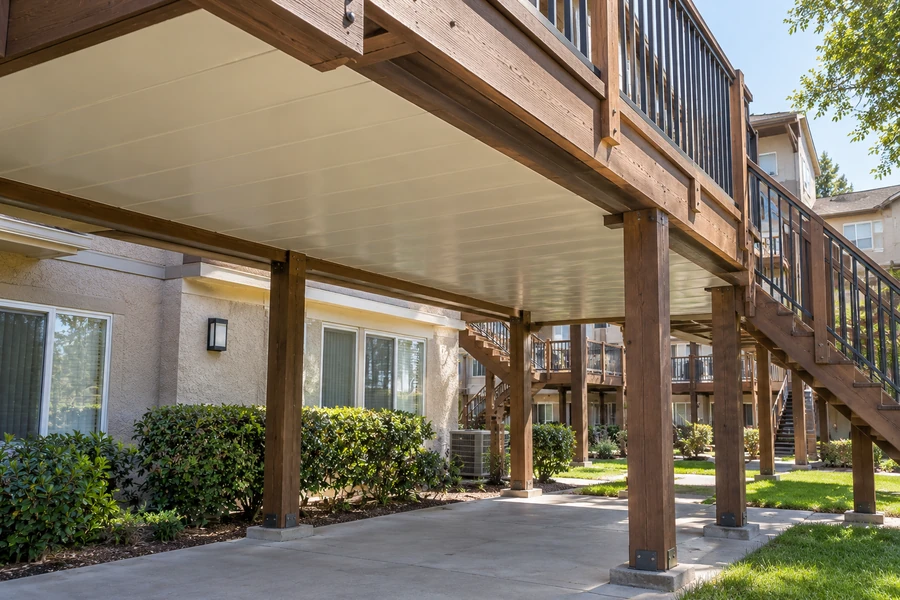
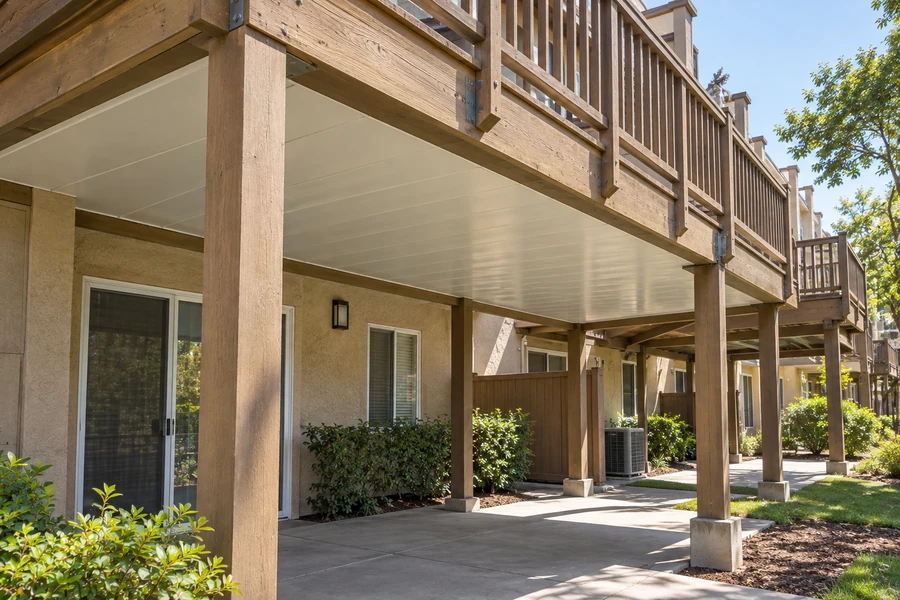
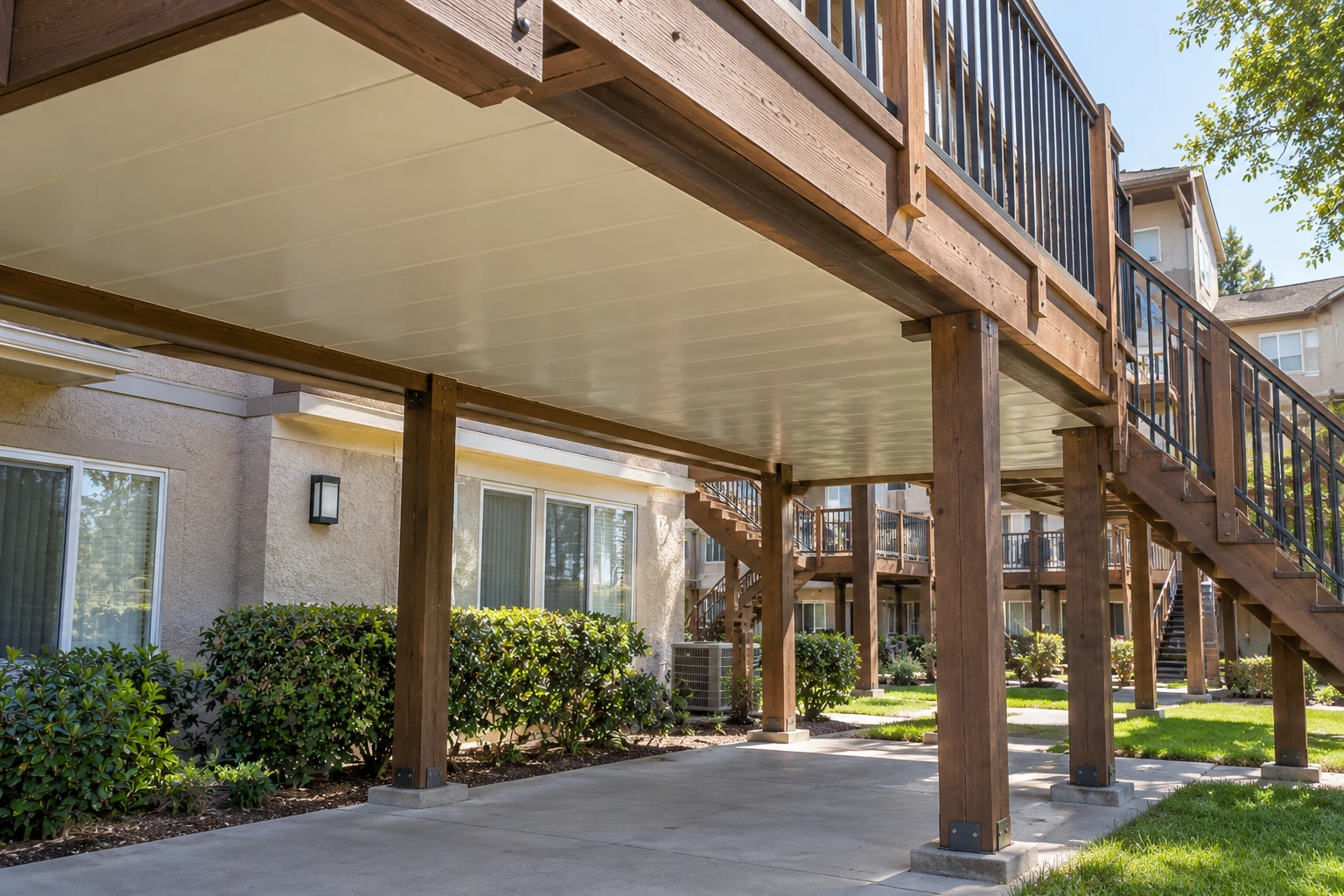
Structures we’ve worked on across the region.
07 Project example
A recent project
A property had paid to have a film-forming coating rolled onto timber decks over ground-floor patios, expecting the patios to stay dry. It hadn’t worked and couldn’t have: the coating bridged nothing, cracked along every board edge within a season, and trapped moisture in the boards it did cover. On the decks that sat over occupied space, D&B took the boards off, installed a continuous substrate, and laid a traffic coating properly turned up at the wall — those patios are dry now. On the decks where nothing sat below, we stripped the failed product, let the timber dry, and applied a penetrating finish so the boards stayed boards. Two different answers on one property, because the decks had two different jobs.
We’d bought one product for two different problems. Only one of them was ever a waterproofing problem. Community Manager · California apartment community
08 Case studies
Recent Projects, Documented
Real commercial properties — what the building needed, what we did, and what it delivered.
 Deck RepairElevated Deck Reconstruction & Waterproofing — 24 Balconies, SacramentoOpen board decks sitting directly over enclosed garages. Every gap between the boards was a route for water…View case study
  WaterproofingElevated Walkway & Balcony Waterproofing — 40-Unit Apartment Community, Rio LindaDry rot had opened holes straight through the walkway decks. We shored the spans, rebuilt the framing underneath,…View case study
  Deck RepairElevated Restaurant Dining Deck Restoration — SaratogaA multi-level hillside dining deck taken from failing boards and moisture-damaged connections back to a sound, sealed structure…View case study
 09 Client feedback
What property managers say
We’d bought one product for two different problems. Only one of them was ever a waterproofing problem.
Nobody had explained that waterproofing means losing the wood surface. We’d have decided differently on half the decks if they had.
The first coating trapped water in the boards. Stripping it back was more work than applying it had been.
10 FAQ
Questions we get asked
Is waterproofing wooden deck boards possible without removing them?
Not if the boards have gaps between them, which almost all timber decks do. Water goes through those gaps by design, and no coating spans a gap or survives the movement at every board edge. Achieving a genuinely waterproof surface means a continuous substrate underneath the finish — which means the boards come off. What you can do without removing them is apply a penetrating finish that protects the timber, or install an under-deck drainage system that catches water below.
What’s the difference between waterproofing and a deck finish?
Purpose and physics. A waterproof system is a continuous membrane or traffic coating over a solid substrate: it stops water reaching anything below. A finish penetrates the timber, slows moisture movement, and blocks the ultraviolet light that greys boards — it protects the wood, not the space under it. Both are called “coatings for wood decks” in ordinary conversation, and they solve different problems.
Which coatings for wood decks actually last?
Penetrating finishes outperform film-forming products on exterior timber, and the reason is movement. Wood expands and contracts with moisture; a film sitting on top has to move with it and eventually cracks, and once it cracks it traps water under itself. A penetrating finish has nothing to crack — it wears away gradually and gets renewed. The trade is that renewal is on a shorter cycle, which is the honest cost of the approach.
How often does a wooden deck need refinishing?
In the Central Valley, typically every couple of years, because the summer heat and ultraviolet exposure are harder on a finish than coastal conditions. Milder microclimates stretch that. The practical signal is water behaviour: when drops stop beading and start soaking in, the finish has stopped working regardless of how it looks.
Our deck sits over a patio. What do we need?
Either a waterproof system over a solid substrate — dry patio, coated surface — or an under-deck drainage system that catches water below the boards and carries it to a gutter, which keeps the timber surface. Both work. Which suits you depends on whether you want to keep walking on wood, and we’d rather set the choice out than assume it.
Does waterproofing stop the deck rotting?
It stops water reaching what’s underneath, which helps the framing considerably. It doesn’t stop rot that’s already established, and it doesn’t help if water is arriving from somewhere else — an unflashed ledger, a threshold draining the wrong way, a post base standing in water. That’s why we probe before covering anything: a new surface over a wet frame hides the problem rather than solving it.
Is wooden deck protection the same as waterproofing?
No, and the words get used interchangeably in a way that costs people money. Protection means keeping the timber sound and looking right — that’s a finish, on a renewal cycle. Waterproofing means keeping water out of the space below — that’s a system, over a continuous substrate. Deciding which one you want is the first question, and it’s the one most quotes skip.
Are you deck waterproofing contractors in California?
We’re a CSLB-licensed contractor (#1060736) working across the Bay Area, Central Valley, and Sacramento on commercial, multifamily, and HOA property. Assessment, framing repair, substrate, membranes, coatings and finishes come from one crew — and we’ll tell you when the answer is the cheaper of the two rather than the larger.
11 Start here
Decide which job it is — free assessment
Tell us what’s under the deck and what’s bothering you: drips onto a patio, boards going grey, a coating that failed. We’ll assess the structure, set out both approaches with what each actually delivers, and price them separately.
CSLB #1060736 · 9+ years · Insured & Bonded · Commercial, multifamily & HOA properties across the Bay Area, Central Valley & Sacramento