Commercial Waterfront Balcony Construction · CSLB #1060736
Commercial Waterfront Balcony Construction for California Coastal & Bayfront Properties
We build and rebuild balconies on oceanfront, beachfront, and bayfront buildings across California — hotels, coastal condominium associations, and multifamily properties where the view is the asset and the air is the problem. A balcony is held together entirely by metal, and salt air spends every hour of every day working on that metal. Building on the water is a materials decision before it’s a construction one.
- CSLB #1060736 Licensed California contractor
- 9+ yrs Building for coastal & bayfront exposure
- Marine-grade Stainless hardware specified for salt air
- Commercial Hotels, condo HOAs & multifamily on the water
01 Why it matters
Salt air attacks the one thing holding a balcony together
Every load path in a balcony runs through metal. Joist hangers, ledger bolts, post bases, connector plates, railing anchors — the timber and the surface get the attention, but the connections are what carry people at height, and they are all steel. In coastal air, chloride is in constant contact with that steel, and corrosion runs continuously rather than seasonally.
The consequence is a specification problem more than a construction one. Hot-dipped galvanised hardware is the sensible standard on an inland balcony and has a materially shorter service life in marine air. Stainless is the appropriate answer near salt water, with Type 316 preferred over 304 where chloride exposure is heavy. Get that decision wrong and nothing looks different on handover — the balcony corrodes from inside connections that nobody will look at again for years.
There’s a local point worth making. Waterfront in California isn’t only the surf line. Frontage on San Francisco Bay carries the same salt exposure, so buildings in Sausalito, Tiburon, Alameda, Richmond, and Vallejo face the problem that owners tend to associate only with the open coast. And because the deterioration curve is steeper on the water, coastal properties frequently produce findings earlier in their SB 721 or SB 326 cycle than inland ones do — the inspection interval is the same, but there is more to find.
Owners on the coast worry about the timber. The timber is replaceable. It’s the steel inside the connections that decides how long the balcony lasts.

02 The D&B difference
What building a waterfront balcony properly involves
We build coastal balconies to a marine specification throughout — because corrosion doesn’t respect the parts of a budget where somebody economised.
Marine-grade hardware, consistently
Stainless connectors, fasteners, and anchors specified for the exposure rather than a mix of grades. A single galvanised bolt in a stainless assembly becomes the weak point, and on the coast it becomes one quickly.
Dissimilar metals isolated
Where different metals meet — an aluminium railing base on a steel plate, a stainless fastener into a galvanised connector — the contact is isolated or the metallurgy is made consistent. Galvanic corrosion in salt air attacks the less noble metal fast, and it’s a failure owners never see coming because both components were the right choice individually.
Detailed for wind-driven rain
Coastal rain arrives horizontally. Flashing laps and thresholds that perform perfectly inland let water track upward and inward under wind pressure, so we detail the wall junction, the door threshold, and the perimeter for water that is being pushed rather than falling.
03 · Service Areas
Where We Work in California
Every city links to a dedicated local page — crews, recent projects and compliance details for that area.
Sacramento Metro
14 cities
East Bay
21 cities
Don’t see your city? We likely still cover it — call (916) 848-2728.
04 How a project runs
How a waterfront balcony project runs, start to finish
-
01
Exposure assessment
We establish how much salt the building actually sees — distance from water, prevailing wind, shelter — and inspect existing hardware for corrosion, which on a coastal property is usually the most informative thing on site.
-
02
Specification
Hardware grade, railing material and finish, decking, and membrane chosen for the exposure, with the maintenance implications of each set out before anything is ordered.
-
03
Engineering & permitting
Stamped structural engineering including coastal wind loading, then through plan review.
-
04
Structure
Framing, posts, and connections installed to marine specification, with dissimilar metals isolated at every contact point.
-
05
Waterproofing & flashing
Continuous membrane, with flashing laps and thresholds detailed for wind-driven rain rather than falling rain.
-
06
Guardrails & finish
Guardrails to the 42″ / 4″ standard in a material and finish suited to salt exposure, and all exposed timber sealed.
-
07
Handover & maintenance plan
As-built documentation for the SB 721 / SB 326 file, plus a maintenance schedule written for a coastal property rather than a generic one.
05 Scope
What’s included in a D&B waterfront balcony project
Complete coastal balcony construction — specified, built, and documented for a marine environment by one CSLB-licensed crew.
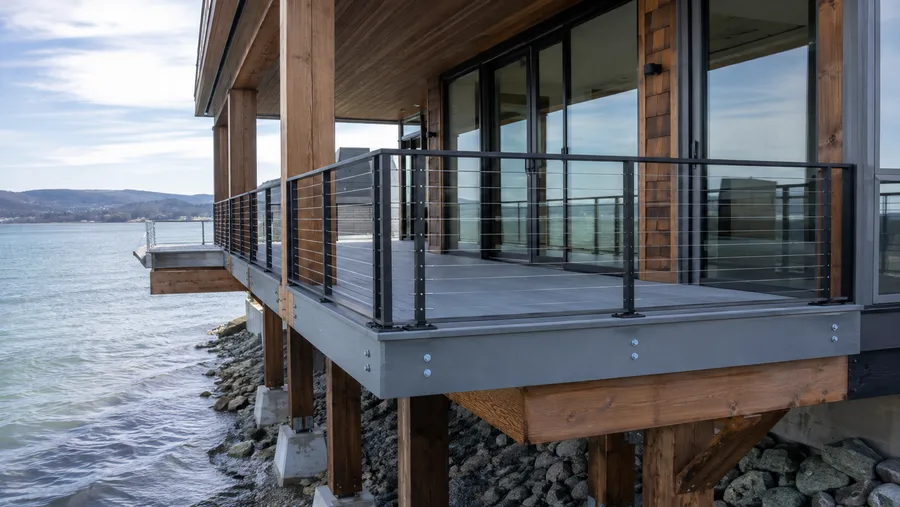
- Exposure assessment and inspection of existing hardware for corrosion
- Stamped structural engineering including coastal wind loading
- Stainless connectors, hangers, fasteners, and anchors specified to the exposure
- Isolation of dissimilar metals at every contact point
- Framing in pressure-treated timber, with post bases holding wood clear of standing water
- Ledger connections flashed and fastened per CBC 1604.8.1
- Flashing laps and door thresholds detailed for wind-driven rain
- Continuous waterproofing membrane and drainage
- Guardrails to the 42″ height and 4″ sphere standard, in powder-coated aluminium, stainless cable, or glass
- Walking surfaces selected for UV and salt exposure
- Exposed timber sealed and finished for marine conditions
- Replacement of corroded hardware and repair of framing damaged behind it
- Coastal maintenance schedule at handover
- As-built documentation for the SB 721 / SB 326 compliance file
Built to current code: CBC 1604.8.1 connections · ASCE 7 including coastal wind exposure · Title 24 · 42″ / 4″ guardrail standard
06 Investment
What a waterfront balcony costs
Coastal balconies are quoted after an exposure assessment, because the specification — not the size — is what separates a waterfront balcony from an inland one of the same dimensions.
What drives the number
- Distance from the water and how sheltered the elevation is
- Hardware grade throughout — stainless costs more than galvanised and is the reason the balcony lasts
- Railing material and finish, and how it behaves in salt air
- Framing and decking material selection
- Extent of corrosion found in existing hardware on a rebuild, and framing damage behind it
- Coastal wind loading and what it does to the structure and guardrail design
- Waterproofing system and flashing detailing for wind-driven rain
- Access and staging on a constrained shoreline site
- Engineering and plan review in your jurisdiction
Where the money should go on the coast: the premium over an inland balcony sits almost entirely in metal — connectors, fasteners, anchors, railing. It is not a large share of the total project, and it is the part that determines whether you rebuild in twelve years or thirty. If a coastal bid comes in noticeably below the others, the hardware specification is the first line worth comparing. Final pricing follows a site assessment — request a free consultation, no obligation.
In the field
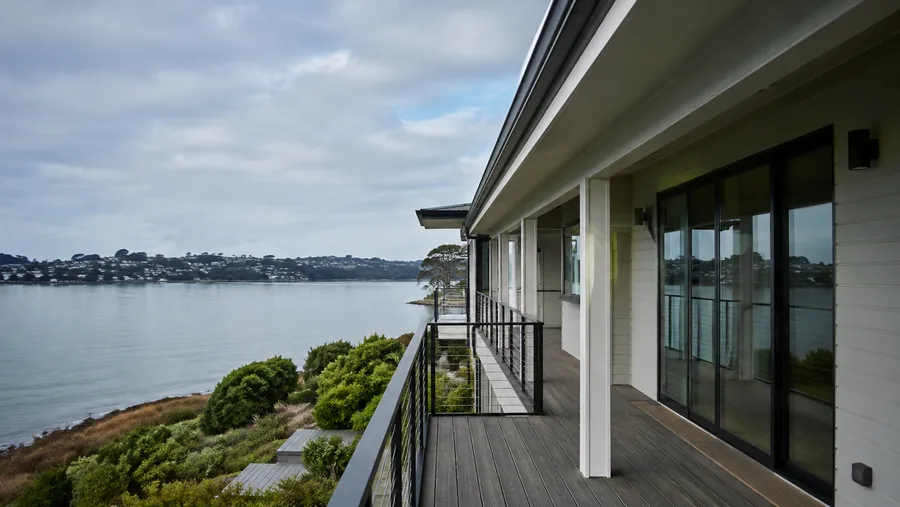
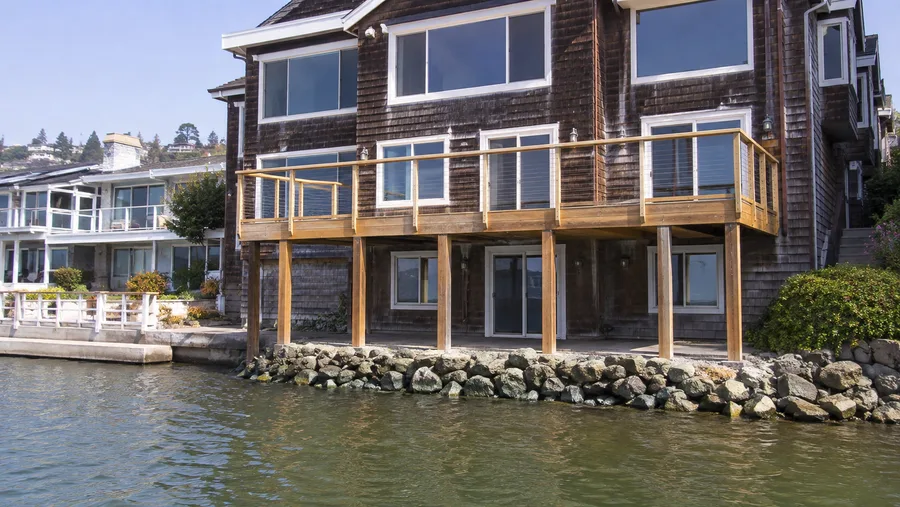
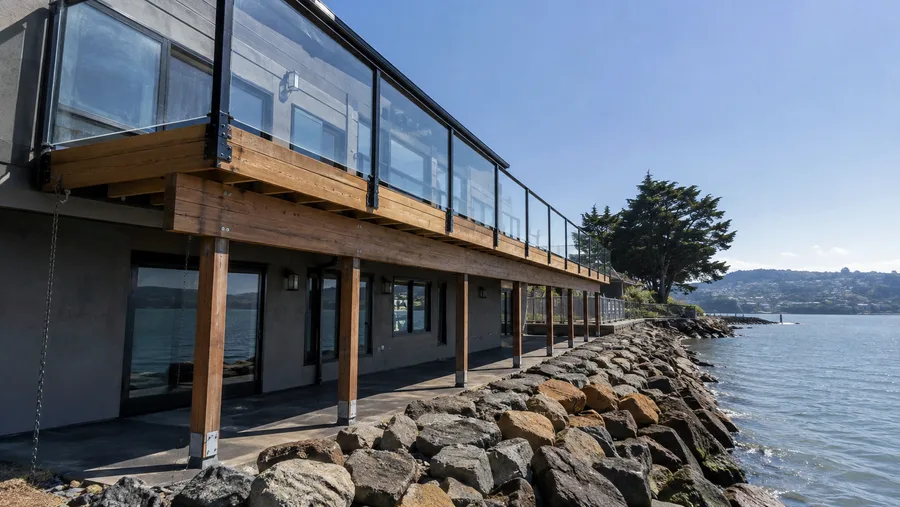
Coastal balcony detail
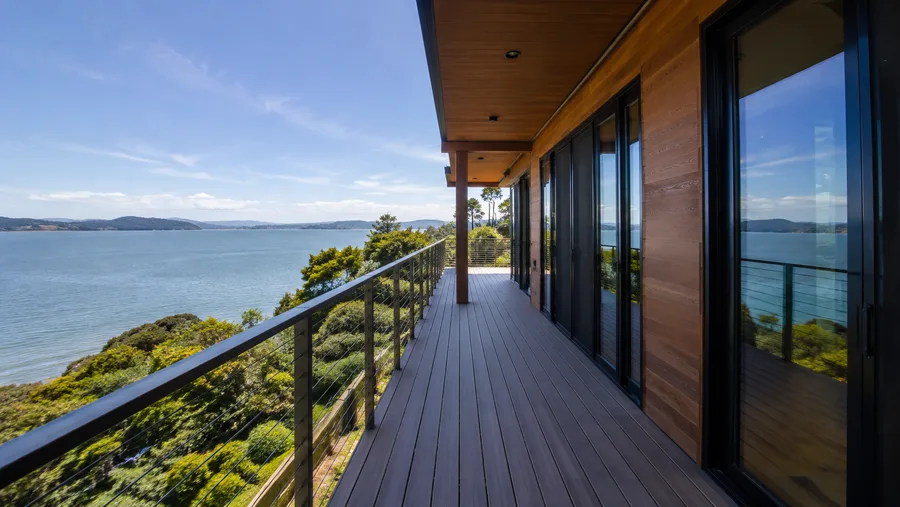
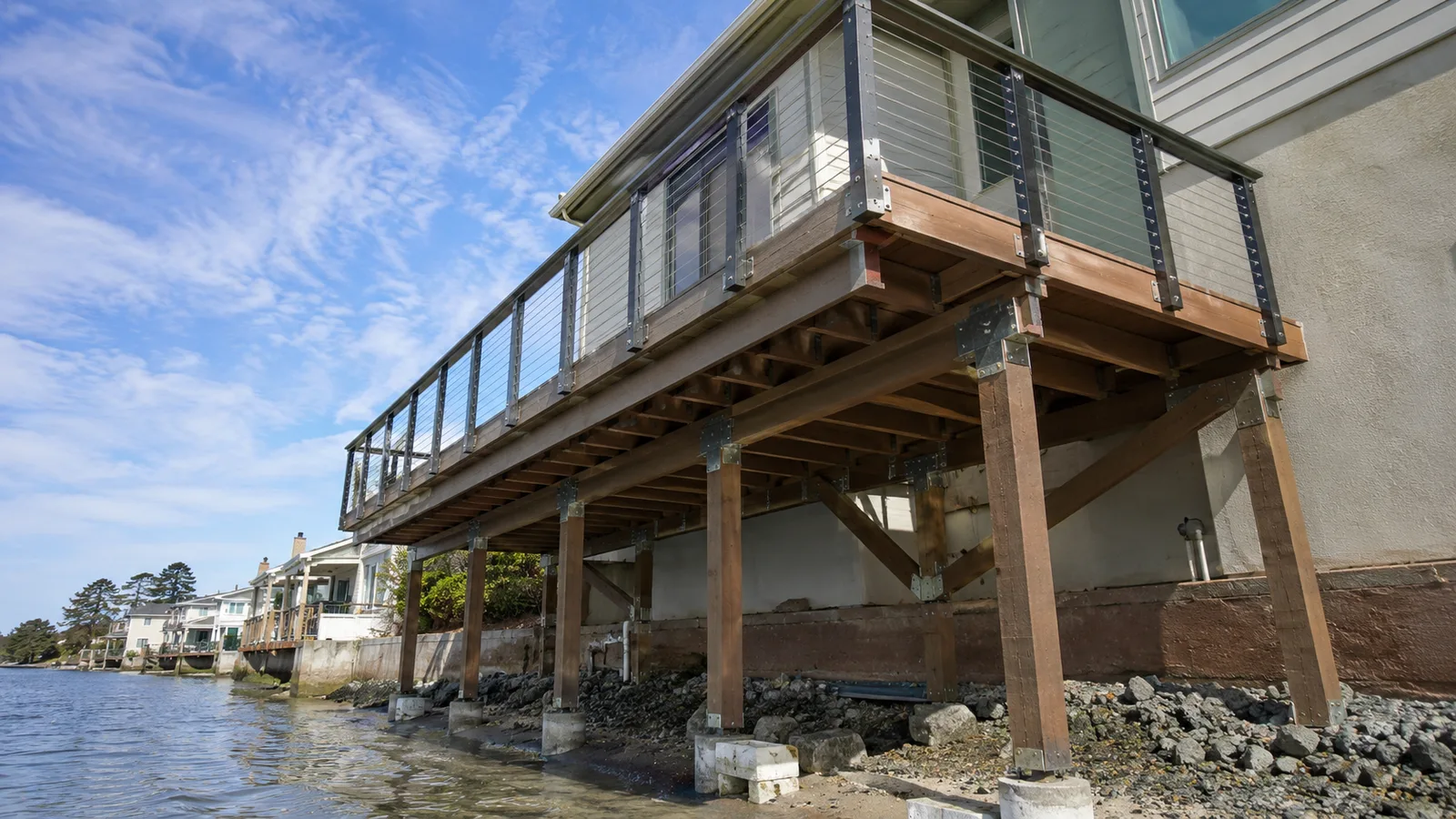
Balconies built where salt air is a permanent condition rather than an occasional one.
07 Project example
A recent waterfront balcony project
A bayfront property had balconies fourteen years old and already producing findings — soft framing at several ledger connections, and railings that had begun to stain the fascia beneath them. The timber itself was in better condition than expected. The problem was underneath it: the original build had used standard galvanised connectors, and in salt air they had lost enough section that the connections were no longer carrying what they were designed for. D&B replaced all connectors, fasteners, and anchors in stainless, isolated the aluminium railing bases from the steel beneath them, repaired the framing where corroded fasteners had let water in, and re-detailed the flashing at the wall for wind-driven rain. The owner received a maintenance schedule written for the exposure rather than a generic one.
The wood was fine. It was the bolts holding the wood that had been quietly failing for a decade. Property Manager · California bayfront property
08 Case studies
Recent Projects, Documented
Real commercial properties — what the building needed, what we did, and what it delivered.
 WaterproofingBalcony & Walkway Waterproofing — Sunset Park Apartments, SacramentoThe concrete had never been coated. Water sat on it, worked through the cracks and ran to the…View case study
  WaterproofingElevated Walkway Rebuild & Waterproofing — 96-Unit Apartment Community, Citrus HeightsThe walkways weren't leaking from the top. The low-slope roof above them had lost its edge metal and…View case study
  Balcony RepairBalcony Replacement with Trex Composite Decking — 18 Balconies, AntelopeThe rot had already reached the beams and posts. We rebuilt the framing under every balcony and re-decked…View case study
 09 Client feedback
What property managers say
Our previous contractor built it the way they’d build anything. Fourteen years later we were paying for that decision, and nobody had ever mentioned hardware grade to us.
They isolated the railing bases from the steel underneath and explained why. Small detail, and apparently the reason the last set corroded where they did.
The maintenance plan is two pages and actually specific to us. Rinse the hardware, check these points, on this interval. Nobody had given us that before.
10 FAQ
Waterfront balcony questions
Why do coastal balconies fail faster than inland ones?
Because of the metal. Airborne chloride is in constant contact with every connector, fastener, and anchor in the assembly, and corrosion runs continuously rather than seasonally. The timber and the surface usually hold up better than owners expect on a beachfront balcony — it’s the hardware inside the connections that loses section, and it does so where nobody can see it.
What hardware should a beachfront balcony use?
Stainless throughout for connectors, hangers, fasteners, and anchors, with Type 316 preferred over 304 where chloride exposure is heavy. Hot-dipped galvanised is a sound inland specification and has a materially shorter life in marine air. Just as important is consistency: a single galvanised bolt in an otherwise stainless assembly becomes the weak point, and on the coast it fails first.
What is galvanic corrosion, and why does it matter on the water?
When two different metals are in contact in the presence of salt, the less noble one corrodes faster than it would alone. On a balcony this shows up where an aluminium railing base sits on a steel plate, or where a stainless fastener passes through a galvanised connector — both components chosen correctly, failing because of what they were paired with. On coastal balconies we isolate those contacts or keep the metallurgy consistent.
Are bayfront properties really as exposed as oceanfront ones?
For corrosion purposes, close enough that they should be specified the same way. Frontage on San Francisco Bay carries salt exposure, so buildings in Sausalito, Tiburon, Alameda, Richmond, and Vallejo see the same problem that owners usually associate with the open coast. We assess exposure on site rather than assuming it from the address.
How much more does a coastal balcony cost than an inland one?
The premium sits almost entirely in the metal specification, and as a share of the total project it’s smaller than most owners assume — while being the single factor that most determines service life. It’s also the easiest line for a competing bid to quietly economise on, since nothing looks different at handover. If a coastal bid is noticeably cheaper, compare the hardware schedule first.
Do waterfront balconies need more maintenance?
Yes, and the most valuable item on the list is also the cheapest: rinsing hardware and railings with fresh water removes accumulated salt before it does its work. Beyond that, coastal balconies need shorter inspection intervals and more frequent attention to sealants and finishes. We hand over a schedule written for the exposure rather than a generic one.
Does SB 721 or SB 326 treat coastal balconies differently?
The statutes don’t — the inspection interval is six or nine years regardless of location. What differs is what the inspection finds. Deterioration runs faster on the water, so a coastal property that waits the full cycle often has more to remediate than an inland one on the same schedule. Many coastal owners we work with inspect more often than required for exactly that reason.
What railing material works best in salt air?
Powder-coated aluminium is the practical workhorse: it doesn’t rust, holds its finish, and costs less than stainless. Stainless cable systems preserve the view and suit waterfront elevations, though they need rinsing to stay clean. Glass performs well structurally but shows salt spray quickly, so it needs more washing on a seaside balcony than owners expect. Painted mild steel is the one option we’d steer you away from on the water.
Do you work on beach house balconies?
Our work is commercial, multifamily, and HOA — coastal hotels, condominium associations, and apartment buildings on the water. A single-family beach house balcony sits outside what we take on, but if you manage or own a coastal building with three or more units, that’s exactly our scope.
Are you coastal balcony contractors near me in California?
We’re a CSLB-licensed contractor (#1060736) building waterfront balconies across the Bay Area, Central Valley, and Sacramento, exclusively on commercial, multifamily, and HOA properties. Exposure assessment, specification, structure, waterproofing, guardrails, and documentation come from one crew.
11 Start here
Start your waterfront balcony project with a free assessment
Tell us about the property and how close it sits to the water. We’ll assess the exposure, inspect the existing hardware, and give you a written estimate with the specification set out — so you can see exactly what you’re paying for and why.
CSLB #1060736 · 9+ years · Insured & Bonded · Serving the Bay Area, Central Valley & Sacramento