Balcony Rot Repair · CSLB #1060736
Commercial Balcony Rot Repair in California
We repair rot in balcony framing across the Bay Area, Central Valley, and Sacramento — beams, cantilever joists, rims, and the connections into the building. On a balcony, decay is not just damage to be cut out. On a cantilevered element it sits in the one place that carries the entire structure, and there is no second load path behind it.
- CSLB #1060736 Licensed California contractor
- 9+ yrs Repairing commercial balcony framing
- Opened at the wall Cut back to sound wood, cause corrected
- Commercial & HOA Apartments, condominiums, HOAs & hotels
01 Why it matters
On a cantilever there is no second load path
A cantilevered balcony works by running its joists through the wall and into the building, and the whole structure is held by what those joists can resist at that one line. Bending is highest there — not at the outer edge where people stand, but at the wall. It is also the wettest point on the element, because that is where the balcony meets the building and where flashing details fail. And it is the least visible point, because it is inside the wall.
Those three facts sitting on top of each other are why balcony rot behaves differently from deck rot. A post-supported balcony losing strength at the ledger still has posts underneath it doing part of the work. A cantilever has nothing behind the wall line. The joist either carries or it doesn’t, and the loss of section that would be a repair item on a deck is a structural condition here. That is also why a cantilever gives little warning: the surface can feel sound while the section that matters, several inches inside the wall, has lost most of its strength.
The second thing worth understanding is the terminology, because it changes how far the repair has to reach. “Dry rot” is a misleading name — the fungus needs moisture like any other, but it can move water along its own strands and attack timber some distance from the original source, sometimes travelling through masonry to get there, which is why the affected wood can look dry. Wet rot stays where the water is. Practically: wet rot is cut out around its source and the source corrected, while dry rot requires a wider search, because assuming it stopped where the damp patch stops is how it comes back.
The section that matters on a cantilever is inside the wall. You can stand on a balcony that feels solid and be standing on very little.

02 The D&B difference
What proper balcony rot repair involves
The connection at the wall is opened
Not probed from outside and estimated. On a cantilever the critical section is behind the wall line, and any assessment that doesn’t reach it is a guess about the part that decides everything.
Cut back past the visible edge
Decay extends into timber that still looks sound, and further again where the fungus is the type that travels. We cut to material that resists a probe and keep going past it.
The cause corrected before new material goes in
Almost always an unflashed connection, a threshold draining the wrong way, or a coating that stopped working. New timber into the same conditions starts the same clock.
03 · Service Areas
Where We Work in California
Every city links to a dedicated local page — crews, recent projects and compliance details for that area.
Sacramento Metro
14 cities
East Bay
21 cities
Don’t see your city? We likely still cover it — call (916) 848-2728.
04 How a project runs
How a balcony rot repair runs
-
01
Assessment
Probe testing across the framing, moisture readings, and an opening at the wall connection so the cantilever section or the ledger can actually be seen.
-
02
Identification
Which type of decay, where the water is coming from, and how far the fungus is likely to have travelled beyond the visible damage.
-
03
Scope & estimate
Written extent, with a stated allowance for what opening up may add, and a clear statement where the element has passed the point repair helps.
-
04
Support
Element taken out of service and temporarily shored where the loss of section requires it.
-
05
Removal & replacement
Decay cut back to sound material, beams and joists replaced or sistered with rated connectors, and the connection into the building rebuilt.
-
06
Cause correction
Flashing, threshold detailing, drainage, and waterproofing corrected so the replacement isn’t put back into the same conditions.
-
07
Handover
Photographs of what was found and what went back, plus documentation for the SB 721 / SB 326 compliance file.
05 Scope
What we repair
Balcony rot repair on commercial and multifamily property, from one CSLB-licensed crew.
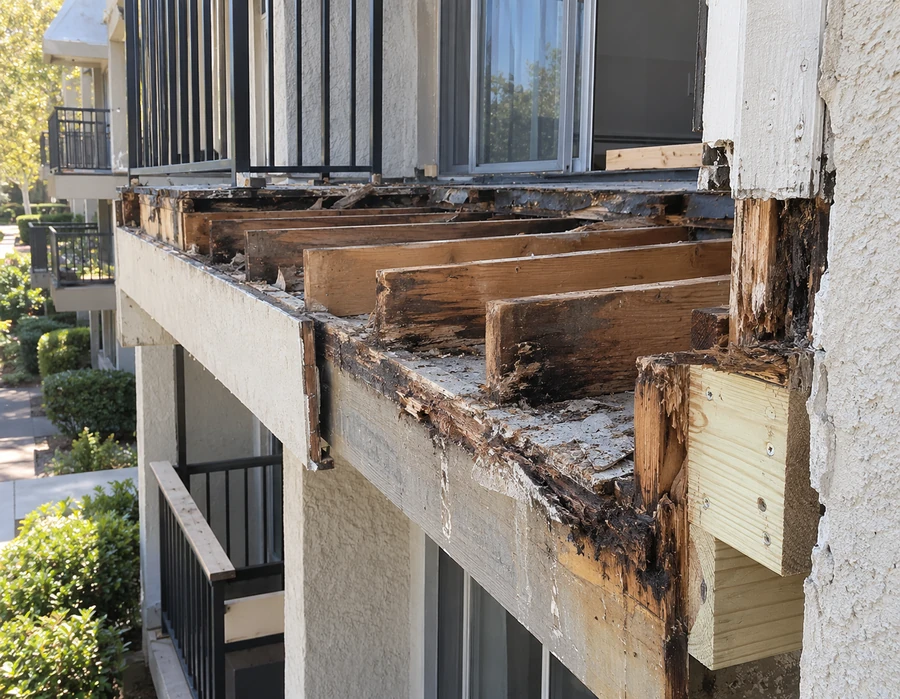
- Probe testing and moisture readings across the framing
- Opening at the wall connection so the critical section is seen, not assumed
- Identification of decay type and likely extent beyond the visible damage
- Temporary shoring and removal from service where section loss requires it
- Balcony dry rot and wet rot cut back to sound material
- Dry rot on beams under balcony structures cut out and the beams replaced or sistered
- Balcony wet rot cantilever joists replaced where section is lost at the wall
- Rim and blocking replaced
- Ledger connections rebuilt and flashed per CBC 1604.8.1
- Post bases replaced and re-set clear of standing water
- Threshold detailing corrected where water drains toward the building
- Waterproofing reinstated as a continuous system
- Honest assessment when the extent makes rebuilding the better value
- Documentation for the SB 721 / SB 326 compliance file
Built to current code: CBC 1604.8.1 ledger connections · ASCE 7 load criteria · rated connectors and structural fasteners
06 Investment
What balcony rot repair costs
Quoted after the wall connection is opened, because on a balcony that is where the cost lives.
What drives the number
- Whether the element is cantilevered, post-supported, or suspended — and therefore what a given loss of section means structurally
- How far the decay has travelled beyond the visible damage
- Whether the building’s own framing has been reached
- Temporary shoring and time out of service
- Restoring the weather barrier and waterproofing across the opening
- How many neighbouring elements share the same detail and condition
- Access and phasing around residents
Why the type of decay affects the number: wet rot is localised around its water source and prices fairly tightly once that source is found. The type that travels does not, and an estimate that assumes it stopped at the damp patch is an estimate that will move. We state that as an allowance rather than discovering it halfway.
Where repair stops being the right money: when section loss at the wall line is extensive on a cantilever, or when several elements on the same run share the condition. At that point you are paying repair prices for most of a rebuild. We will price both and say which we’d choose.
Final pricing follows an on-site assessment. Request a free estimate — no obligation.
In the field
Balcony rot detail
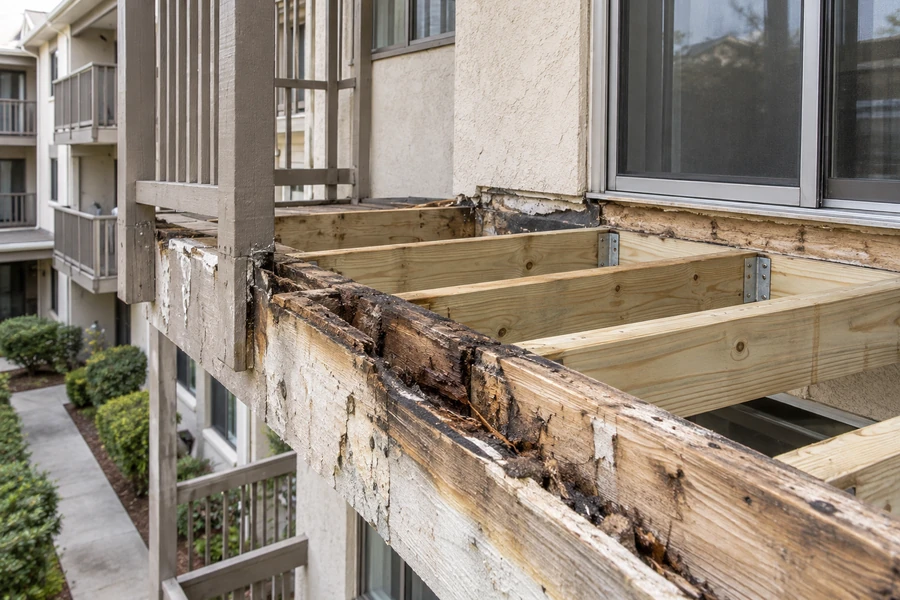
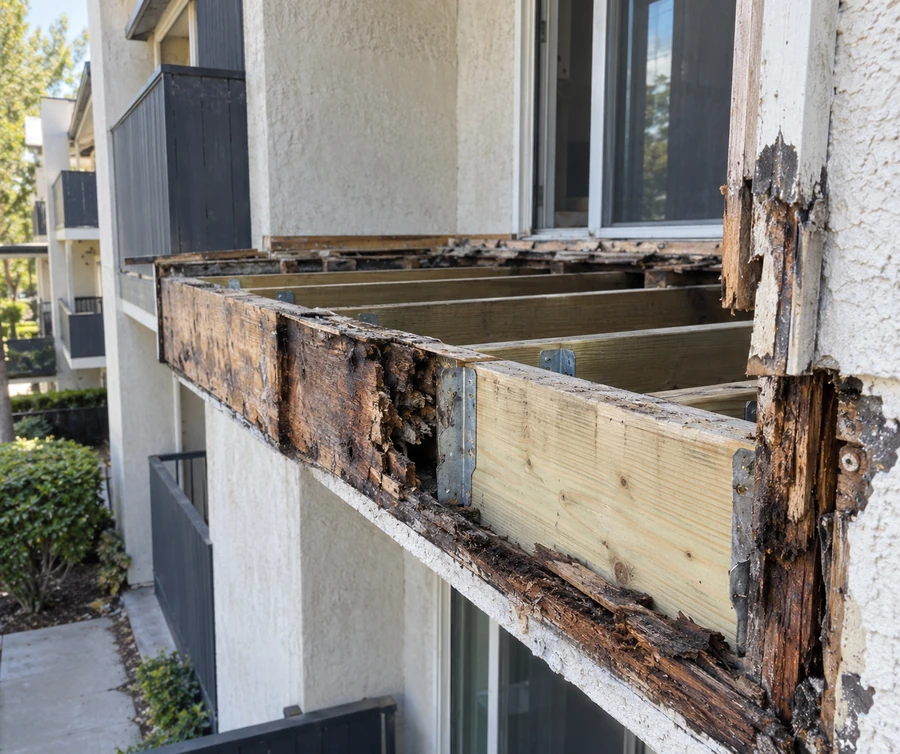
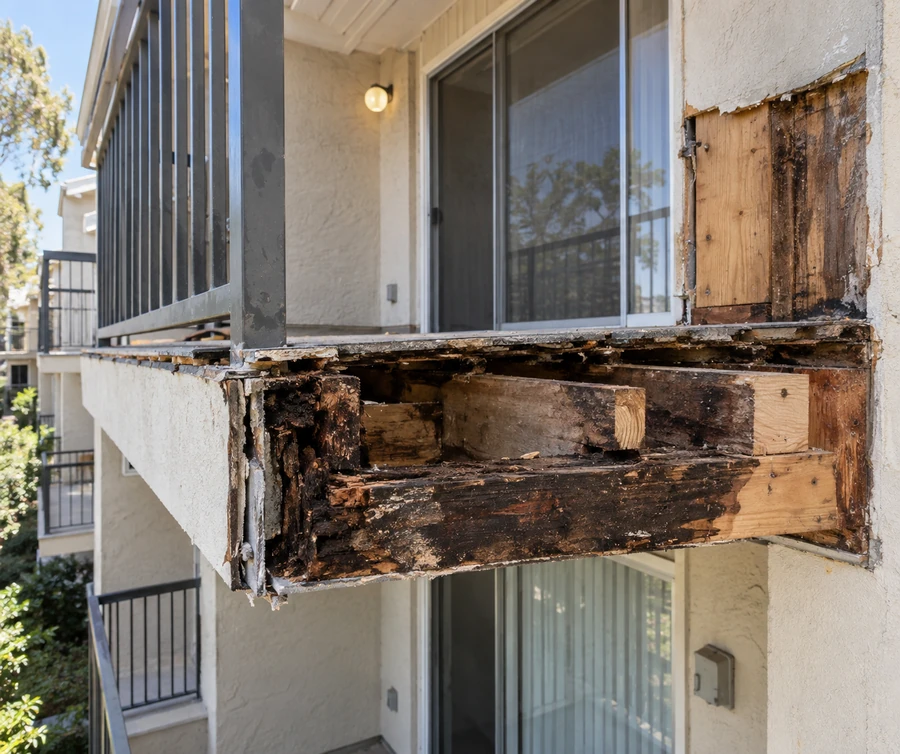
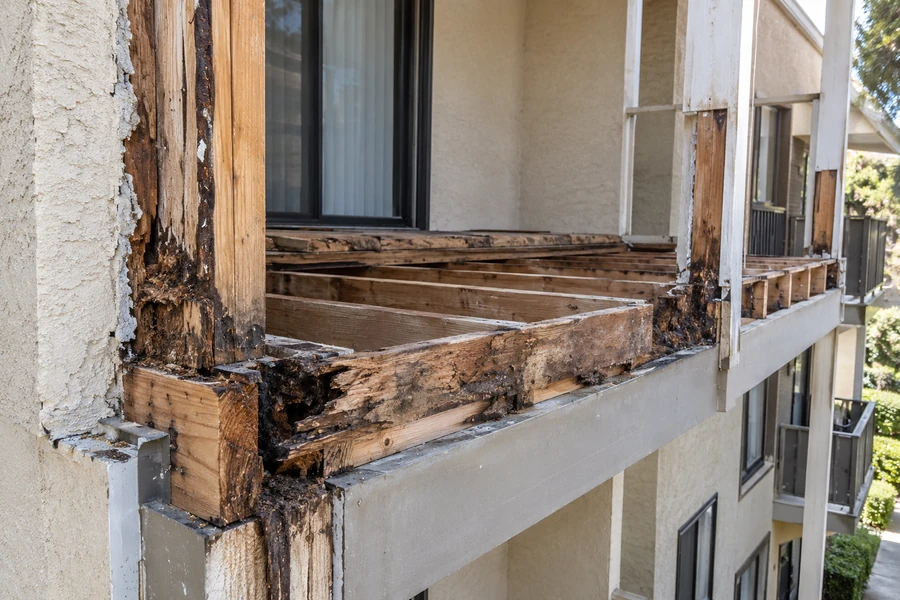
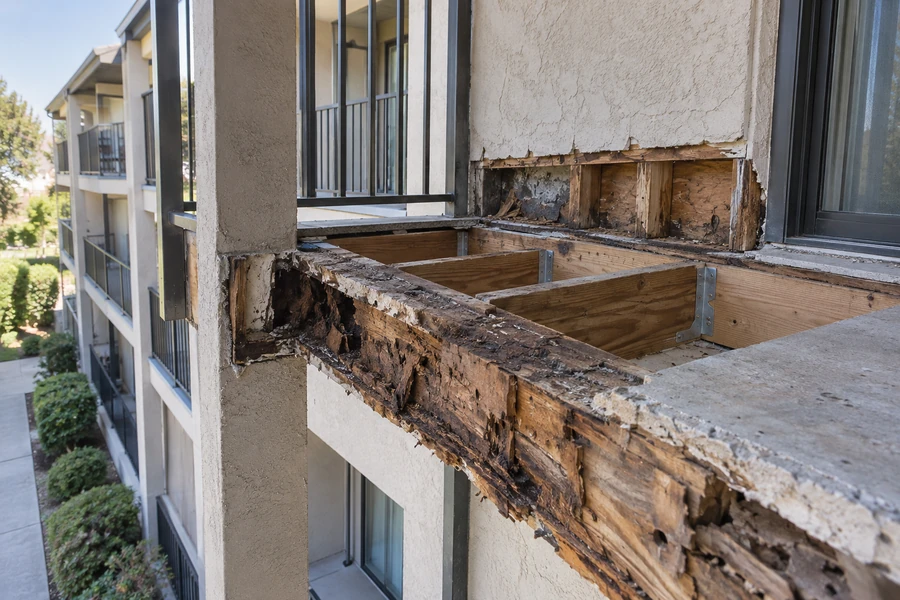
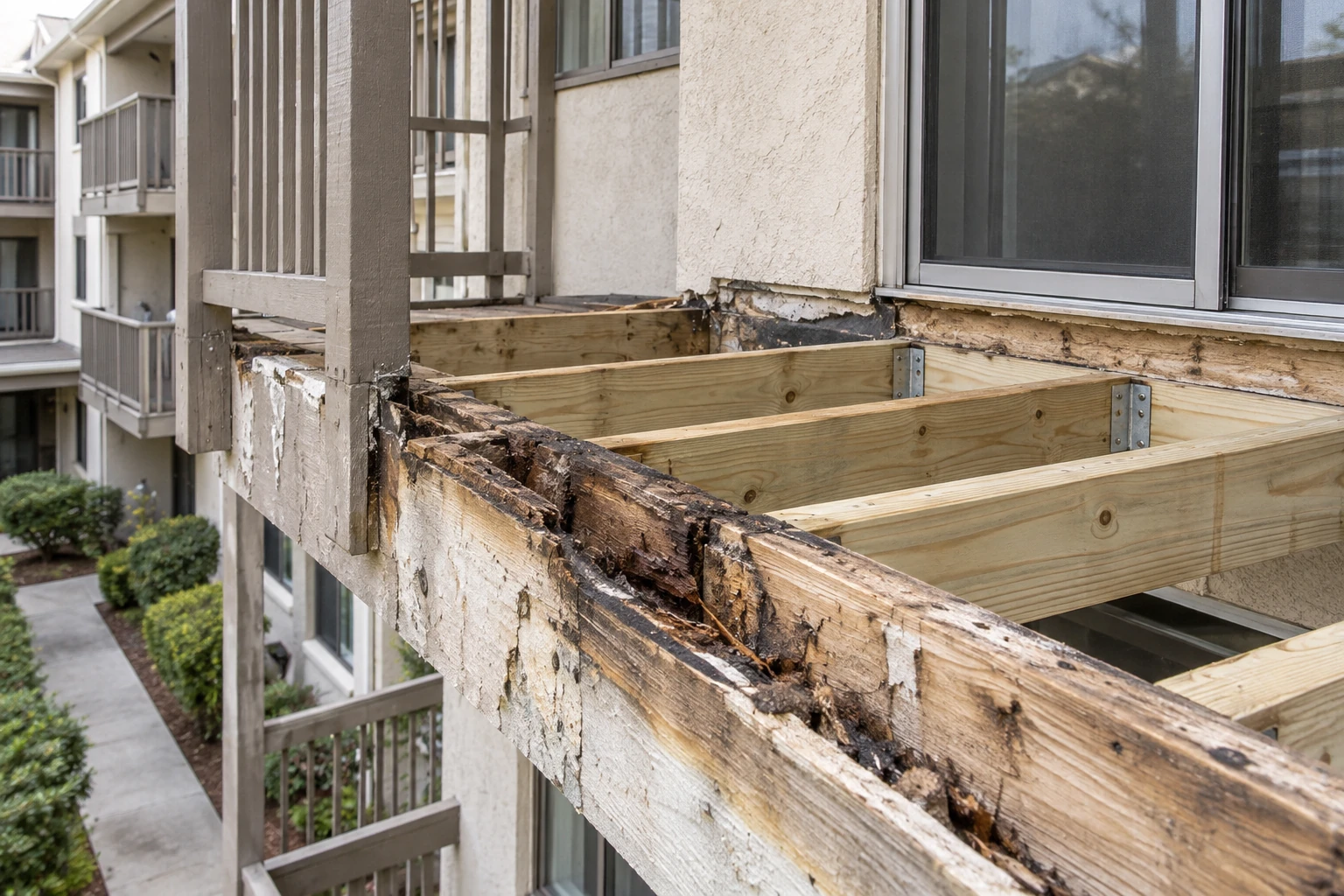
What was behind the stucco, and how far it reached.
07 Project example
A recent balcony rot repair
A resident reported that a balcony felt springy near the door. The surface looked unremarkable and the outer edge was sound, which is the pattern on these. Opening the wall connection explained it: the joist ends had lost most of their section for several inches inside the wall, exactly where bending is highest, and the building’s own rim behind them was wet along its length. The decay had travelled further than the visible staining suggested. D&B shored the element, cut the framing back past the soft material into wood that resisted a probe, rebuilt the connection with rated connectors, flashed it properly, and reinstated the waterproofing. Two neighbouring balconies on the same run were opened as a precaution and one of them was at an earlier stage of the same thing.
It felt springy by the door and solid at the railing. Turns out that’s exactly what you’d expect, and exactly the wrong way round from what we assumed. Community Manager · California apartment community
08 Case studies
Recent Projects, Documented
Real commercial properties — what the building needed, what we did, and what it delivered.
 WaterproofingElevated Walkway & Balcony Waterproofing — 40-Unit Apartment Community, Rio LindaDry rot had opened holes straight through the walkway decks. We shored the spans, rebuilt the framing underneath,…View case study
  WaterproofingBalcony & Exterior Stair Waterproofing — 32-Unit Multifamily Community, SacramentoThe rot wasn't out at the edge — it was where the deck met the wall. We stripped…View case study
  WaterproofingBalcony Waterproofing & Reconstruction — Apartment Walkway, San JoseThe walkway read as concrete and the railing read as tired. Both were wrong: the surface was a…View case study
 09 Client feedback
What property managers say
It felt springy by the door and solid at the railing. Turns out that’s exactly what you’d expect, and exactly the wrong way round from what we assumed.
They opened the wall instead of probing from outside. Everything that mattered was six inches in from where anyone had looked.
The stain on the ceiling had stopped years ago. The rot behind it hadn’t.
10 FAQ
Balcony rot questions
What’s the difference between dry rot and wet rot on a balcony?
Both need moisture — the names mislead. Wet rot stays where the water is: find the source, cut out around it, correct the source, and the repair holds. The type commonly called dry rot can move water along its own strands and attack timber at some distance from the original leak, occasionally travelling through masonry to get there, which is how it reaches wood that looks perfectly dry. The practical consequence is scope: wet rot is contained, and balcony dry rot needs a wider search before anyone decides where the repair ends.
Why is rot on a cantilevered balcony more serious?
Because there’s no second load path. A cantilever carries everything at the line where its joists enter the wall, and that is simultaneously where bending is highest, where water gets in, and where nobody can see. A post-supported balcony losing strength at the ledger still has posts sharing the load. A cantilever doesn’t, so the same loss of section is a repair item on one and a structural condition on the other.
Our balcony feels solid. Could it still have rot?
Yes, and on a cantilever that’s the common case. The outer edge, where people stand and where the feel of the deck is judged, is not the section that matters. The section that matters is inside the wall. Balconies that feel firm at the railing and slightly soft near the door are describing exactly the pattern we expect — the springiness is nearest the failing end.
How do you find dry rot on beams under a balcony?
Probing the underside, moisture readings, and an opening at the connection into the building. The soffit usually hides the beams, and stucco or a closed underside hides them completely, so an assessment that doesn’t open anything is reading the outside of a box. Where the underside is enclosed, a small opening at the wall answers more than an hour of tapping.
Can rot cause a balcony to collapse?
Balcony rot collapse is what the California legislation exists to prevent, and loss of structural section is what makes an element unsafe, and on a cantilever the loss is concentrated at the one point carrying the load. That is the reason these elements are inspected under statute at all. It is also the reason we take an element out of service and shore it when probing finds substantial loss at the wall line, rather than scheduling the repair for a convenient week.
Can rotted balcony framing be treated instead of replaced?
Not where it’s carrying load. Consolidants and epoxy fillers restore appearance and have legitimate uses on trim and non-structural timber. A beam or a cantilever joist that has lost section has lost capacity permanently, and no filler returns it. On an element people stand on at height, over occupied space, that distinction is the whole answer.
When does repair stop making sense?
When section loss at the wall line is extensive, or when several elements on the same run share the condition — they were framed the same week to the same detail, so one failing says something about the others. At that point you’re paying repair prices for most of a rebuild. We price both and give a straight recommendation.
Are you balcony rot repair contractors in California?
We’re a CSLB-licensed contractor (#1060736) repairing balcony rot across the Bay Area, Central Valley, and Sacramento, exclusively on commercial, multifamily, and HOA property. Assessment, shoring, structural repair, flashing, and waterproofing come from one crew — which matters here, because putting new timber back into the conditions that destroyed the last set is the most common way this work gets done twice.
11 Start here
Get the wall connection opened — free assessment
Tell us what you’re seeing: a soft spot near the door, a stain on the ceiling below, a soffit that sounds hollow, or an engineer’s report you need acted on. We’ll probe the framing, open the connection, and tell you what the section actually looks like where it matters.
CSLB #1060736 · 9+ years · Insured & Bonded · Commercial, multifamily & HOA properties across the Bay Area, Central Valley & Sacramento