Is HOA Responsible for Balcony Repairs?
A balcony springs a leak, a board sinks, a railing comes loose — and right away the awkward question surfaces: who pays for this? The unit owner is sure that anything outside the walls is the association’s job. The board reasons the other way: one specific resident uses the balcony, so it’s theirs to fix. Usually both are half right, and the truth hides in the building’s governing documents and in California law.
In condominiums this is a perennial, contested topic, so let’s work through it calmly and on the merits — without trying to hand down a legal verdict for any particular building. We’ll look at how California law divides responsibility, what “exclusive-use common area” means, when the mandatory balcony inspections come into play, and what to do when the two sides don’t agree. The goal is to give a clear, even-handed picture that’s equally useful to a unit owner and a board member.
Why the Question Is So Tangled
The root of the confusion is that a balcony is a borderline zone. It adjoins a specific unit and serves that unit’s resident, yet physically it’s part of the building’s outer shell, which the association normally answers for. Hence the two mirror-image misconceptions: the owner figures that since it’s outside, the association pays for everything, while the board figures that since one person uses it, the repair is entirely on them.
In reality neither extreme is correct. The answer depends on which category of property the balcony falls into, what the building’s governing documents say, and exactly which element is at issue — the surface or the load-bearing structure. We’ll work through each of these forks so the full picture comes together.
What California Law Says
In California this question is governed by the Davis-Stirling Act — the main body of rules for homeowners associations. It sets out several categories of property, and which one a balcony falls into determines how responsibility is split. Most condominium balconies fall under what’s called exclusive-use common area (Civil Code §4145): formally it’s common property, but only the owner of the adjoining unit uses it.
The key rule is written into Civil Code §4775. By default, unless the building’s governing documents say otherwise, the owner is responsible for maintaining such a balcony — cleaning, painting, minor upkeep — while the association is responsible for its repair and replacement. In other words, the phrase “exclusive use” by no means implies “at your own expense”: day-to-day care sits with the resident, but when it comes to fixing a rotted frame or replacing the waterproofing, that’s the association’s zone. Only the governing documents themselves can change this allocation — not a board decision or a verbal understanding.
Who It Applies To
The key marker here isn’t the type of building but the form of ownership. SB 326 and the rules tied to it apply to condominiums managed by a homeowners association under the Davis-Stirling Act. If that’s your structure and the building has balconies on wood supports, everything above relates to you directly.
At the same time, it’s important to distinguish a condominium from developments and communities with a different ownership form — the rules for those can differ. The confusion shows up more often than you’d think: a board can spend years convinced its building falls under one law, when in fact another applies, with a different set of obligations. If you’re not sure which law covers your building, check our breakdown of the differences between SB 721 and SB 326.
Where the Line Runs: Finish or Structure
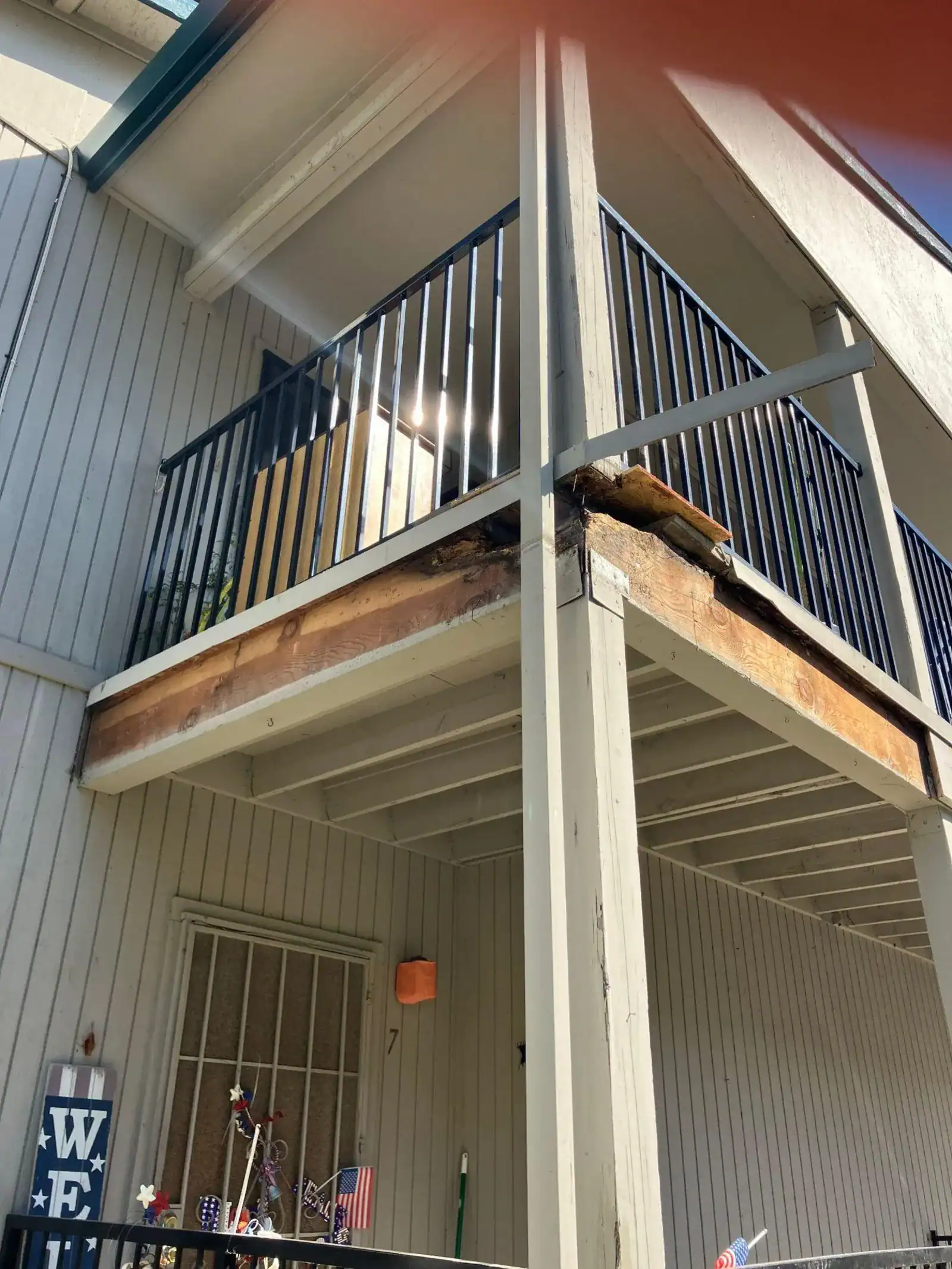
In practice a dispute almost always comes down to one thing: what exactly broke. Cosmetic and surface elements — flooring, paint, sometimes the railing — are more often placed in the owner’s zone. Load-bearing beams, the connections to the building, the waterproofing membrane, and the structure itself belong to the association’s zone. Understanding this line settles half of the conflicts in advance.
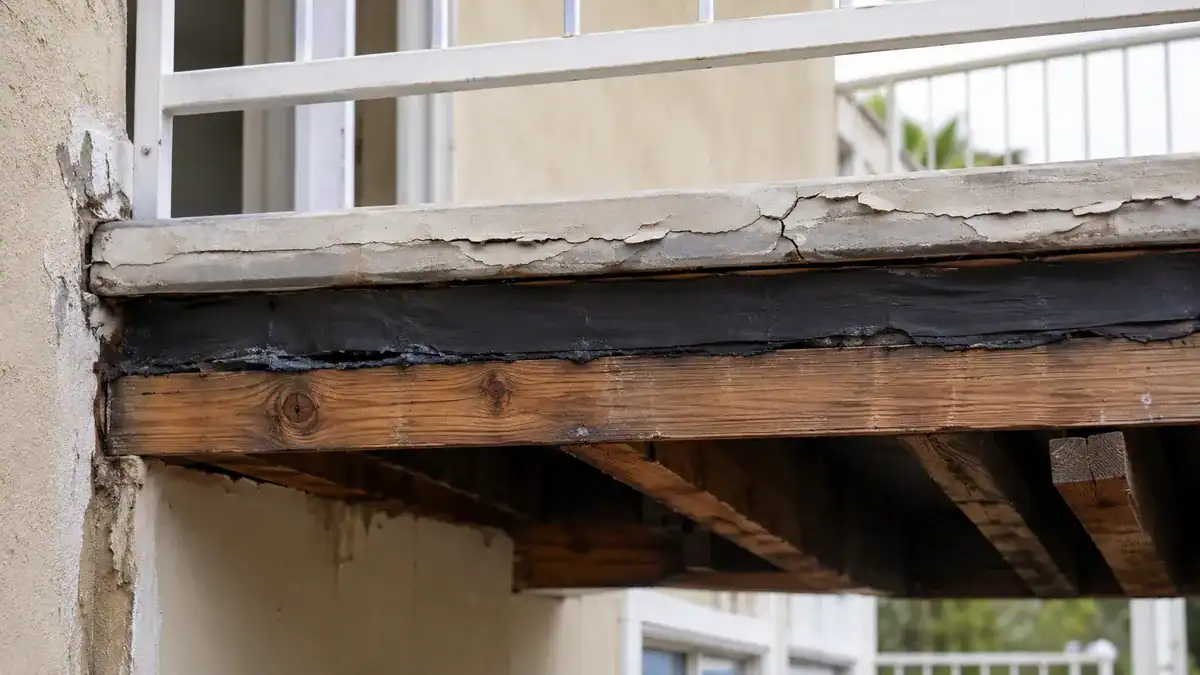
So when a problem comes up, it helps to pin down its nature right away. Peeling paint on a railing is one thing; a soft, springy board or stains on the downstairs neighbor’s ceiling is quite another — almost certainly water has reached the frame, and that’s no longer cosmetic. The more precisely you name the nature of the damage, the clearer it is whose responsibility it is by default and who to turn to for a fix.
There’s an engineering subtlety here that’s often missed: visible cosmetics and hidden structure are connected. Peeling paint or a cracked coating is often not a trifle but the first signal that water is already working its way toward the beams. So cosmetic signs deserve attention: a stain caught in time spares both the owner and the association a far larger and more contested repair.
How the Mandatory Inspections Change the Picture
SB 326 adds a separate layer to this topic. It requires condominium associations to regularly inspect balconies and other elevated structures using a licensed engineer or architect; the first inspection was due by January 1, 2025. These inspections bear directly on the question of responsibility.
When an inspection turns up defects in the association’s zone — frame rot, waterproofing failure, weakened connections — addressing those defects becomes the board’s direct duty, not a matter for debate. Such a repair is funded from the building’s reserves, and putting it off is no longer a saving but a breach of the board’s duties to the owners. We cover the inspections themselves in our breakdown of the SB 326 law.
Not sure how this applies to your building?
A licensed contractor answers — free, same-day callback.
How to Read Your Governing Documents
Since it’s the governing documents that can change the default allocation, that’s always where to start. Read carefully the sections on common property, on exclusive-use property, and on maintenance and repair duties. Below are the things to look at first.
- How exactly the balcony is classified. Whether it’s assigned to exclusive-use common area or to something else — that’s the starting point.
- The split between “maintenance” and “repair/replacement.” Governing documents often separate these terms, and the answer to who pays for what lies in their exact wording.
- Special provisions. Sometimes the documents explicitly shift part of the responsibility onto the owner — and then the default rule no longer applies.
- The approval process for work. Where it spells out how and with whom to coordinate a repair, so it doesn’t turn out later that you went off-procedure.
If the wording is contradictory or unclear, that’s normal — documents like these were drafted by lawyers, sometimes decades ago. In a contested situation it’s better to check with a specialist; our material is a reference point, not legal advice for your particular building.
What to Do When the Two Sides Disagree
Sometimes an owner and a board see who’s responsible for the repair differently, and the correspondence hits a wall. In California there’s a clear ladder of steps for cases like this, one worth climbing gradually rather than skipping rungs.
- Gather the facts. Document the damage with dated photos, save the correspondence and, if you have one, the inspection report.
- Contact the board in writing. Lay out the problem and cite the specific clauses of the governing documents and the law.
- Request internal dispute resolution. The Davis-Stirling Act provides a procedure for settling disagreements within the association — cheaper and faster than court.
- Bring in a specialist. An independent engineer’s assessment often defuses the dispute by showing the true nature of the damage.
- Consider the court route as a last resort. If you can’t reach an agreement, a lawsuit remains, but it’s long and costly for both sides.
Most disputes fizzle out on the first rungs, when both sides have facts and an independent assessment in hand. Taking a matter to court pays off for no one: it’s months of time, legal expenses, and soured relations with neighbors. So an early, calm conversation grounded in the governing documents and a specialist’s opinion is almost always preferable to litigation.
A Special Case: A Leak Reaching the Neighbor Below
A separate, painful situation is when water from an upper unit’s balcony ruins the property of the resident a floor down. Here there are three interested parties at once: the source owner, the affected neighbor, and the association. Who pays depends on what leaked (the owner’s zone or the association’s) and whether anyone knew about the problem ahead of time but dragged out the repair.
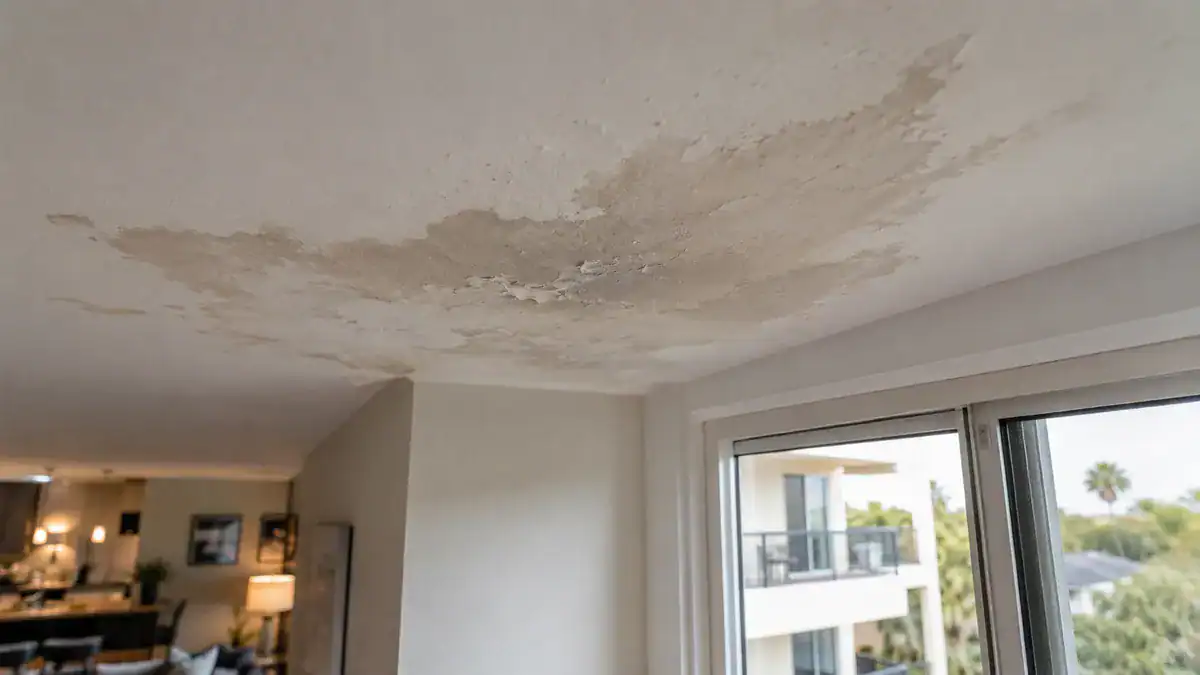
Sorting out a case like that to the last cent is the work of lawyers and insurers, and we won’t presume to hand down a ready verdict here. The practical takeaway is simpler: the faster the leak is fixed, the fewer parties are affected and the cheaper the resolution. That’s exactly why sound balcony waterproofing is in everyone’s interest at once: no leak means no ruined property and no argument over who’s at fault and who pays. For an association it’s the cheapest way to manage the risk.
Clear Rules Instead of Needless Disputes
Responsibility for a balcony repair in a California condominium isn’t a lottery but a sensible system. By default the owner maintains the balcony while the association repairs and replaces its structure; the exact lines are set by the governing documents and the Davis-Stirling Act, and the mandatory SB 326 inspections make the association’s duties more explicit still.
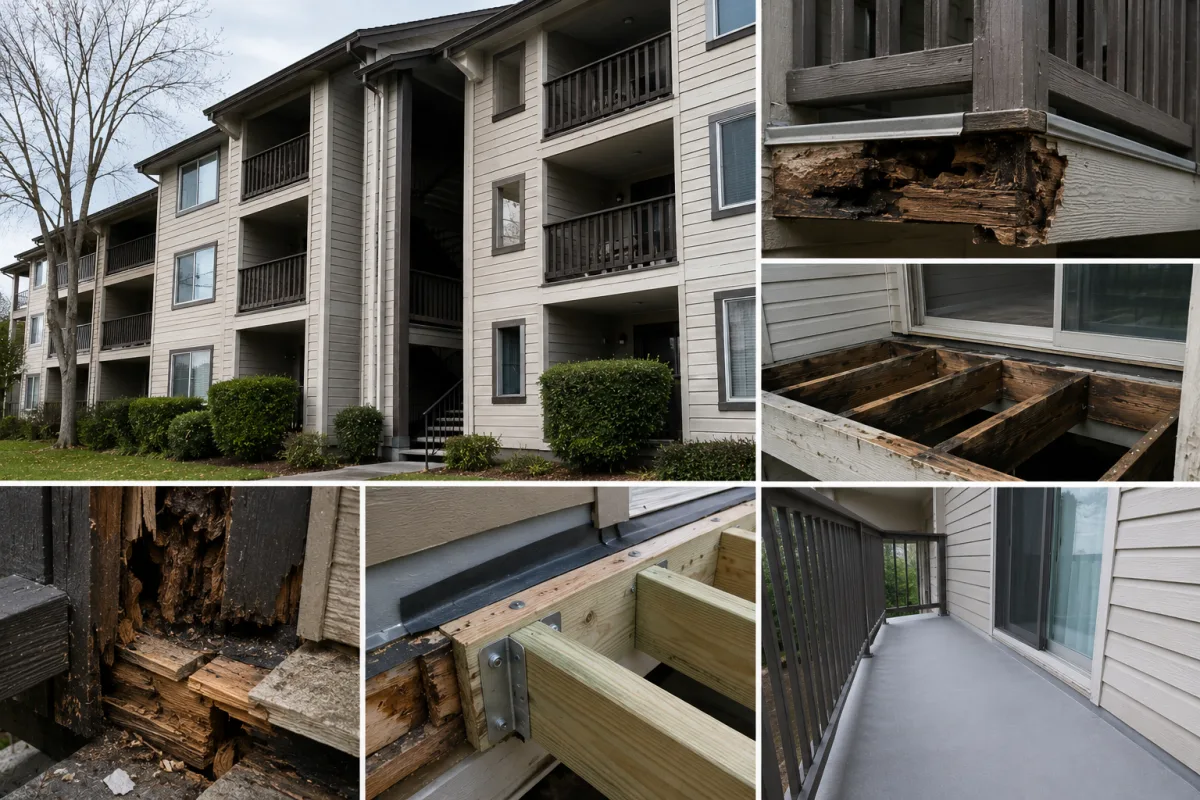
If your building needs an assessment of its balconies, an SB 326 inspection, or a repair based on its findings across Sacramento or the Bay Area, we’ll take the whole cycle on ourselves — from the inspection by our in-house engineer to fixing the defects with a single team, with no passing of responsibility between contractors.
Related service
SB 326 Inspection
Licensed, insured and SB 721/326-fluent — from assessment to sign-off, one accountable team.
About the author
Tom Marsden
Retired Property Inspector · Reviewed under CSLB #1060736
Tom Marsden is a retired property inspector with 20 years of experience. Starting as a general contractor, he transitioned to inspections, specializing in multi-family dwellings. Known for his straightforward approach and ability to simplify complex regulations, Tom became a respected figure in the local property management community. Now retired, he mentors new inspectors and writes about building safety, focusing on balcony inspections and maintenance. In his free time, Tom enjoys restoring vintage sailboats and volunteering at the local community center.
More from Tom Marsden